ASA 105 Coastal Navigation Course

The ASA 105 Coastal Navigation certification provides instruction on navigating using paper-based nautical charts.

Many people consider the traditional paper-based navigation techniques to be outdated in the age of GPS and electronic navigation systems. But it still stands that the electronics may break down at some point, leaving you with only paper navigation to fall back on.

As part of Boston-based Community Boating’s Coastal Piloting course, I learned many of these nautical chart navigation techniques back in 2000…but even back then I only partially absorbed the material, and by now I had forgotten 99.9% of what was taught back then.

So for this Coastal Navigation course, I was going to make sure that I not only learned and mastered each technique and skill, but also that I would take the time to document what I learned – this way if I look forward 10-15 years, I would be able to refer back to my notes and remember or re-teach myself the skills without too much trouble.
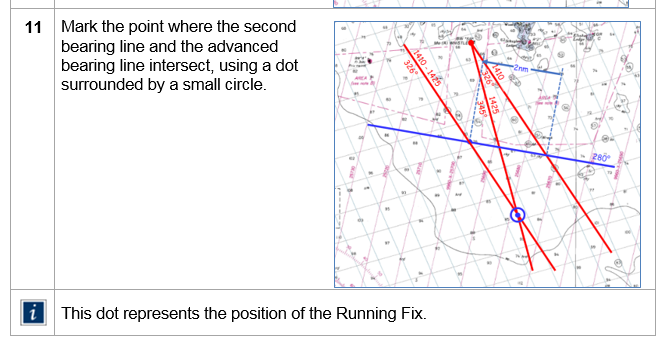
Image of a snippet of a procedure on establishing a running fix on a nautical chart.
Determine position using a running fix (snippet from my documentation)

The course was at Bay Area Sailing School, and is a 2-day classroom course.

The instructor of the course developed a method of teaching which did not rely on textbooks and/or lots of reading material, but rather all skills and techniques directly taught using real examples. Now that the course is over and I have obtained the certification, I admit that I agree that that this teaching method was very effective in learning and understanding all of the skills without much confusion.
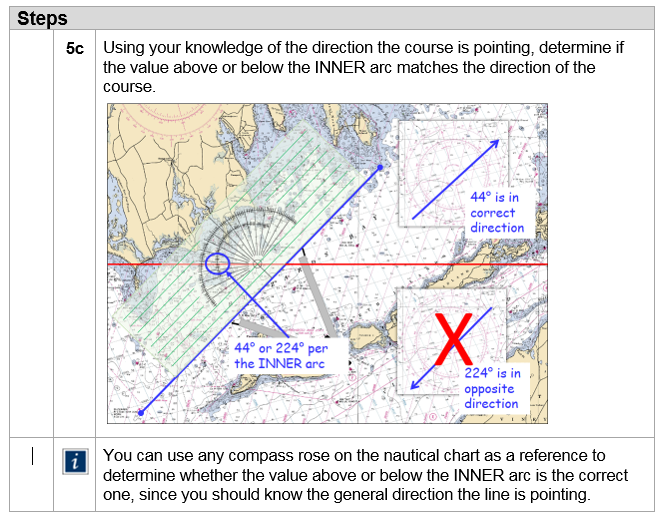
Image of a snippet of a procedure on determining direction using an overlay plotter
Measuring direction using an overlay plotter (snippet from my documentation)

The only major drawback of this method, is that it requires students to take diligent notes, if they are to leave the classroom and remember all which was taught. And there is not a tremendous amount of time during the course to take sufficiently detailed notes about the techniques; rather you spend most time committing the techniques to memory using exercises.

I will not bore you with a detailed breakdown of how each day went. I will, however, list out here the different techniques that we learned:

  • Determining Latitude and Longitude of a location
  • Measuring distances on a nautical chart
  • Plot and Label a course on a nautical chart
  • Determine a Fix using Lines of Position
  • Establish a DR Position
  • Determine a Running fix
  • Correcting for Current
  • Determining Set and Drift of a Current
  • Correcting for Leeway
  • Establishing Danger Bearings
  • Determine True course using Relative Bearings
  • Read and understand Tide and Current Tables

The certification works as follows: first you take the 2-day classroom course. You leave the course with a Workbook with exercises, a pair of of dividers, an overlay plotter, a training nautical chart (1210 TR) and a very simple solar–powered calculator. You then need to schedule a time with the school to take the exam. The main thing you have to practice with, is 2 practice exams they provide.
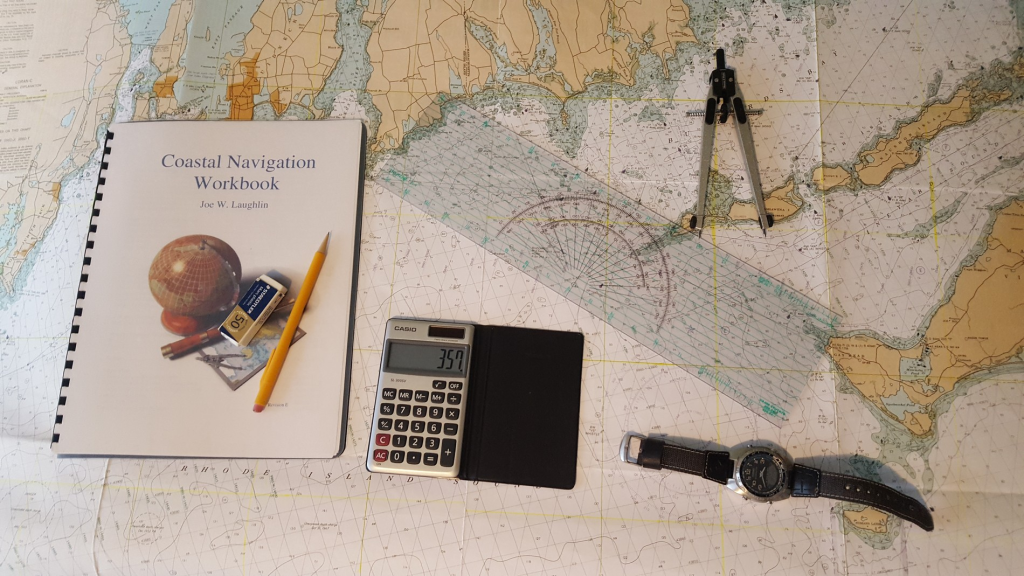
Image of a nautical chart with notebook. pencil, eraser, calculator, wristwatch, overlay plotter, and dividers on top
Tools of the trade

So for me, the 2-day course was only the beginning of my instruction on Coastal Navigation. The meat of the instruction for me, was after the course was over, when I made the decision to fully document each skill and technique in sufficient detail that I would always have a quick reference to fall back on. So for the next 4 weeks or so, I slowly went through each skill or technique, and documented each skill in a step-by-step procedure. All of this was being done on a computer, so that I would have a digital copy of the procedures. The basic method for each procedure was as follows: First, document the procedure using pen and paper. Next, transfer the procedure to an MS-Word document. Next came the challenging part, specifically for the techniques requiring writing on the nautical chart – to create clear visuals documenting each step in the paper plotting procedure.
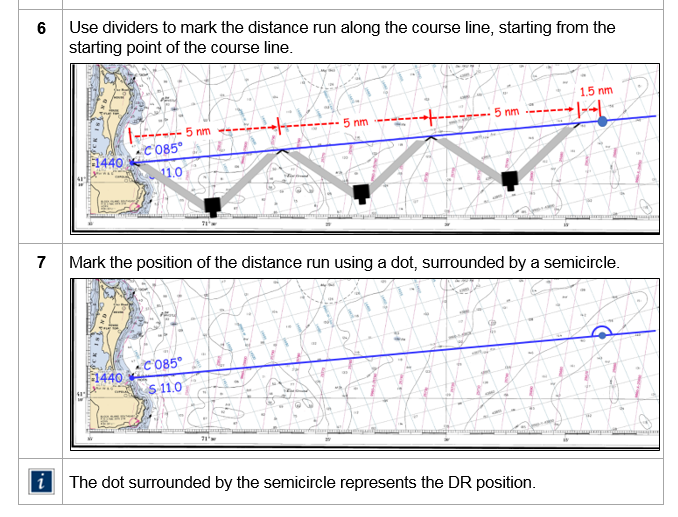
Image of a snippet of a procedure on establishing a DR position on a nautical chart
Establishing a DR position (snippet from my documentation)

What I found was that in the course of writing each skill in a step-by-step procedural format, is that I was forced to truly understand the skill thoroughly by the time that the documentation exercise was complete. That took a tremendous amount of time, but in the end it was definitely worth it. And now not only have I obtained the certification, but I also have a printed and bound permanent record of all which I have learned, documented in a way that I should always understand if I ever forget any skill and need to remember how to use it.

At this point the only key certification remaining for me to take under the ASA certification curriculum is the ASA 106 Advanced Coastal Cruising certification. This is where you learn to come into harbor at night, and other advanced skills allowing you to sail under any sea and weather conditions.
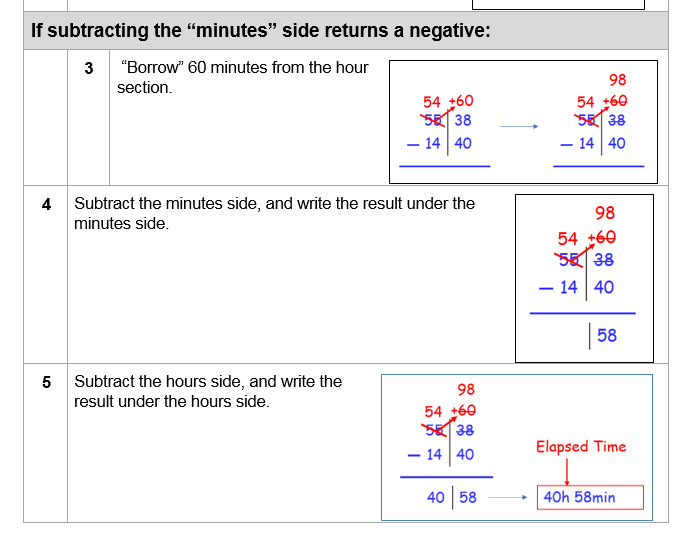
Image of a snippet of a procedure on using military time arithmetic
Using military time arithmetic (snippet from my documentation)

But at this point, more important than that course is for me to just get out there and get to sailing. Let’s get it!
A Peaceful Day Sail

Things might get hectic for the next few months, so I wanted to squeeze in another sailing excursion before it got too difficult to get out. My wife was originally supposed to come out on this sail, but she fell ill at the last minute and so I managed to get somebody to fill in for her.

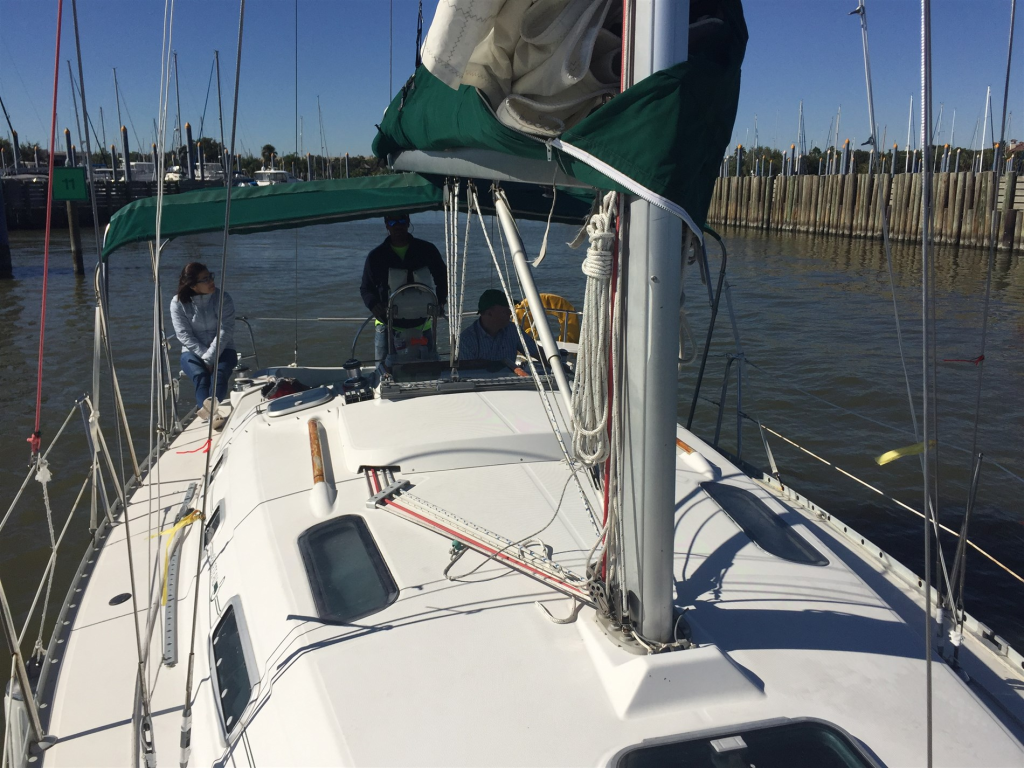
Heading out to sea

Since this was a paying charter, I opted for the “full day” charter. And since I also joined the Bay Area Sailing Association (the sailing school’s sailing club), the “full day” means a full 24-hour charter with no time limit. The lack of time limit is a much more pleasant way to plan for a sail – you can show up later in the morning, and there is no hurry to get the boat back to the marina. The only trick is that if you are not going to head out until after 10AM, you’re gonna want to being food on board because you’ll get damn hungry sailing through the lunch hour.

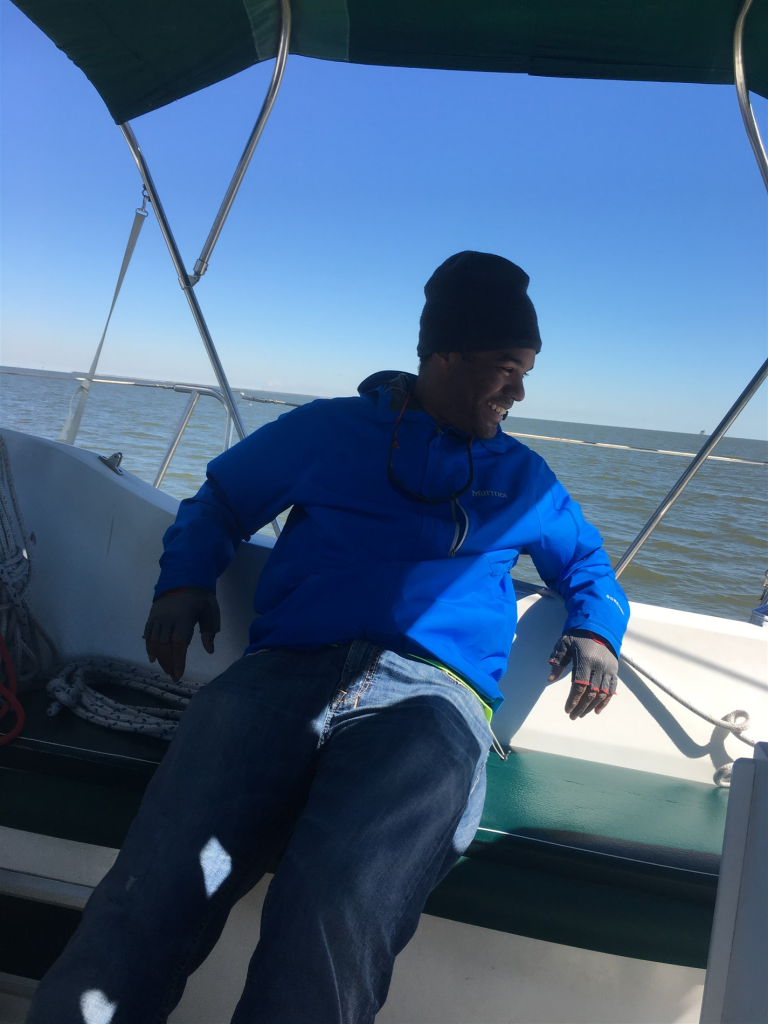
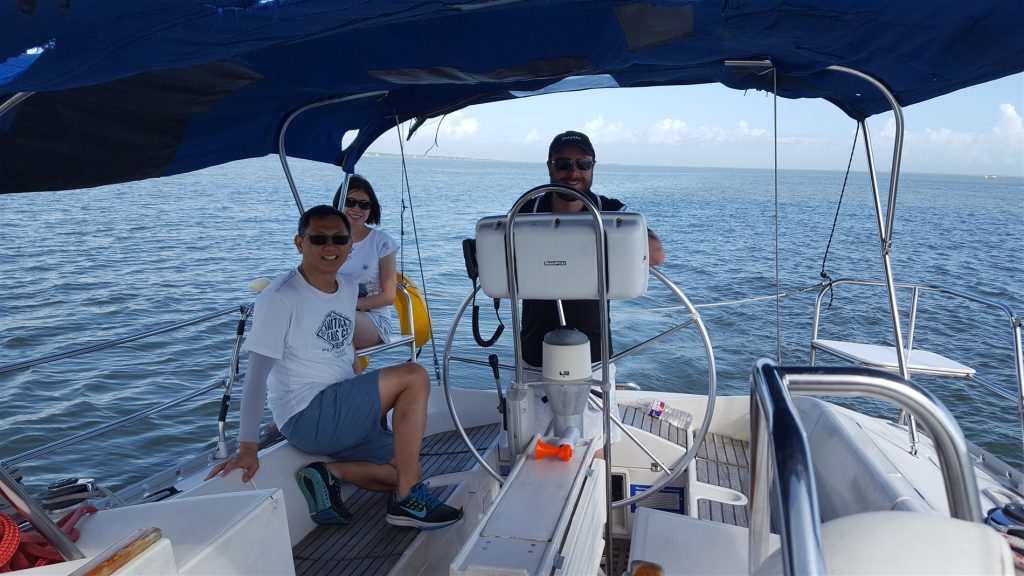
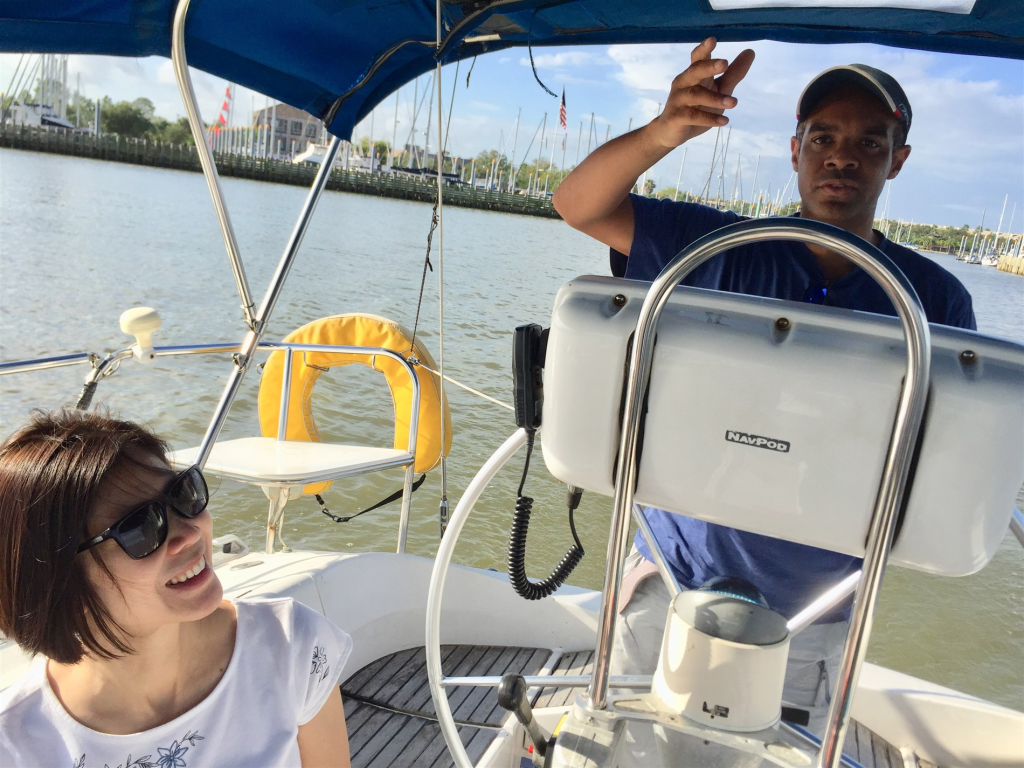
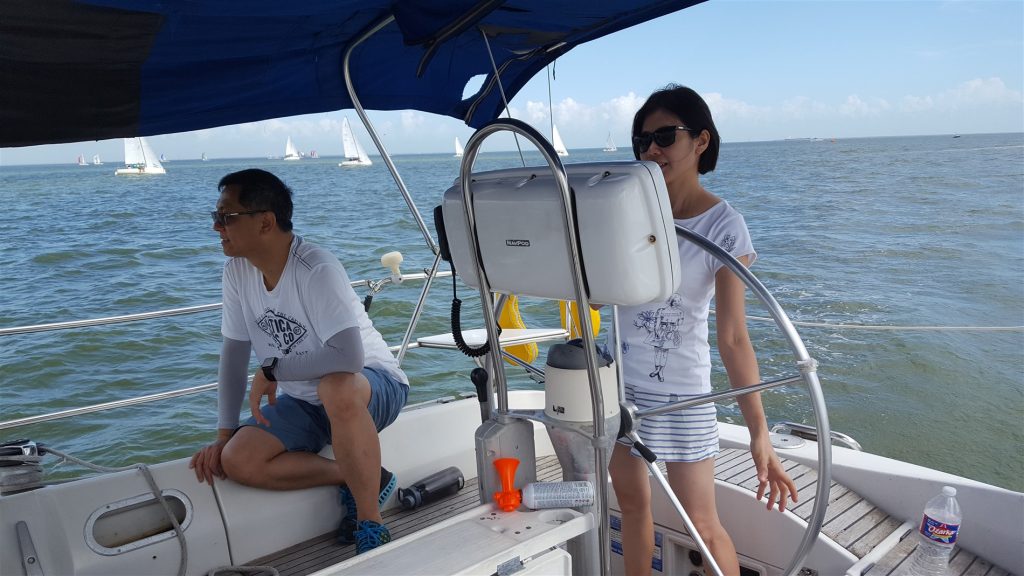
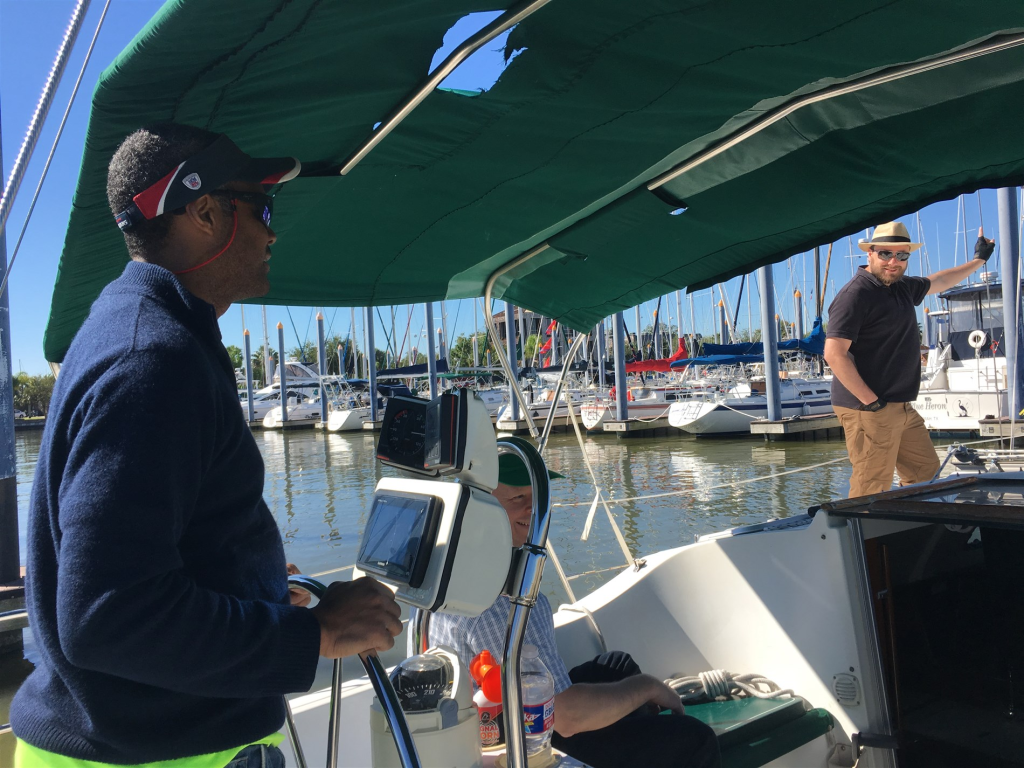
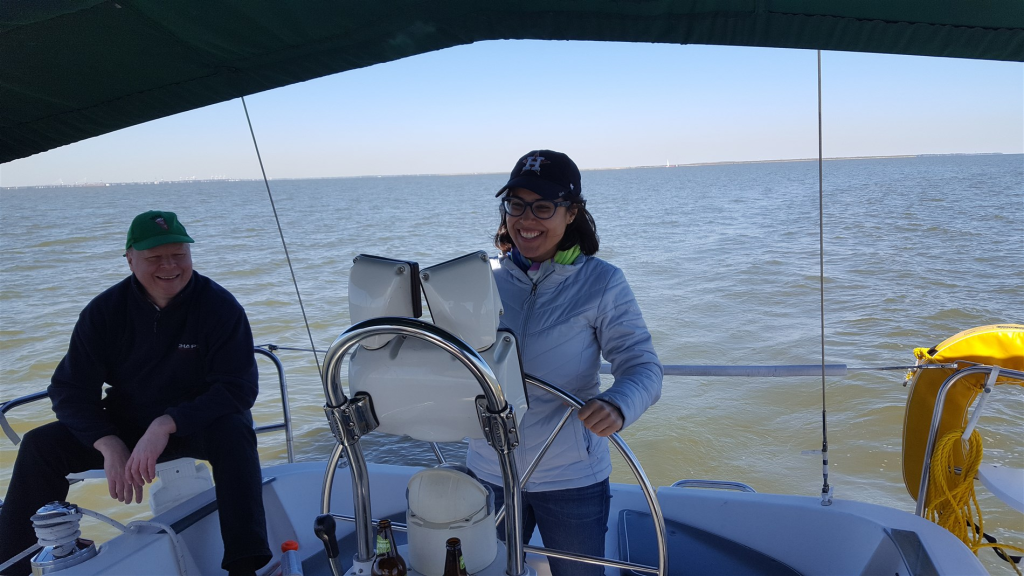
Hiba helming

We had 2 new crew members, Nick and Hiba. Drew came along also, and so since this was his second time out with me he was automatically promoted to First Mate 🙂

We all met at the house, piled into one car and drove down together to the Marina. Since I was signing up to be a member, the crew was taken aboard the boat while I finished up the membership and chartering paperwork. Once all of the formalities were taken care of, and I was shown around the boat, we took a bit of time to familiarize ourselves with this boat. A Beneteau 32, the nice thing about this boat was that the sail cover is designed to neatly stow the mainsail as it is dropped, so no worries about returning the boat with the mainsail all sloppily wrapped around the boom. (That MIGHT have happened on a previous trip)

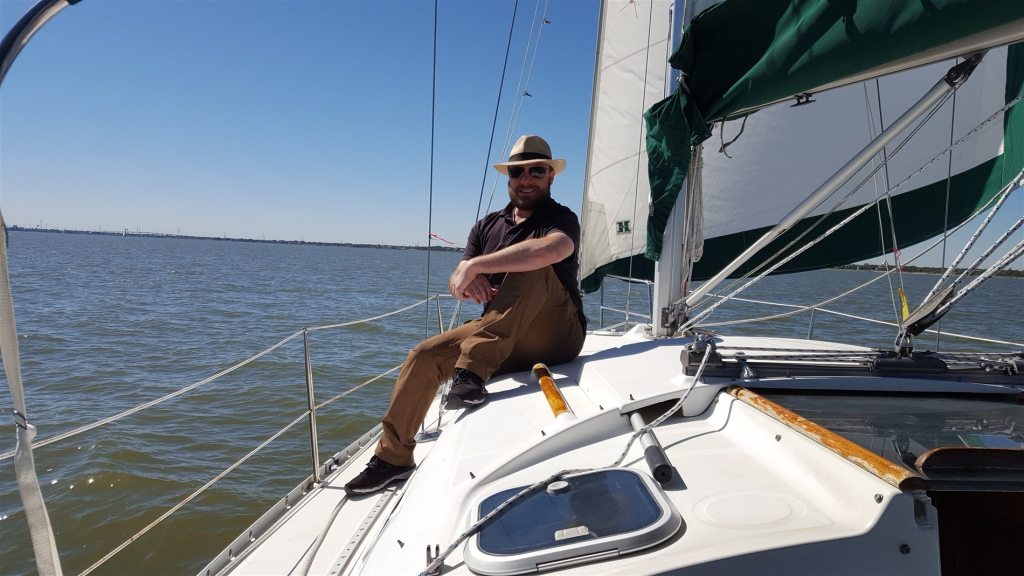
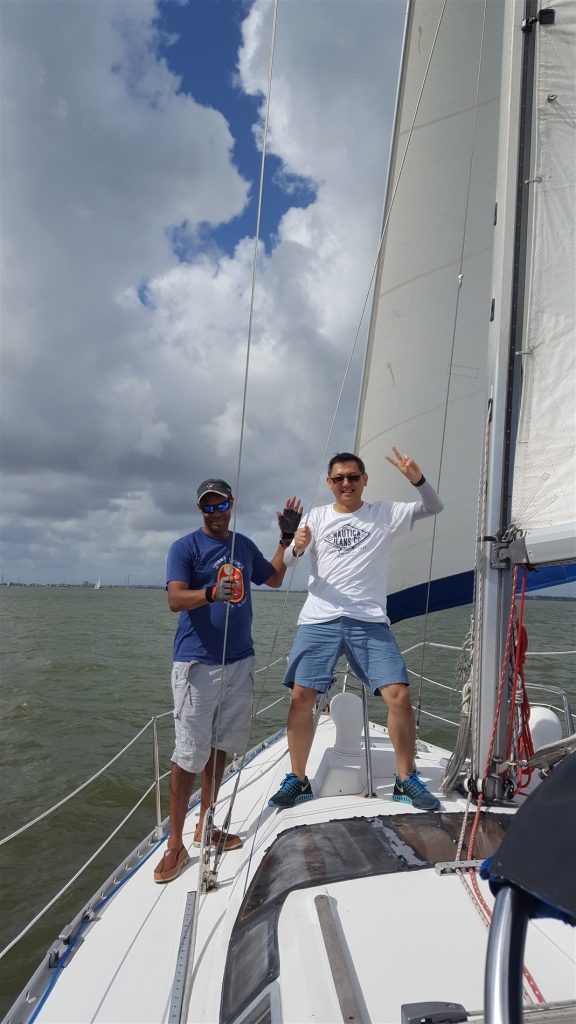
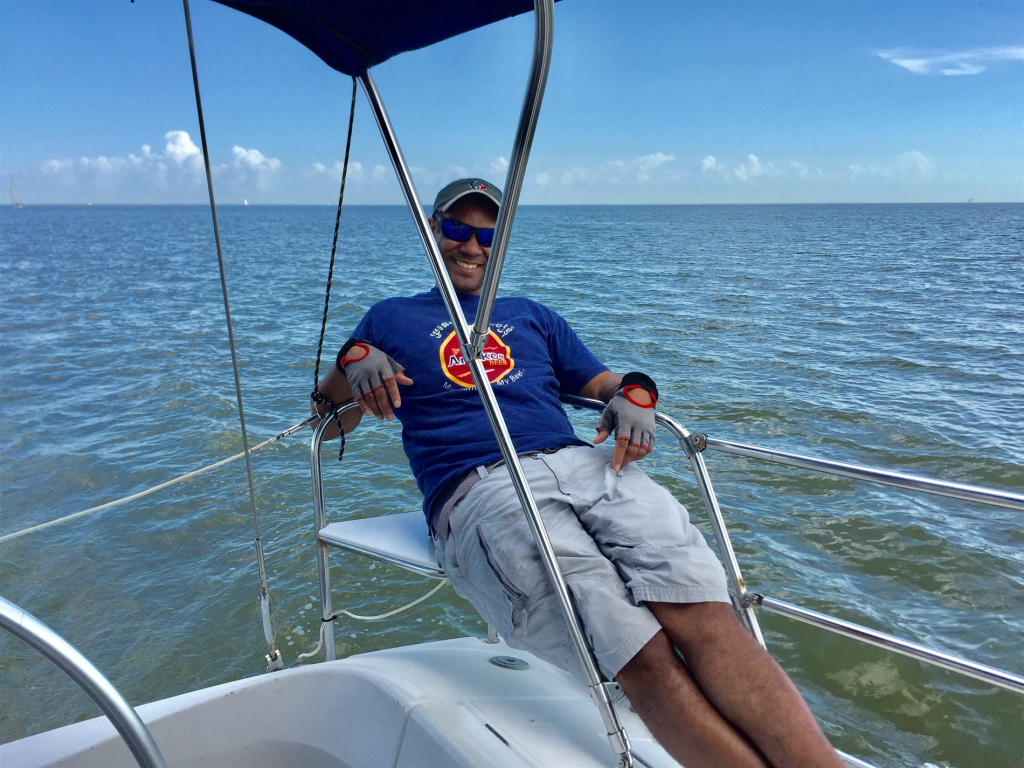
Drew striking a pose

After we went over the sail plan and what to expect, we fired up the engine and headed out. The seas were very calm at about 10:30 in the morning, with almost no wind to speak of. But we headed out anyway, beyond the Kemah Boardwalk and out into Galveston Bay. Today the Bay was a lot less crowded — partially I’m sure because it was a lot colder than it normally is in Houston, but also because there were no races planned for that day.

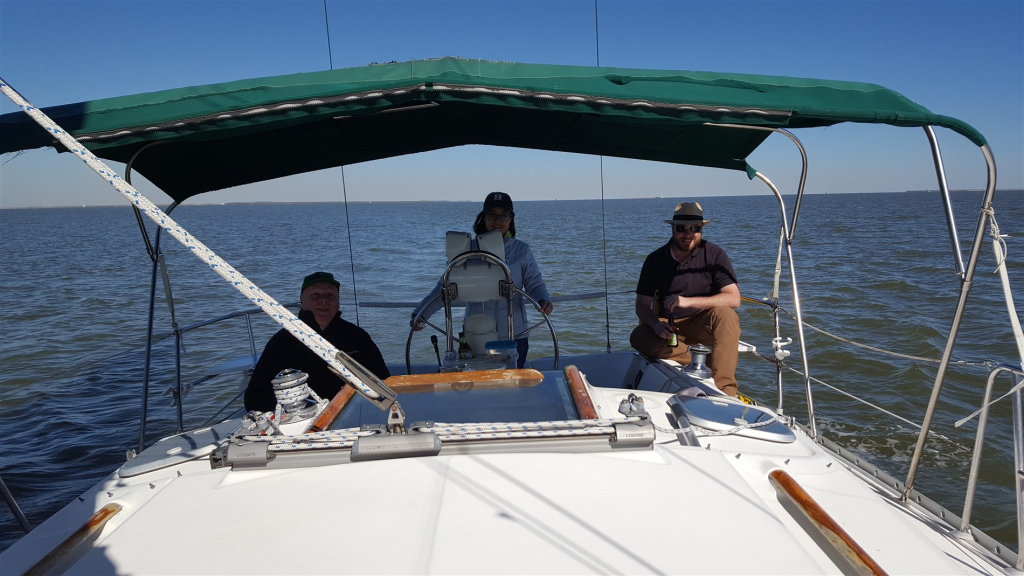
Competent Crew

At the helm, Nick took us out of the channel and into open water. We raised the mainsail and jib, but the wind was so low that I was concerned we would not move anywhere. In fact we did start to move forward, albeit at a very calm pace (2-3 knots maximum).

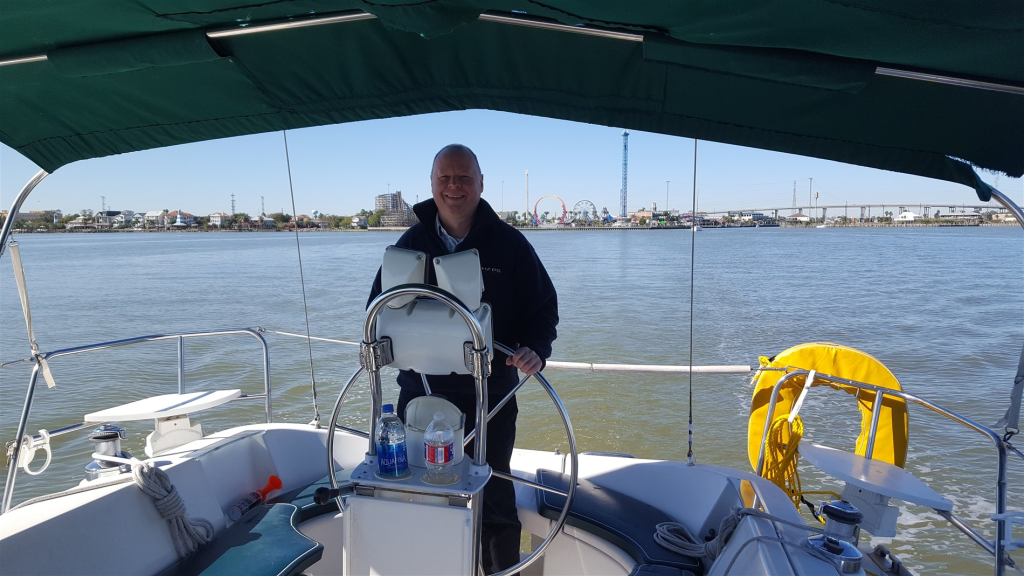
Nick at the helm

We kept at that for awhile, and we practiced a few calm tacks to get the mechanics down with Nick at the helm and Hiba & Drew handling the jib sheets.  After awhile the wind started to pick up ever so slightly, and we began to cruise around 3.5 knots, and eventually making it up to four knots.

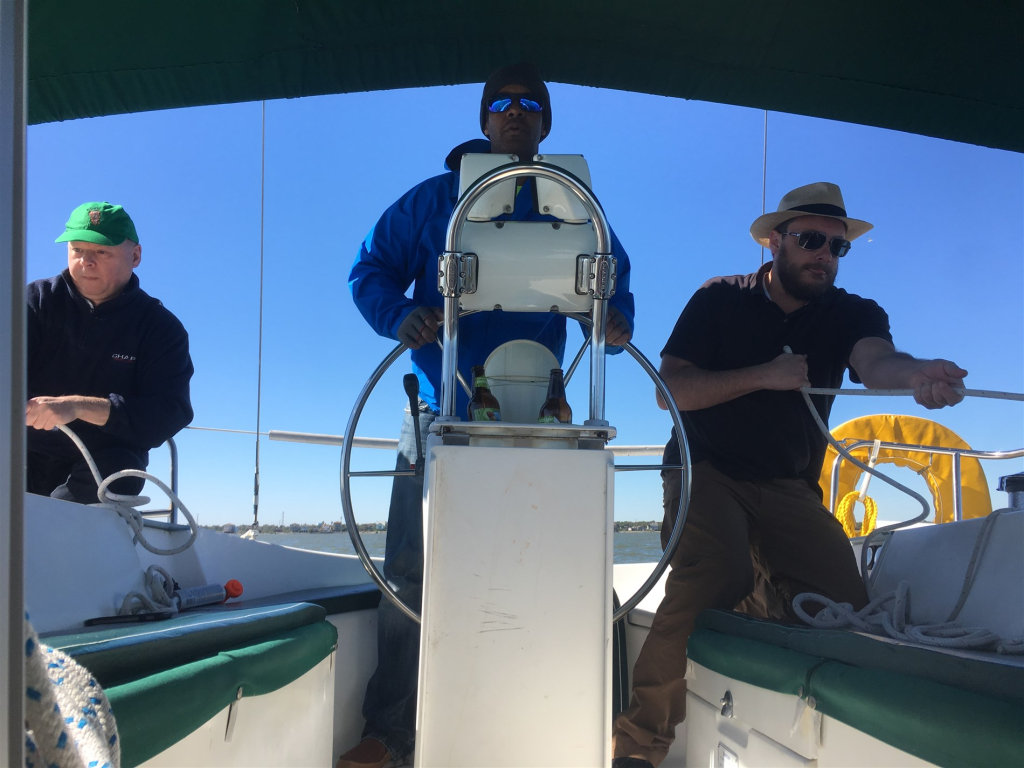
Crew hard at work getting through a tack!

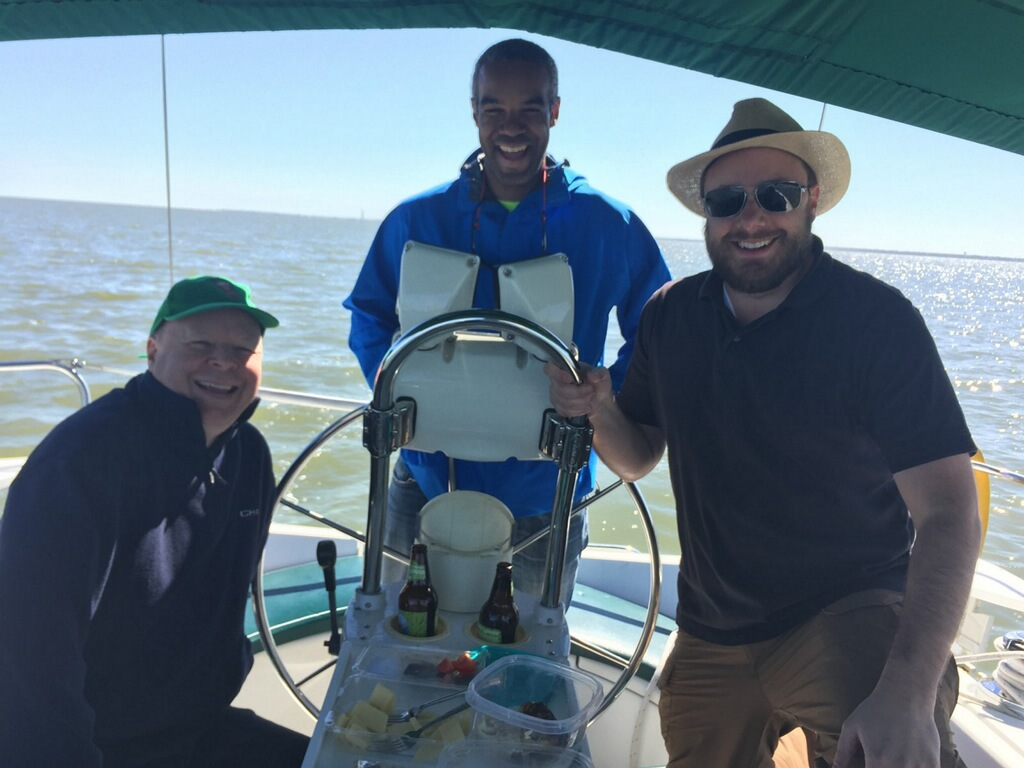
After about 1.5 hours, we all got hungry so we broke out the snacks. Cheese, crackers, tomatoes, drinks, and we even cranked up the radio to kick back with some music. We never actually stopped sailing, I think we were at a broad- to close-reached course with me behind the helm for most of the time while we all snacked.

Snack time!

When we finished up with the snacks, we tidied up and then got back to the sailing, because the wind started to pick up a bit more. With Hiba at the helm we got up to 4.5 knots, which was pretty good considering the light wind conditions we were sailing in. But it was a bit too cold out (for Houston), and after awhile Hiba sneaked down into the cabin to warm up as the rest of us continued on sailing.

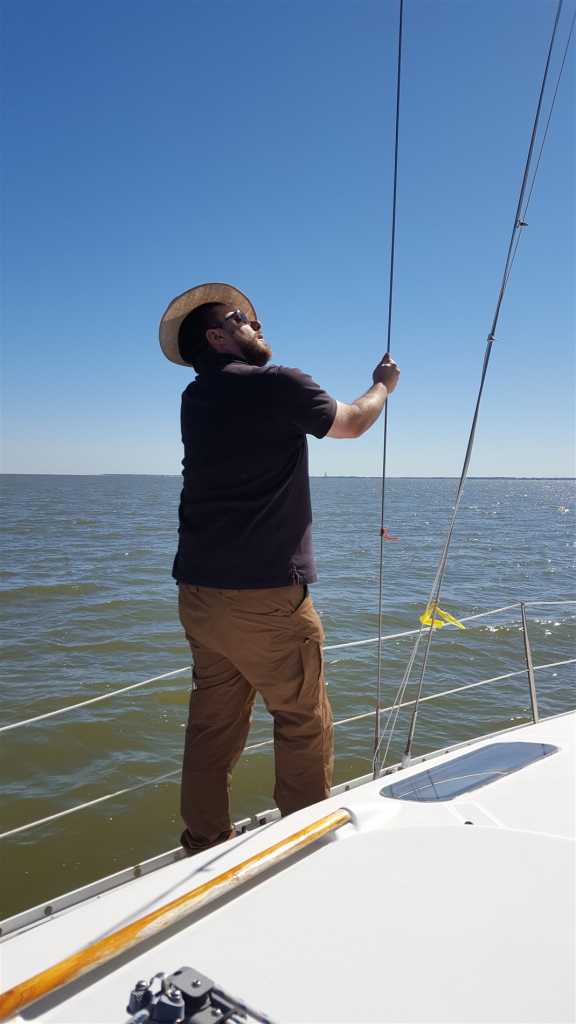
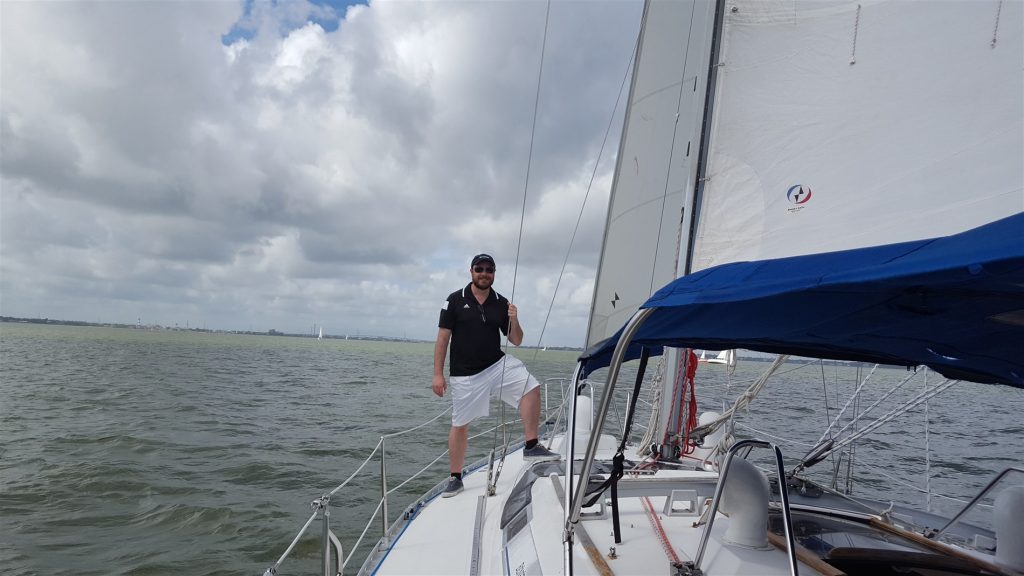
Moving forward to check the sail trim

By this time we were almost up to 5 knots, but we were just about ready to head back in. It took us about an hour to make it back to the channel entrance – we had sailed out much further than I had realized. It will be good practice in the future for me to start estimating how far out we sail based on our time out and average speed, to see if I can start getting good at navigating us on a planned course, schedule and travel plan.

With the sails dropped and the engine started up, I took us back in to the marina under power. The docking this time was a bit of a mess, with two misfires and u-turns. But we eventually managed to get the boat back into the slip after a few tries and without rubbing the boat against the dock, so all was good.

Bringing her back to the slip in the marina

There was not much tidying up to do, just stowing away all of the items which were loose in thee cockpit. I realized later that I should have brought the winch handles into the cabin, but I’ll just remember that for next time.

Hard at work skippering again 🙂

So even though the wind was very light, we still were able to enjoy a nice calm excursion out in Galveston Bay, with good sailing time. Looking forward to more practice !

Click here to see additional pictures from the excursion. (Contact Joel for the password)

First Time Skippering in Galveston Bay

As part of the Bay Area Sailing School‘s ASA 101 Basic Keelboat Sailing course, I had the right to one free 4-hour charter on a 27-foot keelboat. And since I obtained my Bareboat Chartering certification, I was able to take the boat out by myself, as long as I could find an able-bodied crew.

Drew, Alex and Varence all decided that they were down to accompany me on my first bareboat charter. None of them considered themselves to be “competent crew”, but Drew had at least been on a sailing cruise before.

Photo of crew in a sailboat on the water
The Competent Crew!

We were assigned a Beneteau 390, which is a 39-foot sloop-rigged keelboat with auxiliary power (diesel engine). That size of boat is fitted out with two bedrooms (“staterooms”), toilet, oven & stove, and refrigerator. We would not be needing any of those amenities, though, on our short trip.

After Glen from the Bay Area Sailing Association gave me all of the forms to fill out and explained where everything was on the boat, he left me with my crew and told us to make sure to get back by 1:00 PM. We spent a few minutes more sitting on the boat in the marina, so that I could explain our sail plan and how the sailing excursion would go. The plan was a typical one for such a short trip out of Kemah – take the boat out under power out of the marina to Clear Lake, motor out past the Kemah Boardwalk, and head out into Galveston Bay until we clear the channel (we take 2 channels to get out to Galveston Bay from the marina in Kemah). After that raise the sails, and start sailing until about 12:00 PM, when we would drop sails and bring the boat back to the Marina.

Skipper providing his expert tutelage 🙂

Since it was a calm day with no wind at the dock, casting off was simple and we were under way in no time. The ride out to Galveston Bay was cool, as it gave us a chance to talk about some basics of sailing, and how to navigate in a channel. Once we made it out to the final channel marker, we turned out and raised mainsail first, then the headsail, and we were off!

Joel & Alex posing for a photo op

Well, we were not really off to a speedy start because the wind was pretty weak. But after 10 minutes or so, we were able to head up to an upwind course, and since around that same time the wind started to pick up, we managed to get a little speed and wind in the sails, and we were sailing on our close-hauled course! Alex was at the helm to start us off, and he had a steady hand which was great. We picked up speed slowly but steadily, the boat was keeled well over, and we made it to about 6 knots by the time we needed to change course via a tack maneuver. Not bad for light winds.

Man posing at the bow of a sailboat on the water.
Drew posing for the camera

After a short explanation of the mechanics of tacking and the verbal commands and responses, and with Drew and I handling the jib sheets, we handled the tacking with not too much pain. After the tack, Drew took over as helmsman, and he took us first on a beam-reached course, then a more broad reached downwind course. After a jibe, we turned back upwind so Drew could have a hand at helming the upwind course. Since the wind picked up, Drew was able to get us up to almost 7 knots. With the boat nicely keeled over again, this was a good clip to sail on and we all enjoyed feeling the wind on our faces.

sailboat on the water with sails out, heeled over
Moving upwind at a good clip

After 10 more minutes of that, it was time to start heading back. Varence took over at the helm to get us closer to the shore. The crew pointed out the direction of the first channel marker and we approached the channel entrance, dropped sails, fired up the motor, then I took over helm duties to maneuver into the channel. By this time the wind had picked up and the sea was much more choppy, and so we rocked and rolled a bit as we motored our way back to the marina. Just before we got into the final stretch, a procession of about 25 speedboats began to intersect our path, and it was a bit hairy to find out way though that. But we managed okay, and before long we were heading back into our boat slip in the marina. I was a bit anxious as I don’t have the best track record for docking, but it went very smoothly and all in all we looked like pros as the boat slid gently into its slip and we tied the boat in.

Varence at the helm

I think this first trip out was a success – I had a good time, no major mishaps, and I’m getting more experience maneuvering the boat in the tight quarters of the marina. I discovered that skippering is a fun experience also, because you have the opportunity to really enjoy the sailing, while giving the crew members lots of time to learn how to helm and manage the lines. I think I can begin to enjoy these types of outings.

Skipper hard at work skippering! 🙂

The biggest thing I need to work on for the next times out, is managing the dropping of the mainsail when it’s not a in-mast roller-furling type of mainsail. It was a very sloppy and ridiculous looking affair this time out, and it also looked sloppy with the sail cover on back in the boat slip. So I definitely would like some more practice getting that mainsail sorted out properly, because I strive to leave the sailboat in the best condition as possible when the charter is over.

Skipper Joel out.

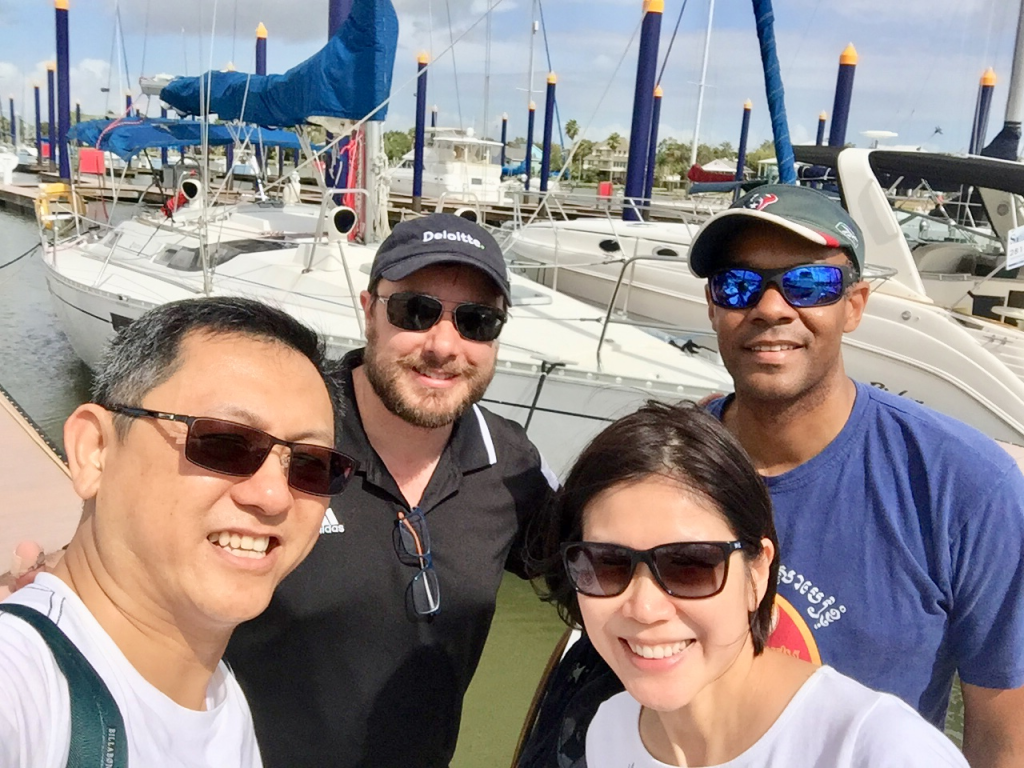
Posing for a selfie after our sailing excursion

Click here to see additional pictures from the excursion. (Contact Joel for the password)

Mentoring and Monitoring

After taking the Bay Area Sailing School‘s ASA 101 Basic Keelboat Sailing course, each student gets 1 free “mentoring” session with a captain, and 1 free charter. I decided to wait until I was certified to take boats out bareboat, before taking advantage of my mentoring session. And it worked out good because I did not get a lot of practice taking boats out of a slip and docking while under motor.

Captain Vernon is the old-timer who accompanied us on the mentoring session. The session lasts about 4 hours, from 8:30 AM to 12:30 PM, and its main purpose is for the sailing school to give the students sufficient training and practice for them to take boats out safely without supervision. This means mainly getting sailors comfortable and proficient in docking while under motor, and also taking us out to the bay to show us the safest way to get in and out, and where to sail and where not to sail.

There were four of us out: me and a lady who was also certified in ASA 103/104, and a couple who had just finished their ASA 101 course.

The docking drill was for each of us to take the helm, back the boat out of the slip, turn out to the main traffic lane, make a u-turn, then put the boat back into the slip under motor. This is the most daunting part of sailing for me – once we’re out on the water I am fairly confident in my skills, but it is the docking and maneuvering in tight quarters with the motor that makes me the most nervous. Especially since you can damage the charter boat or even worse, another boat owned by somebody else!

The drill was a great start to building my confidence. Two times of docking with the instructor guiding me, and then once with no guidance. I managed to get the boat into the slip without any mishaps all 3 times, so I am starting to get more comfortable with the whole motoring thing.

After all four of us finished the docking exercise, one of us took us out of the marina, out past the Kemah Boardwalk, and into Galveston Bay. I was surprised to find out that the area just in front of Kemah Boardwalk is known as Galveston Bay, because for me Galveston Bay is nearer to the actual city of Galveston. Once in the bay and clear of the channel, we all got practice in doing man overboard (MOB) drills while under motor. The technique is fairly simple – if the MOB falls on the port side of the boat, first note the compass heading, then turn quickly to port for a few seconds, and make a circle turning to starboard. You straighten up when the boat is heading at the previous heading minus 180 degrees. Simple!

Captain Vernon decided that it was best for us to sail with a Jib only. This was not really due to the wind or sea conditions, but more because of the amount of time required to raise and stow the sail on the Beneteau 32 that we were sailing on (The course was only 4 hours, and by this time we only have about 1.5 hours left).

Image of sailboat on the water with only the front sail open
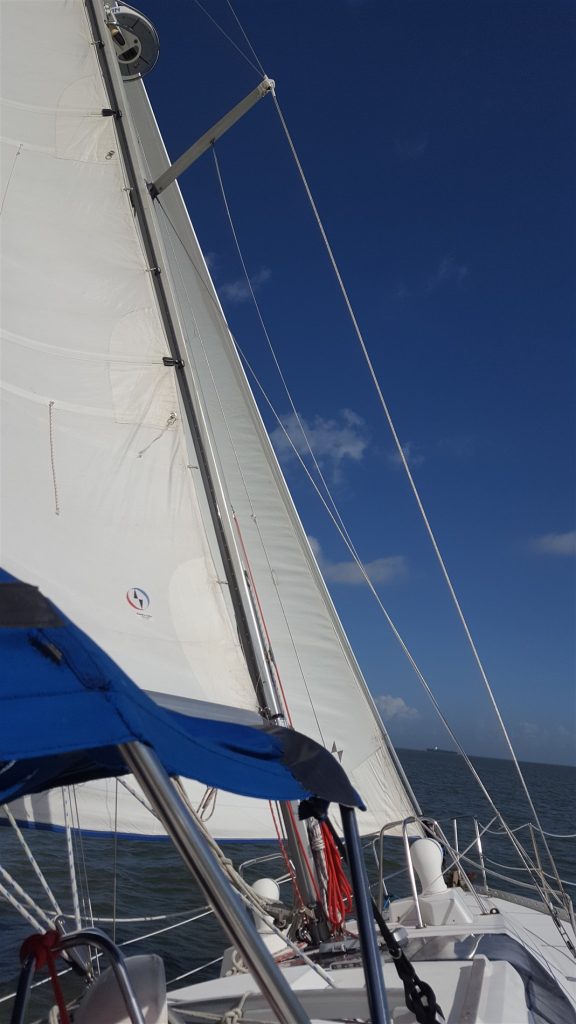
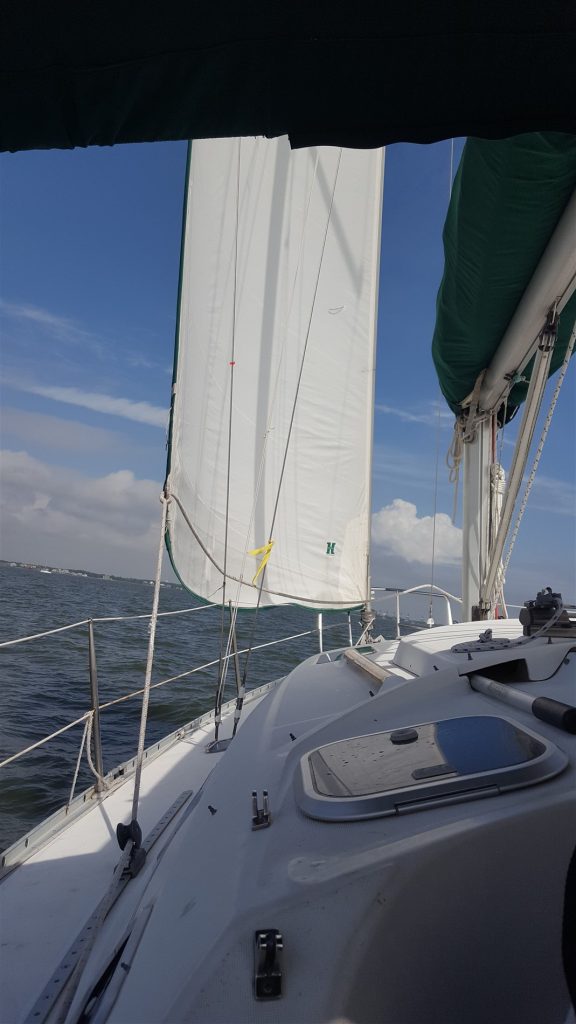
Sailing with a Jib and no mainsail

I had never sailed with only a Jib, so this would be a new experience for me. In the end it was not a huge deal – you sail just as you would as if the mainsail was hoisted. The boat even heels mildly when on an upwind course. So it was new to me, but not much more to learn, really. And when the wind picked up, I was surprised to see just how fast the boat would go with only the headsail up. Captain Vernon did say that if the mainsail were in play we would go 50% faster, but I was still impressed at that one sail’s power.

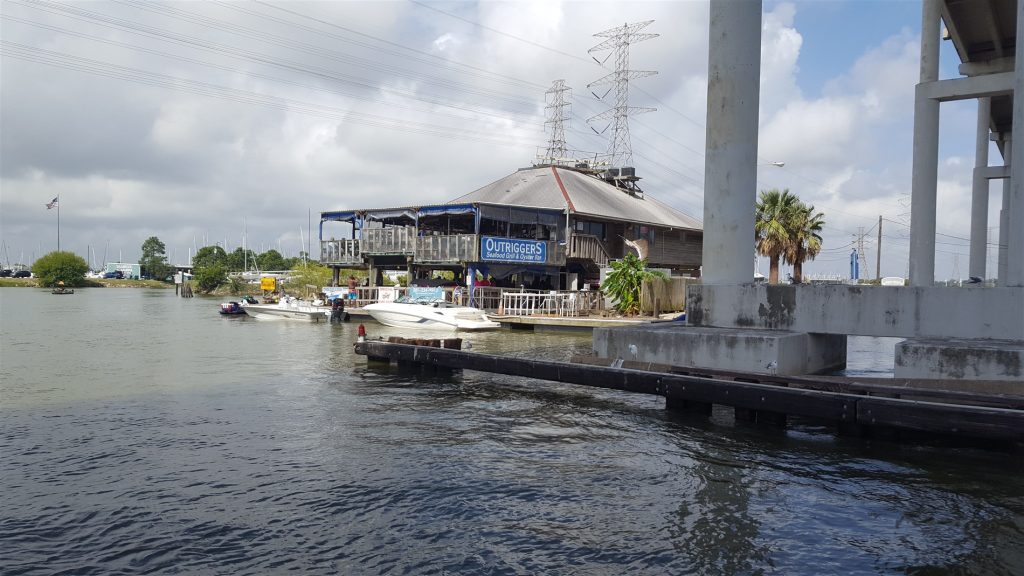
Passing under the Bayport Blvd. bridge (146) on the way back to the marina

After we all had 10 minutes or so each at the helm under sail, we turned back towards the marina as the mentoring session was almost over. After another student took us in, I was to get us back into the slip. First time in? FAIL 🙁  I started to turn in too late, and I would have rammed the bow into a piling if I hadn’t quickly slammed the engine into reverse gear at full throttle at the last minute. Captain took over the helm to recover, backed us up back to a safe point, and let me have another go at it. This time  I made it in the slip just fine, and after the crew secured all of the docklines and we plugged back in to shorepower, the session was over and we parted ways.

In the end the mentoring session was just what I needed. A lot of the time I was just hanging out on the boat, as much of the instruction I already had as part of the ASA 103/104 Combo course. But I definitely learned a great deal about how to safely guide a large sailboat into a slip, and the practice has made me much more confident about taking the boat out on my own.

I have now reached the point where the instruction needs to stop for awhile, and I need to just start getting out on the water on my own and get that sailing experience in! Now just to find a worthy crew….

ASA 103-104 Combo Course, Day 3

Day 3: 10-September-2017

We planned to be out on the water by 8:00 AM, so all of us were up by 6:30 AM to make that deadline. We all ate our bagels and gulped down a short draft of coffee, and quickly motored out of our slip to head back to the ship channel.

Back alongside the Ship Channel

The plan was to sail upwind parallel to the ship channel, which would take us most of the way in. If the wind was blowing in the ideal direction, we could maintain the same point of sail for the entire time without much need of tacking to maintain course. The wind was a strong 15 knots, so it was a very exciting upwind course. On the water, we learned that when sailing upwind, it can actually be smoother and faster to sail with the sails up, than to drop sails and try to motor upwind. We spotted a sailboat with sails dropped, pointed in the same direction as us, about 300 yards ahead. But they not only seemed to be making a very slow go at it, they were also bobbing back and forth quite wildly with the waves. By contrast, our boat was heeled over to one side, but the ride was clearly much smoother than our non-sailing comrades. And in short order, we not only ended up passing them, but by the time we left the ship channel we could not even see them behind us anymore! We really left them in the dust, so to speak.

Image of boat's sails
Trying to get a good picture with the boat heeled way over

Bringing it Home & Wrapping it up

The final hour of sailing is when we turned away from the Houston Ship Channel, and we made a direct course towards Kemah. The big challenge on this final leg, is to maintain a beam-to-broad reached point of sail, with a steady compass heading. The others were fairly good at this, but I was pretty terrible at it. I don’t really enjoy sailing downwind, so I always have a tendency to steer more upwind, which brought us way off course. At one point I realized that I was as much as 50 degrees off course! By the time Captain Jon had come back on deck, he was disappointed to see how much off course we had become after 40 minutes or so. No worries though, we were not in a huge hurry so the slight delay was not a big problem.

Image of the crew riding on the sailboat on the water
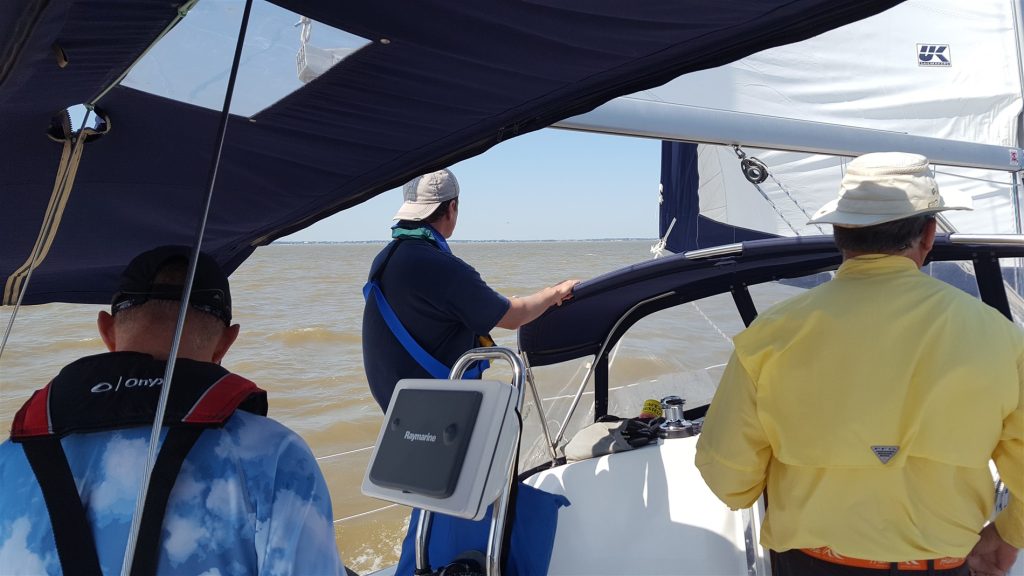
Eddie, Steve, and Capatin Jon on the way back to the Kemah Marina

Our final approach to the marina via Clear Lake was under motor, so we dropped sail and headed in towards our designated slip. I was supposed to take us into the slip, but after an initial mishap, Captain Job took over as the reverse ‘parking’ maneuver was quite delicate in the moderate wind & current conditions. Once secured to the dock, we had our lunch, prepared for a 1/2 hour and then took both written exams back to back. Each exam was 100 questions long!!! I was a bit worried because although I had read both books multiple times, I did not have much time to review the material before taking the tests. But I ended up doing quite well, and in fact I got 100% on the chart navigation questions! (There were only 5)

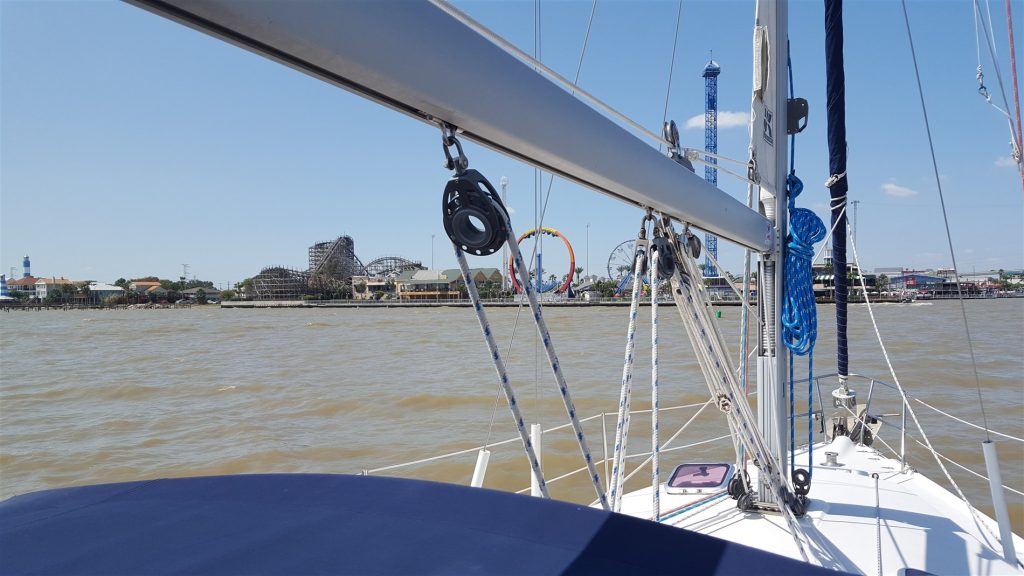
Image of Kemah Boardwalk in the distance, taken from the front of a sailboat on the water
Approaching the Kemah Boardwalk under motor
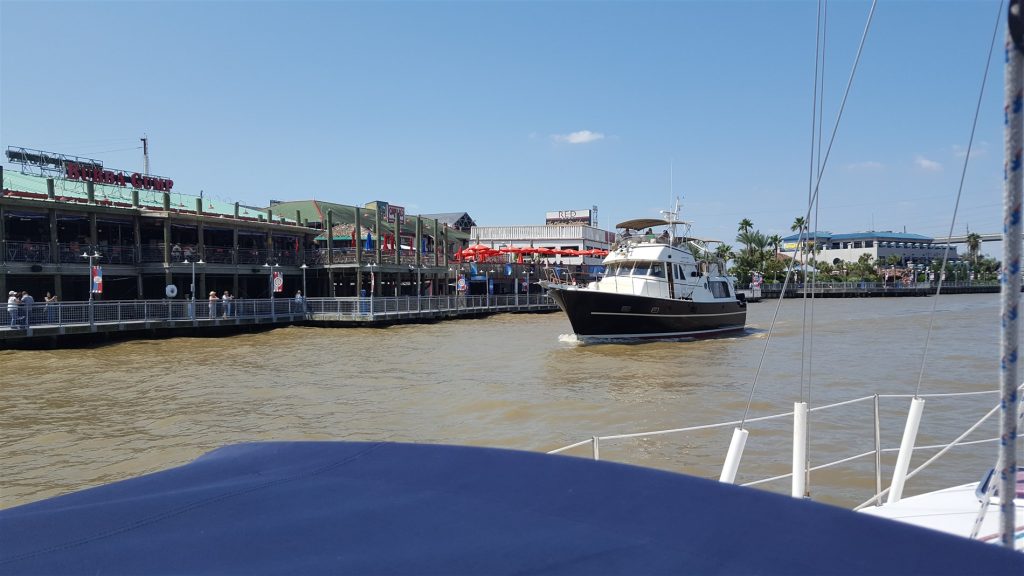
Image of the Kemah boardwalk taken from the water, while passing a motor yacht
Passing a recreational yacht while passing by the Kemah Boardwalk

All three of us students passed the 103 and 104 certifications, so after a final knot review we gathered our belongings, exchanged phone numbers, and parted ways.

Was it worth it?

When I decided to take this ASA 103/104 combo certification course, my motivations were three-fold. First, I had never been on a 36-foot sailboat with toilet, galley, in-board motor and staterooms. So the course would help me gauge whether that class of boat is my preferred class. Second, I had never been on a multi-day sailing excursion. So the course would also provide insight as to whether multi-day excursions are something I will enjoy, or if day-sailing is more my cup of tea. And finally third, I definitely want the freedom of knowing that I can charter out a boat unsupervised. And the ASA 104 certification provides just that.

So all in all, the course was well worth the money. As for the boat class, I have mixed feelings. There are a great number of things to maintain, but in such a small vessel, the maintenance tasks do not seem to be too overwhelming. On a 36-foot boat, the other drawback is that it is not trivial to sail the vessel single-handed. So solo excursions may prove to be challenging and slightly risky. But I suppose that finding people interested on going out for a sail as crew should not be too difficult 🙂

In the way we structured it, the multi-day excursion was just fne, and a nice stay-cation.There is no need for a hotel as you can sleep on the boat, and if you want to sneak off to a full-service restaurant or bar while docked, that is also an option. Another bonus, we never were forced to use the head on board– the Galveston Yacht Marina had toilets & shower facilities, so that was also painless. The beds on the boat were surprisingly roomy and comfortable. In fact my only issue was the snoring between Eddie and I kept me up on the final night. So I enjoyed the multi-day adventure. I think that the longer you are at sea without docking, the less glamorous the adventure becomes, though.

So I learned a great deal on this 3-day course, and I am now ready to start getting my practice hours in so that I can sail independently with confidence!

ASA 103-104 Combo Course, Day 2

Day 2: 9-September-2017

When we all had woken up, Captain Jon had already brewed the first batch of coffee. He was out on the deck having a smoke and listening to the weather report on the VHF radio. We didn’t need to use the toilet or shower on the boat, because the Marina where we were docked had bathrooms equipped with showers. So after we freshened up & emptied our bowels, we cracked open the bagels & cream cheese, and ate our breakfast over coffee.

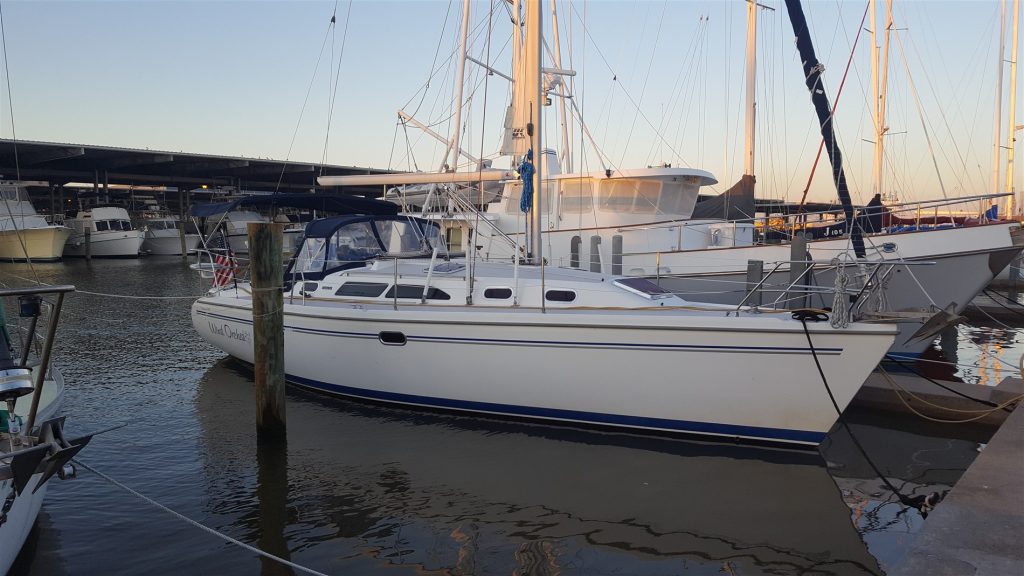
Image of the Wind Orchid sailboat docked at the marina
The Wind Orchid docked in Galveston Marina

The plan for the day was in two parts. In the morning, we could use the area just outside of the Marina to complete our anchoring lesson and exercises. Then we would sail off towards the Gulf, where we would get in more sail time and do our man overboard (MOB) drills. We’d dock back at the same marina in Galveston the second evening.

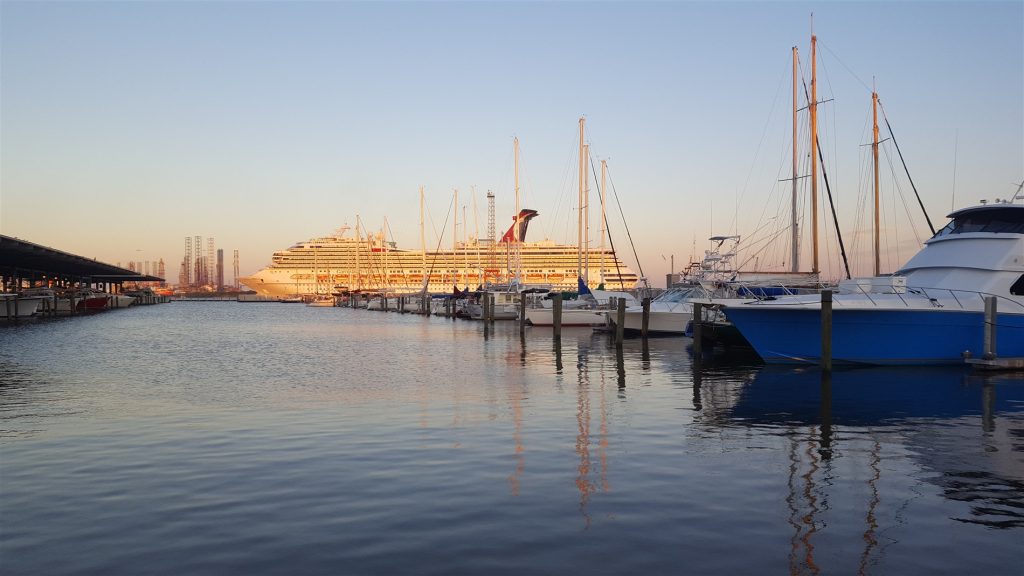
Image of may sailboats docked in a marina at daybreak
The Galveston Yacht Marina at daybreak

Morning at the Anchorage

I manned the helm and took us out to the anchorage site. We circled around for awhile as Captain Jon gave us the instruction, and then we prepared for anchoring. We decided on using the all-chain anchor rode, and Eddie would helm as all others would manage dropping the anchor. Here you realize the importance of hand signals, to communicate to the helmsman to back up, stop, point in the direction of the anchor, etc. Everything went smoothly, except for the windlass accidentally letting the anchor drop just after it had been 100% hauled in. It was not really a windlass failure, but a mishandling of the rode as we were tidying up. But nobody was hurt, and we were able to quickly recover and get on our way. Before we had raised anchor though, we made sandwiches, opened the bag of chips and ate lunch.

Out to the Gulf

As soon as Captain Jon had finished eating, he broke out the tether, harness, and jacklines, and explained that we would need them as the seas were quite choppy in the Gulf that day.

So with all of our equipment prepared, we began motoring out of the bay and along the outside of the Ship Channel in the direction of the open sea. Once we cleared and rounded the end of the jetty with a wide berth for safety, we raised sails and headed out into the Gulf of Mexico under sail. We had good wind, but it became decidedly more tame and easier to manage after a 1/2 hour or so. But no worries, because there was still plenty of wind to sail in and man, was it beautiful weather! It was just before the end of the summer, and it was the first weekend where the sun had relented a bit and gave us a glimpse of the more moderate temperatures of Houston winter & fall. What a great experience!

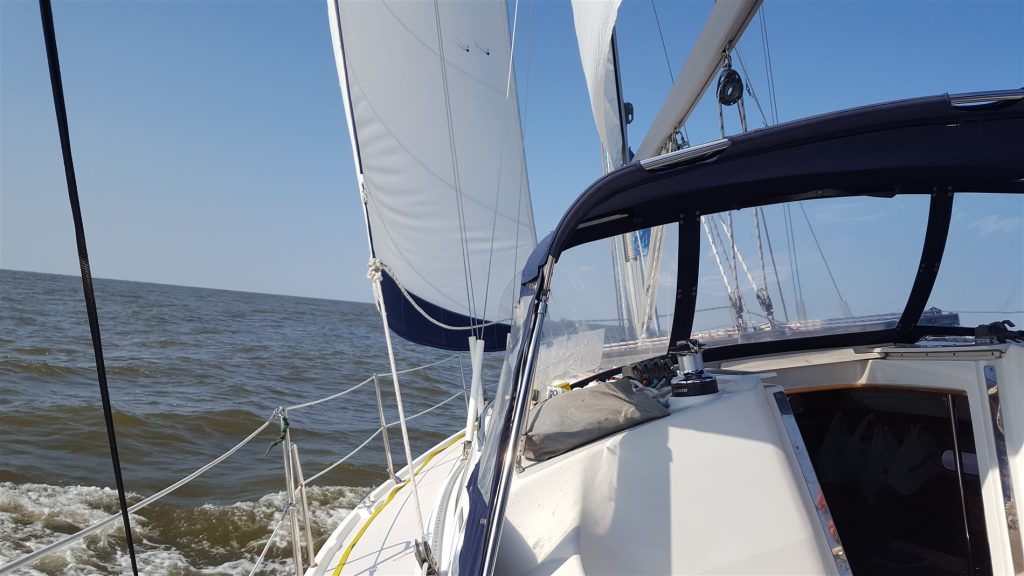
Image from the cockpit of a sailboat which is heeled over to the left
Heeled over on a close-hauled point of sail
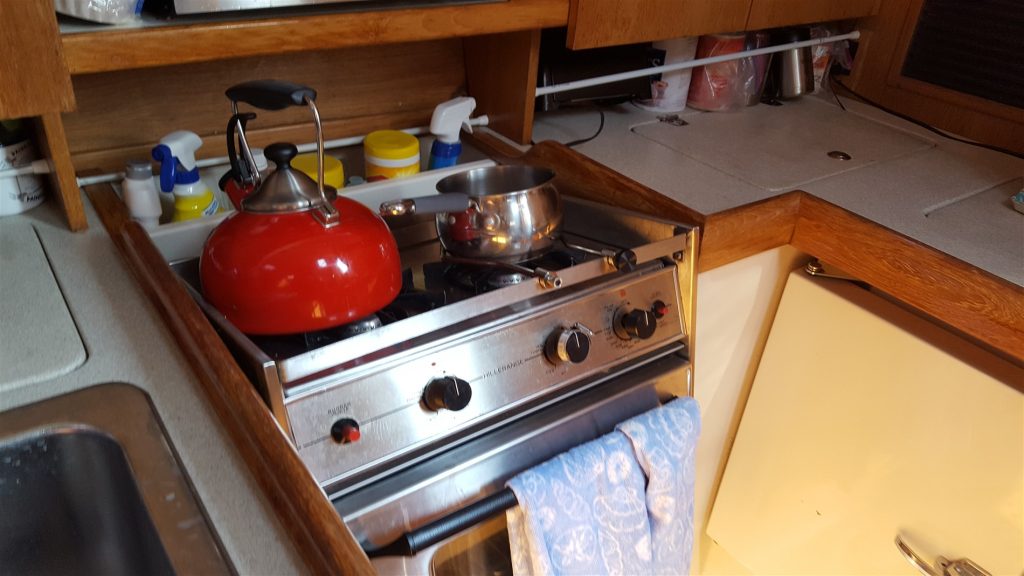
Image of range + oven tilted backwards on the kimbal
The Stove-top remains upright even when the boat is heeled over, because it swivels on the kimbal

Man Overboard Drills

After a few rotations at the helm, we each were to try our hand at the Man Overboard drill. Captain Jon taught us a new method, which involves sailing past the MOB and heaving-to to stop the boat upwind of the MOB. This is a much more pleasant and controlled method, when compared to the method of letting go of the sails and hoping the flogging lines don’t injure the crew or the MOB. I was able to pick up the MOB on my first pass, and the other students also managed just fine. After the MOB drills, we turned to head back to Galveston — we had sailed out to sea for a long time, and we wanted to ensure we got back to the marina before nightfall.

Technique: MOB Drill
In the MOB heave-to technique, you approach the MOB on a close reach. as soon as the bow reaches the MOB, you can tack the boat, leaving the jib back-winded, and complete the heave-to maneuver.

Back to the Marina

The long way back to the marina gave each of us lots of sailing time at the helm. For me, this was a great help because it takes awhile to strike the right balance and to not be forced to over-steer and correct, over steer and correct, on infinite loop. All it took was Captain Jon to take the wheel from me, steer for 60 seconds or so, then show me how well the boat and rudder were balanced by letting go of the wheel and watching the wheel stay in its close to neutral position. If I had let go of the wheel, the boat would have definitely veered wildly off course. So that gave me a good goal to work towards, and I’ll always remember that lesson as I helm in the future.

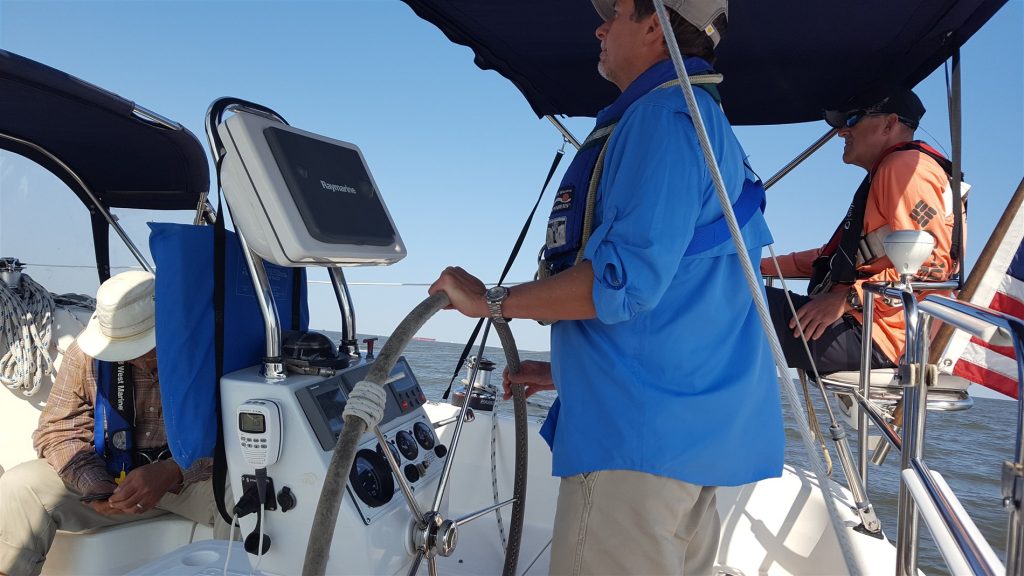
Image of helmsman and crew in the boat
Eddie at the helm of the Wind Orchid
View from the front of a sailboat at a beam reach
Sailing on a beam reach back to the Marina

After a bit of struggle to find the end-of-jetty marker, we rounded the jetty and headed back to the marina on a downwind course. Steve took us in to the slip this time. Once we were all settled in and freshened up, we laid back, cracked a few beers, and got cracking on preparing our dinner. We had planned to make chicken fajitas, chips, and salsa, so while Steve cooked up the fare, the rest of us drank and swapped stories out in the cockpit of the boat. With the food eaten, dishes were washed up and then we went for bed.

Image of a large commercial vessel in the HoustonShip Channel
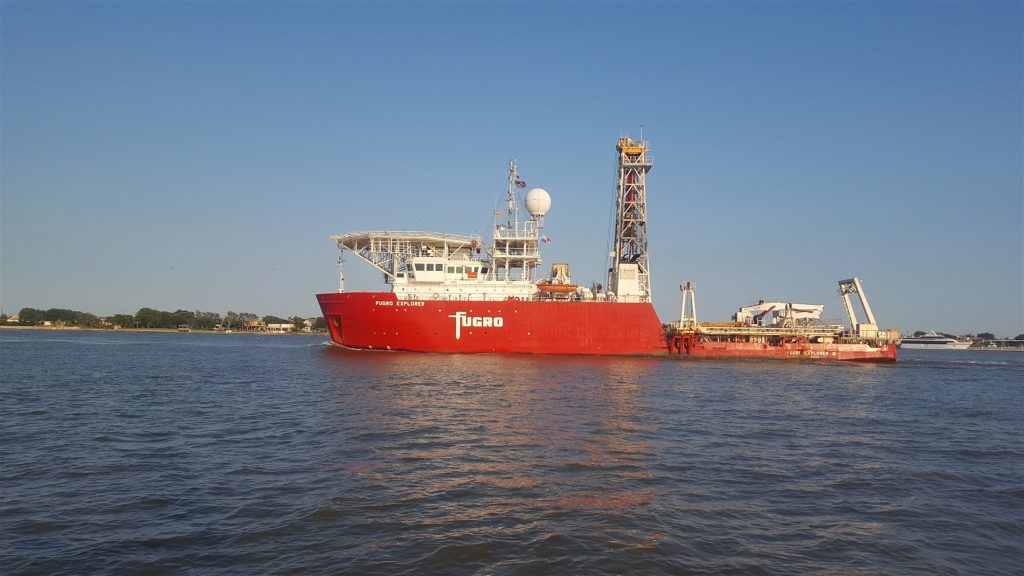
Passing up a large vessel inside the Houston Ship Channel

ASA 103-104 Combo Course, Day 1

Day 1: Friday 8-September-2017

Following a 2-week period of natural disasters and family emergencies, I flew back to Houston from LAX on Thursday night, just in time to make it to the ASA 103/104 Combo Course. This would bee a great break from the stress anxiety of the past 2 weeks, so I’m glad I could make it.

I arrived to the Bay Area Sailing School on time at 8:00 AM, but since one student was late, I drove to the nearby marine supply store to pick up a digital watch because I could not find my fitbit. Once all of us were present, around 9:00 AM, we sat down to spend about a 1/2 hour to get to know each other, and to give our stories about why we’re taking the course.

There were three of us students. Me, I was there to get proficient at keelboat sailing, because dinghy sailing has many limitations. The two other gents were close to retirement age, and both had plans to pick up a new sailing hobby for their retirement. Our instructor Jon seemed pretty laid back. He learned to sail during a U.S.-Canada exchange program and picked up the practice again years later. We learned that we ere to spend the next 3 days aboard Jon’s personal boat – a Catalina 350, which is a 36-foot sloop-rigged keelboat with a steering wheel, head with toilet shower and sink, a galley (kitchen) with sink, faucet and propane stove, two staterooms (bedrooms), air conditioning, and a main cabin with a common table and chart table.

Planning the Itinerary & Provisioning

The basic ASA 103/104 Combo Course at the Bay Area Sailing School is generally as follows:

  • Day 1, AM: Learn the boat, get provisions
  • Day 1, PM: Sail to Galveston Bay, Sleep in Galveston.
  • Day 2: Sail to Gulf of Mexico, and return to Galveston.
  • Day 3: Sail back to Kemah, take written exams while docked.

So we got about an hour of introduction to the boat, and then Captain Jon left us students alone so that we could decide on a final itinerary. This was important, because the itinerary would also include how many breakfasts, lunches, and dinners to provision for.

So here is the itinerary we settled on:

FRIDAY 8-SEP

  • Lunch in Kemah, on shore
  • PM: Sail to Galveston Bay
  • PM: Dock in Galveston
  • Dinner: Onshore, at a nearby Pub
  • Sleep on the ship

SATURDAY 9-SEP

  • Breakfast on boat
    • Coffee, Bagels, & Cream Cheese
  • AM: Anchoring practice in Galveston Bay
  • Lunch on boat
    • Deli-meat sandwiches, chips
  • PM: Sail to the open sea in the Gulf of Mexico
  • PM: Practice sailing in the Gulf of Mexico
  • PM: Sail back to the slip in Galveston Bay marina, and dock.
  • Dinner on boat
    • Chicken quesadillas, chips & salsa
  • Sleep on ship

SUNDAY 10-SEP

  • Breakfast on boat
    • Coffee, Bagels, & Cream Cheese
  • AM: Sail back to Kemah, Bay Area Sailing School
  • Lunch on boat
    • Deli-meat sandwiches, chips
  • Finish written exams
  • Part ways.

So based on the itinerary, we decided that we needed the following provisions:

  • Two Breakfasts:
    • 8 Bagels
    • 1 Pot of Cream Cheese
  • Two Lunches:
    • 1 Sandwich per person per lunch:
      • 16 Slices Whole wheat bread
      • 16 Slices turkey deli meat
      • 16 Slices provolone cheese
    • 1 Bag tortilla chips
  • One Dinner:
    • 2 Chicken Quesadillas per person:
      • 16 flour tortillas
      • 2 bags shredded cheese
      • 1 lb. pre-cooked fajita chicken
      • 3 tomatoes
      • 3 jalapenos
    • 1 Bag Tortilla chips
    • 2 Jars salsa
  • Other Provisions
    • 20 lbs. ice
    • 6 gallons bottled water
    • Granola bars
    • 2 cases lite beer
    • 3 bottles Gatorade

So armed with our list, we got the provisions from a nearby Randall’s grocery store, made a quick stop at the marine supply store so I could pick up a re-usable water bottle, then we had lunch at a Chick-Fil-A. With bellies full and a trunk load of provisions, we headed back to the BASS.

Before getting under way

We loaded the provisions and our suitcases/duffel bags onto the boat, then Captain Jon stepped us through the rest of the preparations required once the itinerary is set. We checked the tide tables and weather to get a good feel for how soon we should plan to be sailing in each leg, and adjusted our planned timings accordingly. Best to hang out in Galveston Bay on Saturday morning, and go to the Gulf in the afternoon. Then an early start on Sunday to avoid an ebb current which would fight us all the way back to Kemah.

So after commending us on not over-provisioning, Captain Jon trained us on using the stove, toilet and engine, and we headed out for Galveston on our boat, the Wind Orchid.

Sailing out to the Ship Channel

Steve (one of us students) took us out under motor, out to Clear Lake, then past the Kemah boardwalk. Once clear of the boardwalk, we were able to raise sails, and so we cu the motor and began sailing to the Houston Ship Channel.

But first, a lightweight chart navigation challenge: if we need to target day marker “61” of the Ship Channel, what compass bearing should the helmsman steer to in order to hit the mark? This was not too difficult, and Ed & I rolled out the chart to determine the right heading: 100 degrees. And sure enough, we eventually made it to the right marker, by steering to that course. I had to learn a lesson though, that you cannot stare at the compass while at the helm to keep a steady course — the best you can do is to glance at the compass from time to time.

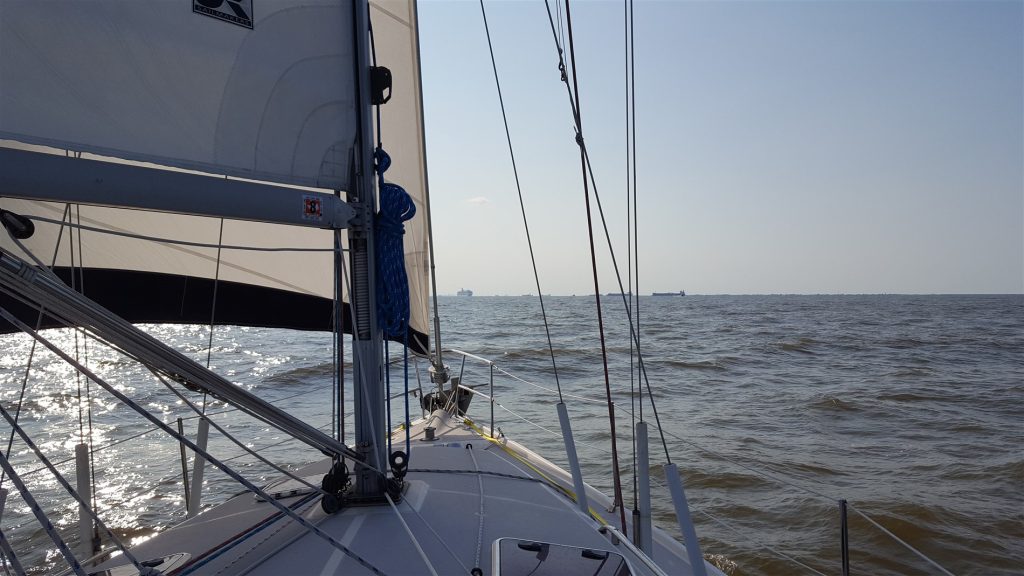
View from the bow of the sailboat
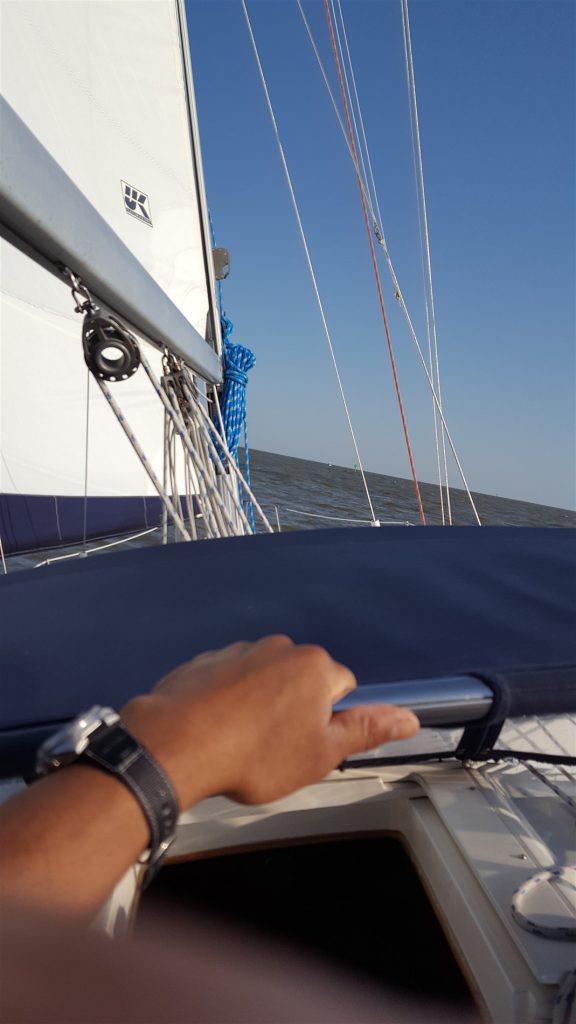
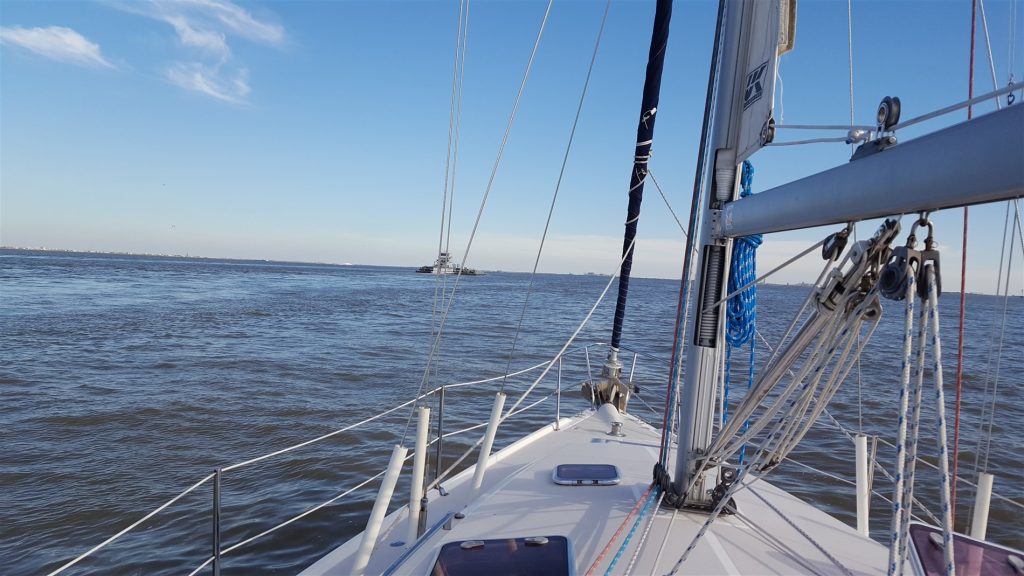
Motoring to the Houston Ship Channel

The plan was to sail outside the Ship Channel, and maintain a course parallel to the Ship Channel. But when the wind suddenly died, we needed to tackle the next chart navigation challenge: how long will ir take us to reach the Galveston marina if we maintain a speed of 4.5 knots? It turns out that the answer was 2 1/2 hours. And since it was already 16:30, we decided to drop sails and use the motor to get us to Galveston before nightfall. (because we were going slightly downwind)

Image of a commercial freighter in the water
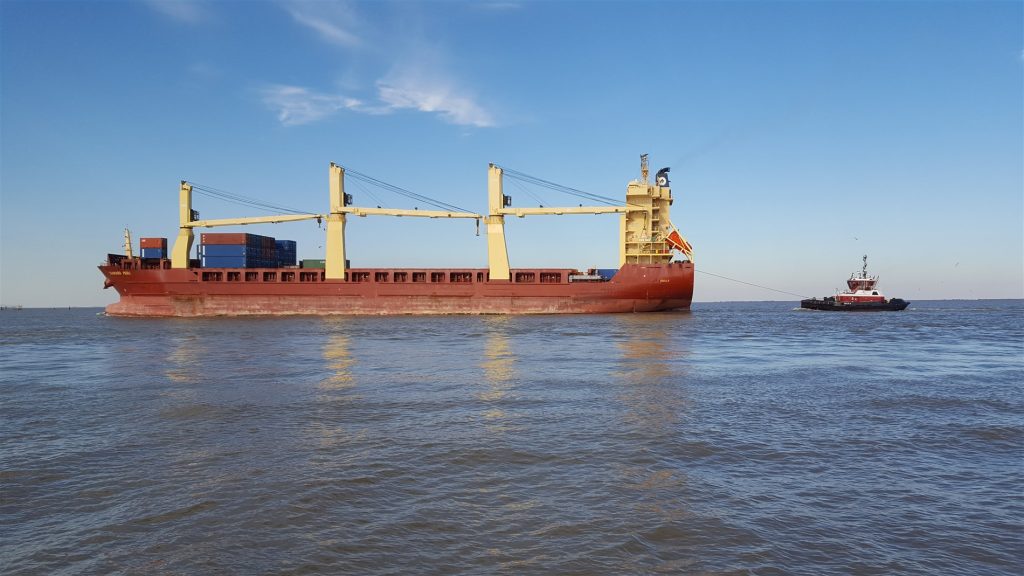
Passing a large ship in the Houston Ship Channel

Settling in for the night

Eddie was at the helm to take us to the slip, and after docking and connecting the boat to shore power, we rushed out to the gastro-pub around the corner to get some dinner & beer before they closed.

Back in the boat, we hung out, drank beer & talked shit for another hour or so before tucking it in for the night. On the Catalina 350, there is one  bed per person: one bed in the V-berth, one bed in the quarter berth, and two convertible beds in the main cabin. So each man on his own bed, we slept on the boat.

ASA 101 Basic Keelboat Sailing, Day 2

Day 2 of the ASA 101 course is supposed to be 80% on the water, and the other 20% is the written exam. But at the start of the day, the wind was so low that we had to postpone sailing for the afternoon.

So the written exam was first. I had a chance to study a bit in the morning, so I did fairly well on the exam. After the exam we headed for lunch, and by 12:30 PM we were on the boat leaving the marina for the bay.

After a bit of cruising around and practicing tacking, we quickly moved to the man overboard drills. Each person had their hand at it, and at the end of my turn lightning began to strike so we started to head back as quickly as we could.

The wind picked up a lot, so we turned into the wind so that we could reef the main sheet to reduce the sail’s power. This is where the importance of knowing the knots by heart really sunk in for me. With a storm coming strong and lightning nearby, securing that mainsail quickly with a series of square knots is critical.

After I guided us to the channel leading to the marina, the instructor fired up the motor and we headed in. Again I was reminded of the knot knowledge, because as I sat down at the bow to lower the jib and secure it to the deck, I must have taken 3 minutes to tie that damn square knot 🙂 And by that time the rain was coming down in buckets. I’m so glad I remembered to bring my fancypants rain coat and then left it in the trunk of my car! Note to self, learn those damn knots!

Anyway in a few minutes we were at the dock, we quickly tied the boat to the dock (again the knots) and ran for shelter, thoroughly soaked through and through.

I passed this certification, but there are two more to go before I can charter a boat on my own – “bareboat” chartering, they call it. (Bareboat means the charter company does not provide any skipper or crew to accompany you) I’m on my way !

ASA 101 Basic Keelboat Sailing, Day 1

After two years in Houston, I decided to try and rent out a sailboat and get out on the water. With my RYA Level 3 certification for dinghy sailing, it turns out that there are no places in Houston that rent out dinghys like the Laser. But I did find a school (Bay Area Sailing School) which gives keelboat certification, where the upper levels allow you to charter a keelboat anywhere in the world. The certification is the ASA, or the American Sailing Assoiation.

This school offers basic certification classes every weekend on a 2-day class, so I figured I would try and show up unannounced and see if they had an open space for me. They did! So by 8:30 AM I was sitting in the classroom ready to get started.

I expected a lot to be re-hashing of concepts I already know, which was true. But I was immediately struck by the amount of classroom time– this must be an American thing, because in one day I almost spent more classroom hours than in 2 separate 2-day RYA certifications. (or maybe I’m just shutting the RYA classroom hours out of my mind?) But it was good, as there were many things I learned about local rules. Example? Dumping rules. Apparently the faster your boat is travelling, the larger waste you are allowed to dump overboard. Weird !

Anyway the afternoon was spent in the keelboat. It was a Catalina 22 Capri (vessel named “Breathe Easy”) which has an outboard motor, a tiller-rudder attached to the transom, and a non-furling jib. One thing which was good, was that the instructor did not rush the rigging up part. This made it clear that learning to tie up the bowline (for the jibsheets) and clove hitch (for the fenders) were critical to being able to rig up and sail. None of us on the boat (4 without the instructor) were good at the knots, so we all had some homework to do.

The instructor took us out of the harbor and into the bay using the motor, then once the sails were hoisted up, he put me at the helm first (handed me the tiller). The mechanics of sailing the keelboat is not very different, except that you must rely on the crew to trim the sails. On a dinghy I’m accustomed to getting a feel for the wind by shifting my weight, adjusting the main sheet, and playing with the tiller. On the keelboat though, this a bit slower going since it’s your crew who are controlling the main and jib. So it is much more of a ‘set course, trim sails, and keep steady’ type of sailing, as opposed to the more active constant adjusting and shifting you do in a dinghy.

The first day’s goal seemed to be to get everybody comfortable with sailing a straight course toward a target, and to practice a few tacks. The instructor didn’t focus on sail trim yet, so it felt weird sailing on a close reach with the sails a bit too far out…but the trimming instruction would come later.

Not much to learn, The main thing was working with a jib using a winch, which was new to me. After everybody had their turn at the helm we headed back and that was the end of the day.

The biggest learning for me on the day, was the mechanics and logistics of entering/exiting the harbor, docking and undocking, and rigging up and rigging down the keelboat. At the end of this first day I am looking forward to more drilling in day 2 – man-overboard drills are required to pass the course so that should get me much more comfortable with sailing this bigger boat.

Stepping it up

Today was my first day going out on a boat meant for 2 people, but I sailed it single-handed. I am considering getting a sailboat but wanted to see if it was not too difficult to sail a boat with both a mainsail and a jib single-handed.

It turns out that it is not too hard. At first I had assumed that I could just leave the jib rolled up and pilot the boat with only the mainsail, but the staff told me that without the jib I would have a real hard time sailing upwind. So I said OK and went for it.

The boat I sailed was an RS Feva. I asked the staff if it was similar to the Laser Vago (another 2-person boat), but he said they were quite different. I could see from the rigging of the kicker that it was not meant for serious racing, but I am not overly concerned about being a speed demon so that didn’t bother me very much.

At first I was having a hard time setting the jib right without losing a grip on the main sheet or the tiller, but I got the hang of it after a few minutes and then I was off.

The key was, whenever attempting a tack, to get the mainsail and tiller sorted out first, then move on to set the jib to the opposite side after the boar stabilizes. That was you avoid being too stressed out and trying to too many things at once.

So sailing upwind and getting to close-hauled felt pretty comfortable. But with the trapeze toe-strap I did feel that if I stayed hiked out too far for too long, that I would be unable to get back into the boat easily. So I didn’t do much hard-core close-hauled hiked out stuff.

Downwind was a different story. Unless the wind direction changed whenever I attempted to go to a reach or downwind, I felt it difficult to manage the boat, unsure how the jib should be set and worried that the mainsail would jibe at any moment. I will need to work on that, in fact I might need to pony up for a lesson with an instructor to get better sailing with the wind with a main and jib.

After almost getting decapitated by a landing seaplane, I sailed back to the shore downwind and made a calm landing without too much trouble.

So the verdict? I’m not sure if I enjoy the added work of controlling the jib single-handed, but there does not seem to be too much choice if I want to sail a boat that can take more than one person. I think a private lesson or two might get me more comfortable to the point of being ready to invest in a slightly larger sailboat as my first boat.

I guess time will tell!