2023 Atlantic Crossing Week 3

Note to reader: The below updates were originally posted to a group chat that I was using to keep my family and friends updated on the progress of my sea adventure.

Update 15-November

It is hot.

This is day 14 of our planned 3-week ocean passage from the Canary Islands to the British Virgin Islands.

And it is hot 🌞🫠

In case it was not clear until now, we can definitely tell that we are approaching tropical weather. As long as the wind keeps up that means we will still be comfortable so here’s to hoping that it keeps up 🤞🏾
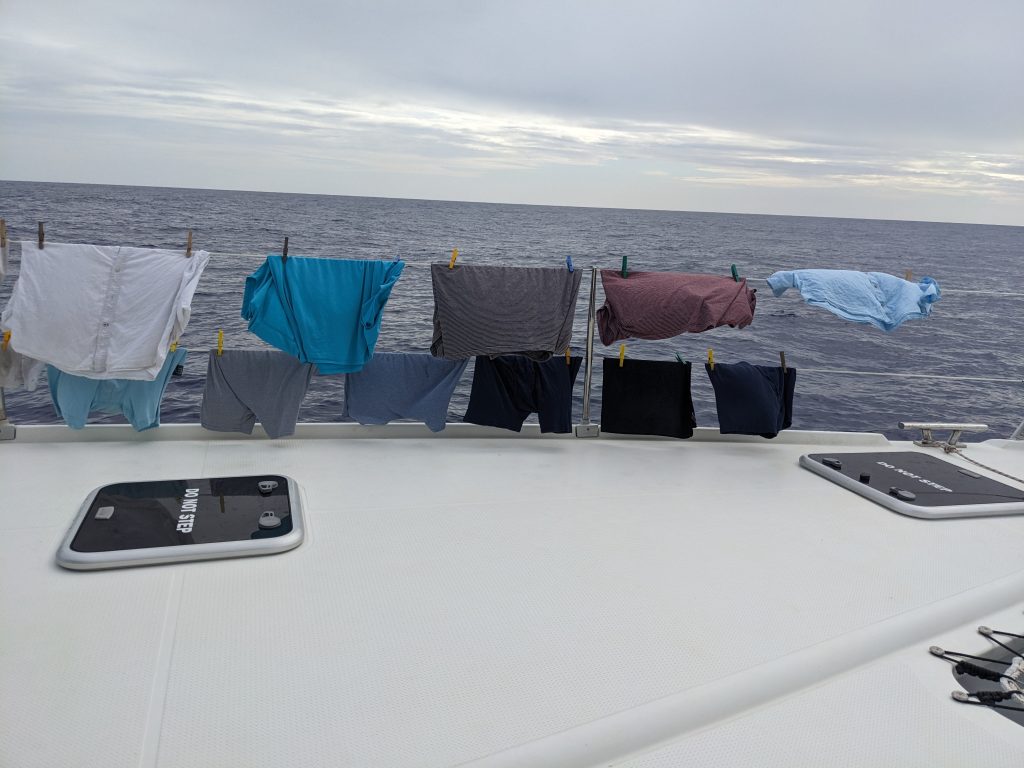
Yesterday we had a bit of repair work to do for our mainsail. The reefing line for the first reef point of the mainsail got chafed so bad that the line broke, with a big portion of the line stuck in the boom! (the horizontal bar that runs perpendicular to the mast)

Reefing lines are used to maintain control of the boat and sails as the wind picks up– going fast is great, but sometimes if you have too much sail exposed in high winds then you can start to lose control. Also sails are only rated to withstand up to a certain amount of wind speed, and beyond those limits you can see either damage to the sails or even structural damage to the boat’s rigging.

Fortunately the boat has plenty of spare and backup line, so it was only a matter of pulling out the damaged line and running new reefing lines. To prevent this line from suffering the same fate as the previous one, we ran the lines differently in a way to avoid the chafing issue.

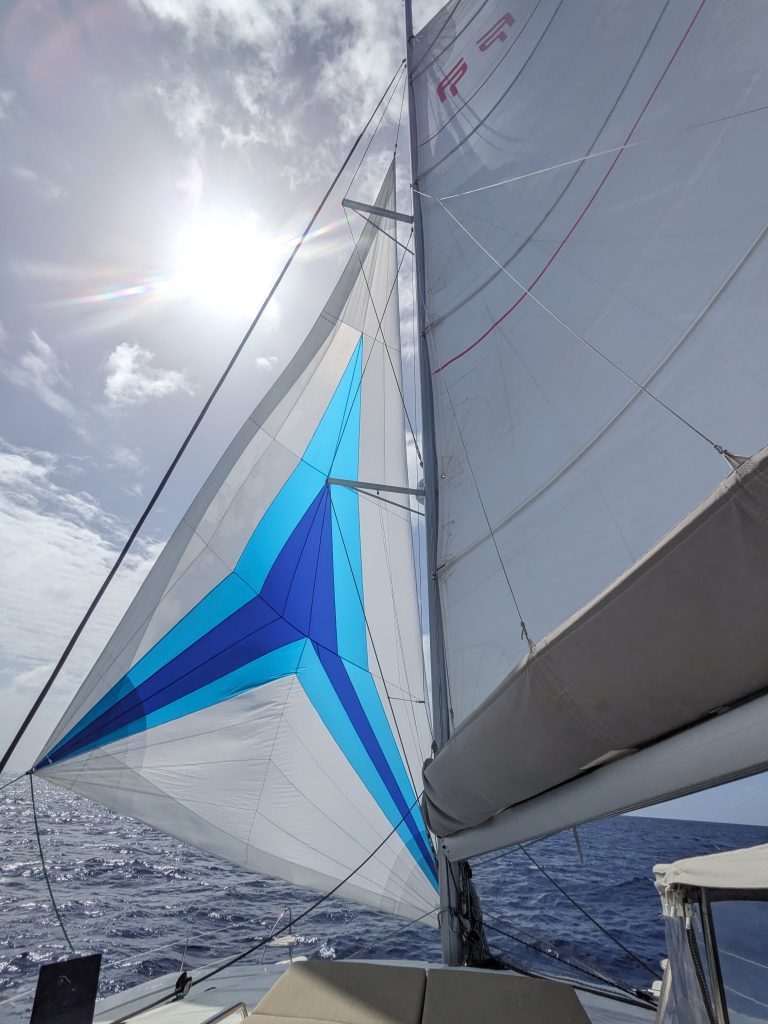
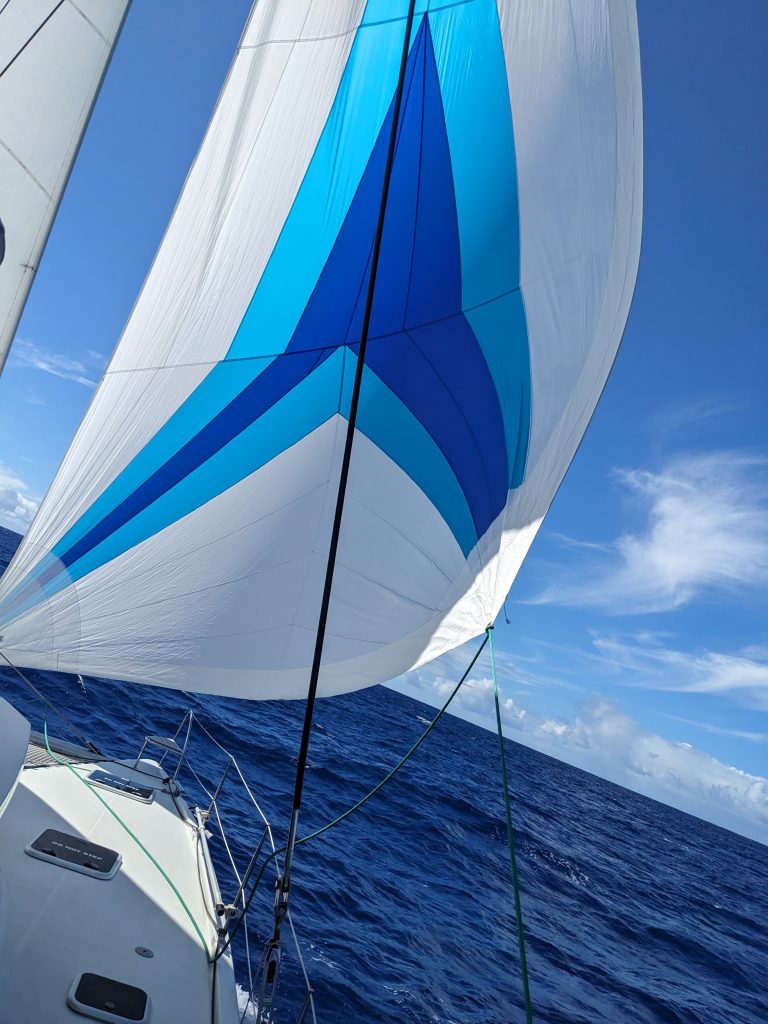
After that we had moderate winds, so we broke out our colorful code zero sail again, which performs well in lighter winds. That enabled us to keep sailing at a good clip of 4-5 knots, which is better than what we were getting with our usual Genoa foresail.

Night watch was fine, I was able to spot Ursa Major (Big dipper) and Polaris (the north star), and learned the names of some of the stars in Ursa Major.

Now it is sunny with scattered clouds, and our code zero foresail is still flying high. I woke up pretty exhausted. I think all of these weeks of disrupted sleep due to night watch duty is finally catching up to us….😴 But that is what espresso is for, so I’ll just keep on taking it one day at a time.

Here is my current location:

https://goo.gl/maps/wGdkVFbuTc9jvcpA9


Update 15-November

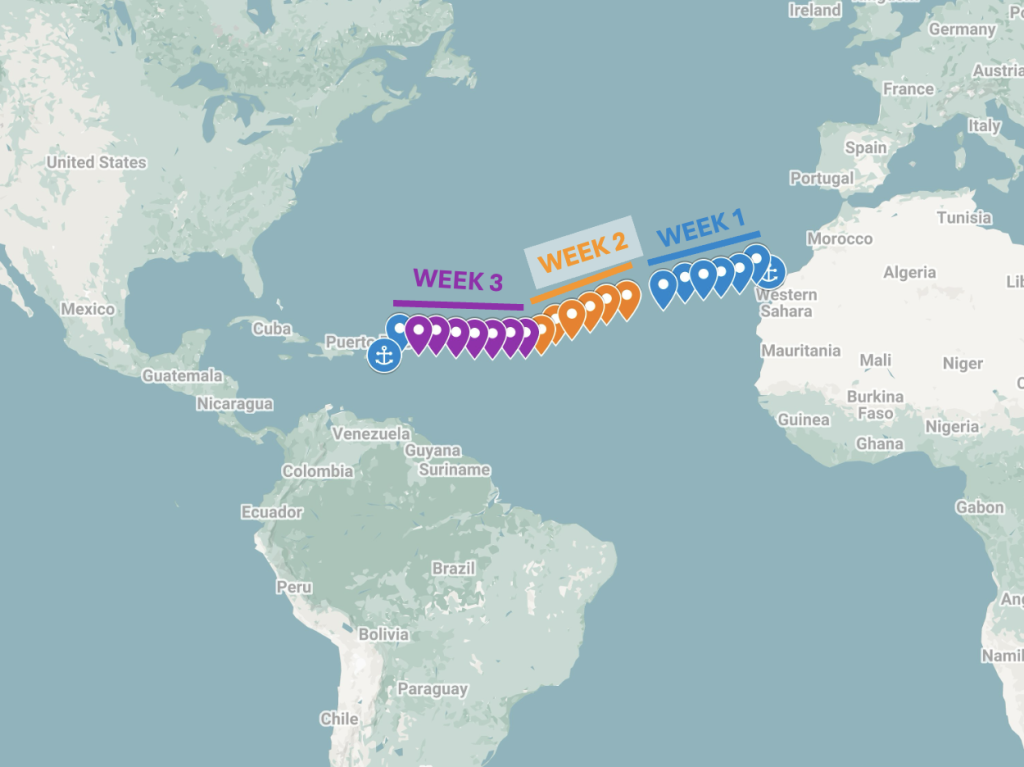
Today is the 2-week mark of my planned 3-week ocean passage from the Canary Islands to the Caribbean. Before the end of the day, we will be less than 1,000 nautical miles from our destination!

As next week is Thanksgiving, we are doing some guesswork to see where we night be when next Thursday comes around. If we are nearing the French Caribbean islands around that time, we may decide to make a stop in Guadeloupe and have a nice meal onshore…to be determined. If we will be onboard we have a nice cut of pork loin that could be a substitute for turkey. So we have some options, but of course this is all just speculation until we get a little closer to arrival time.
Crew morale is hanging in there– I wasn’t the only one  exhausted yesterday, and tempers got a bit shorter, but I think everyone is trying to get a few more nap-times in, to avoid burn-out.

I was complaining about the heat in yesterday’s update, and before the end of my daytime shift, we got some rain to help cool us off !💧💧💧🙏🏾 It’s nice when you can get the rain without the accompanying rough seas and overpowering winds, sometimes.

After my shift I laid down in my cabin to try and catch up on some sleep. I didn’t get any deep sleep in, but allowing myself to just lie there and do nothing did feel like a good rest nonetheless.

During my night shift we were sailing and making some good time. I managed to spot and identify the Aries constellation, which combined with Taurus covers my zodiac sign (I’m on the cusp between the two). I also spotted Cassiopeia and the names of the stars making up that constellation.

It’s a nice sunny day today, and this time we have a cooling breeze so it is looking to be an awesome day!

Here is my current location:

https://goo.gl/maps/xogk4kwvxYvaZiKK7


Update 16-November

It us now day 16 of my planned 3-week ocean passage from the Canary Islands to the Caribbean. We are still travelling westerly towards the Caribbean, headed in the general direction of St. Kitts and Nevis. At this point we have only 942 nautical miles left  to go…we are now down to triple digits!

Yesterday was another good day. We decided to fly our code zero foresail again– this time not for any performance reason, but to let it dry off 🤣  The crew had to bring that sail down and stow it in the rain, so to keep the mildew away it had to go back up.
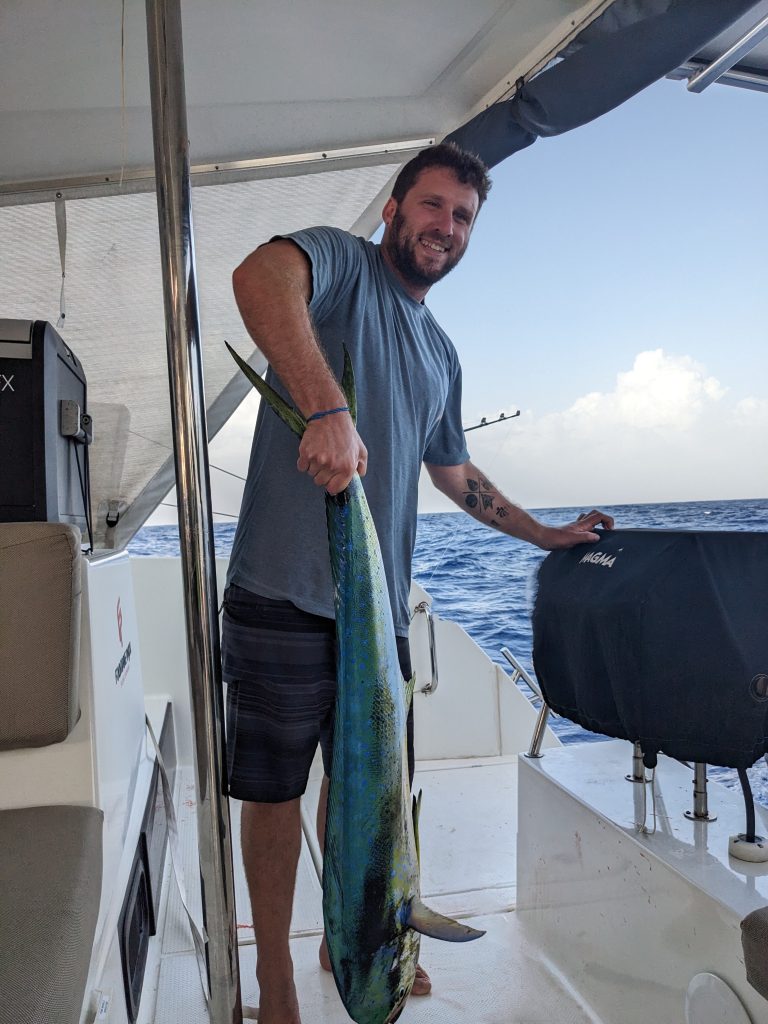
With a fishing line out we caught another mahi mahi! Ezra reeled it in and filleted it, and I made a meal out of it with some aglio e olio pasta on the side. This was a good-sized catch, so plenty of extra fish got packed in the freezer for another day.
By now we are all becoming more vigilant about how much rest we are getting. It’s easy to get set in a certain rhythm, but if you calculate how much sleep you’re really getting and you count less than 5 hours per day, that should be an indicator that you need to figure out how to get some more rest in your routine.

I am on the borderline with my schedule, so that means for me to make sure that after my 12pm-3pm shift I need to go lie down for an hour or two.

Night shift was beautiful, with plenty of stars to see and a very constant wind blowing.

That’s all I got for today. It is starting to feel like the final stretch now, so as long as I make good rest a focus, I am optimistic that I can make it through in good spirits.

Here is my current location:

https://goo.gl/maps/oVkCwZvo77wK3oDp8


Update 17-November

Today is day 17 of my planned 3-week ocean passage from the Canary Islands to the Caribbean. We are headed west and hoping for good winds to take us the rest of the way in.

Yesterday was a good day because I think that the different crew members managed to get control of theit exhaustion issues (including me), which meant that morale is back up to happy levels 👍🏾

We had decent sailing, nothing too fast but a good pace and steady. That kept up for most of the night too, with maybe a slight slow down a bit before dawn.

Speed is back up now, but we are anticipating some rough seas starting this afternoon…so we’ll just have to ride it out and see how rough it gets.

Here is our current location:

https://goo.gl/maps/mrYs8DAMVcP3u8zB9


Update 18-November

Okay this is day 18 of my 3-week planned ocean passage from the Canary Islands to the Carribbean. The weather forecasts are making us think we can bypass the French Caribbean islands now and head straight towards the British Virgin Islands, so that is where we are headed.

The rough seas that were forecasted never really came yesterday. We do have higher swells and waves today than on previous days but nothing near the 20-foot-plus waves we were expecting.

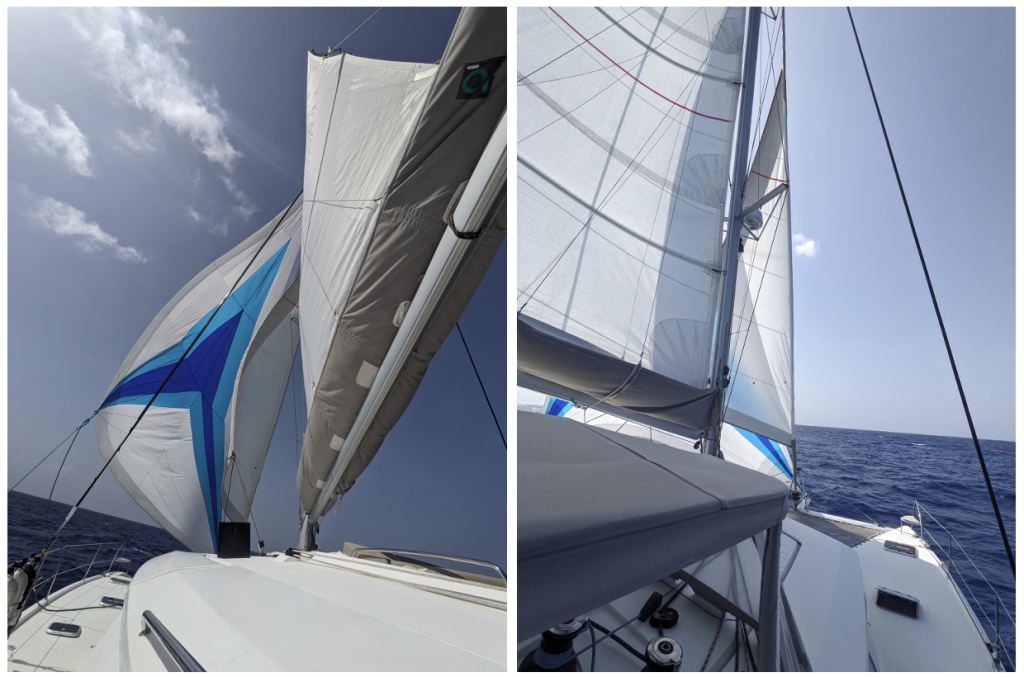
So the rest of the day yesterday was a calm sail. We actually tried out a new 3-sail configuration, which resembles a rig called a “cutter” rig. This is where you have 3 sails out, all angled in the same direction. The theory is if you have 2 sails out, won’t a 3rd sail give you even more speed? Well in our case the answer was yes, but it took some tweaking and adjusting before we were able to keep all three sails full at the same time.
It is starting to show that we are getting close to the islands now: during our night watches, we are starting to see more and more vessels come within visual distance from us. This we would expect to see as we get closer to land.

But no boats appeared during my shift, so I just scanned the sky for stars and managed to spot the Gemini constellation.

Today started out with a bit of rain, but that has stopped and now we have some moderate waves and we are sailing at a decent speed.

Just taking it one day at a time now…

Here is my current location:

https://goo.gl/maps/k5PHJReJ46PgHCpHA


Update 19-November

Today is day 19 of my 3-week planned ocean passage from the Canary Islands to the Caribbean. With only 526 nautical miles left to go, it finally feels like we are on the last leg of our long journey.

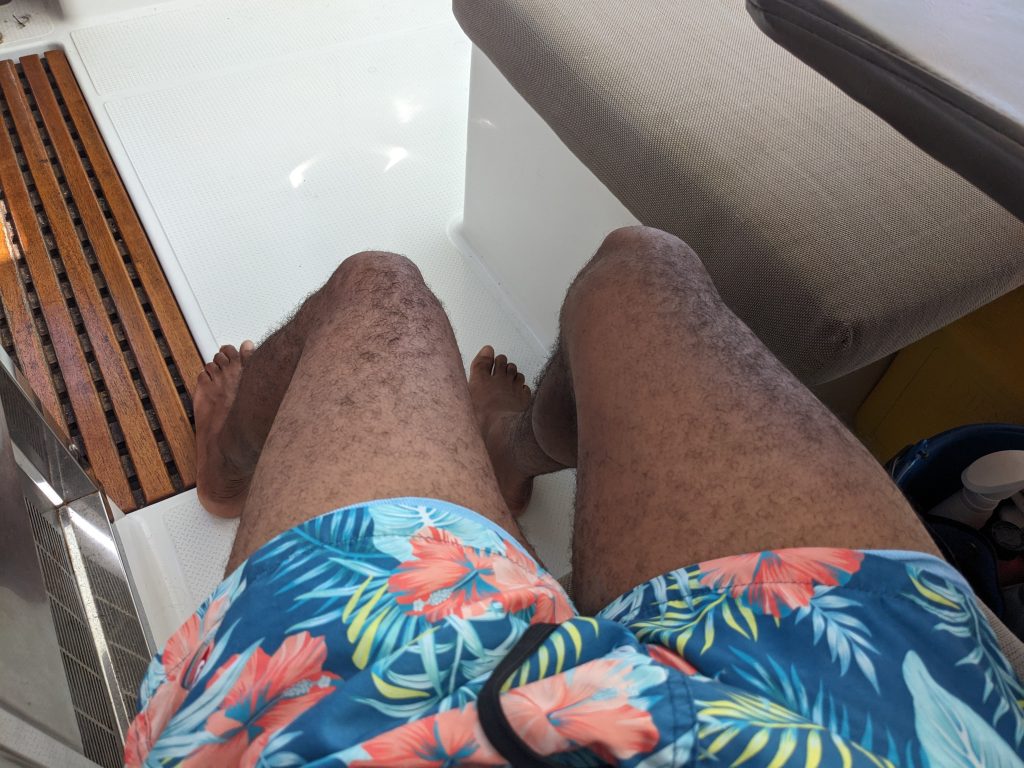
Yesterday yielded another fine day sail. It did get hot enough for me to break out my swim trunks, and let my thighs show a little bit 🫣 But we eventually got cooled down by the breeze so it was not too bad.

I finally finished the first half of my celestial navigation course. I’ve made it far enough to understand the process of taking a reading of the Sun’s altitude using a sextant, and then using a nautical almanac and lookup tables to calculate your position. So today we’ll be breaking out the sextant onboard and putting all of this theory to practice!
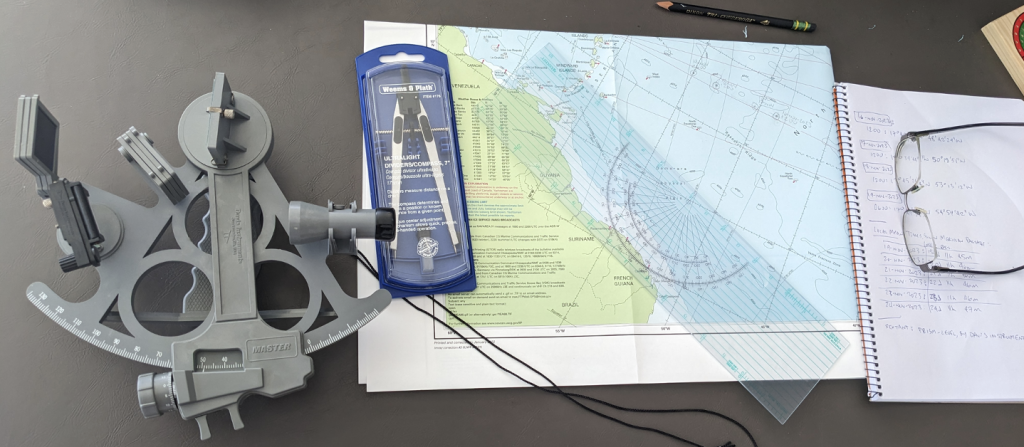
Of course since we have GPS we don’t need to use the Sun, Moon or stars to tell us our location. And in fact the vast majority of active competent sailors out there don’t know how to navigate by stars. But as I see it, the drill goes something like this: we have been using our GPS chart plotter to track our position, and at 3 hour intervals we record our latitude and longitude position in the boat’s official log book (This we are really doing). Then disaster strikes and all electronics on board are no longer available. Maybe phones and tablets and laptops work for a few days but those eventually go out too. Now what? Trace back to our latest known location (via the log book), plot that location on the onboard paper nautical charts, and start using the Sun to keep track of our position.

Well that is what we’ll try anyway 😀

We have now set our clocks back to be one hour ahead of New York, USA time, which is the time zone of our destination. We are ose enough now that we’ve decided to not let the boat drop below a speed of 5 knots (nautical miles per hour). So we will fire up the engines as needed to keep our speed up. In that way we have the best chances of being able to enjoy Thanksgiving dinner on land. British Virgin Islands, here we come!

Here is my current location:

https://goo.gl/maps/1T91B6iGGvJmncgY8


Update 20-November

It’s day 20 of my planned nonstop ocean passage from the Canary Islands to the British Virgin Islands. We are now targeting to arrive on Thursday, so having a nice dinner onshore on Thursday is a possibility.

Yesterday was my first time taking out the sextant and taking sun sight altitude readings with it. Once you’ve taken it, with the help of some lookup tables and some calculations, you should be able to pinpoint at what latitude you are in. Well after yesterday’s sun sight, our calculations gave us a latitude value that was 3 degrees off. That does not seem like much until you understand that 3 degrees is the equivalent of about 180 nautical miles! So it was good practice, but definitely the goal over the next few days will be to see if we can arrive at a more accurate latitude.
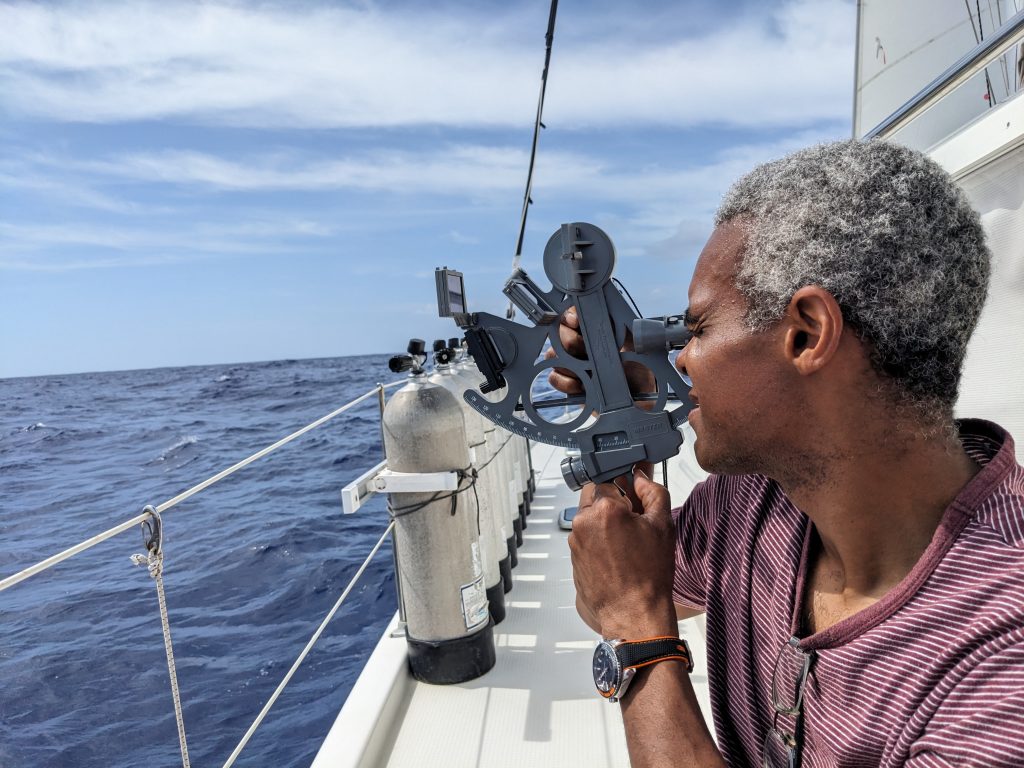
The day was easy other than that. Night shift was also painless, with no other boats crossing our paths and nice steady winds.

The sun is out again today, so looking forward to more great sailing!

Here is our current location:

https://goo.gl/maps/YSerFCdNJUWEbDe46


Update 21-November

Good morning! Today is Tuesday, day 21 of my planned ocean passage from the Canary Islands to the British Virgin Islands.

This morning I showered, washed my hair, and shaved. (I’ll let you guess when was the last time I did that 🤔) I don’t mind roughing it and skipping showers, but it does feel good to be all fresh and clean every now and again. We are definitely all feeling like we are almoat there– we are hoping to make it to the British Virgin Islands  for a Thanksgiving dinner on Thursday at a restaurant / bar on shore.

So only 2 days to go, if all goes well!

Since I started taking sextant sightings, it’s become a daily habit now. Hopefully each day I will get better and better at reading the Sun’s altitude…captain and the crew are even looking to

start taking sights and stepping through the process with me. We’ll all be competent celestial navigators before too long!

With our target destination and day/time in mind, we are now doing a lot of motor-sailing: that means your sails are up, but you still have the engine(s) going to make sure you don’t slow down when the wind drops. But that is fine for us, I think we are all looking forward to bringing this chapter in our ocean adventures to a close.

Sun is out and so are my thighs, so you know we are in full-blown tropical weather now!
Here is my current location:

https://goo.gl/maps/xuLejvrK1tZP6mni6

Update 22-November

This is day 22 of my planned ocean passage from the Canary Islands to the British Virgin Islands. It is Wednesday, and if all goes according to plan we should arrive at our destination tomorrow, mid morning.

During my night shift we passed just 24 nautical miles north of Barbuda heading west, so we are now officially in the Carribbean.

I sent a pic and video of us stopping the boat and jumping in the water for a bit. We were able to do that because the wind haf died down to almost nothing and the current & waves were also minimal. After we fired up the engines and set off again, we dropped the sails and used the engines for the rest of the day and all night.
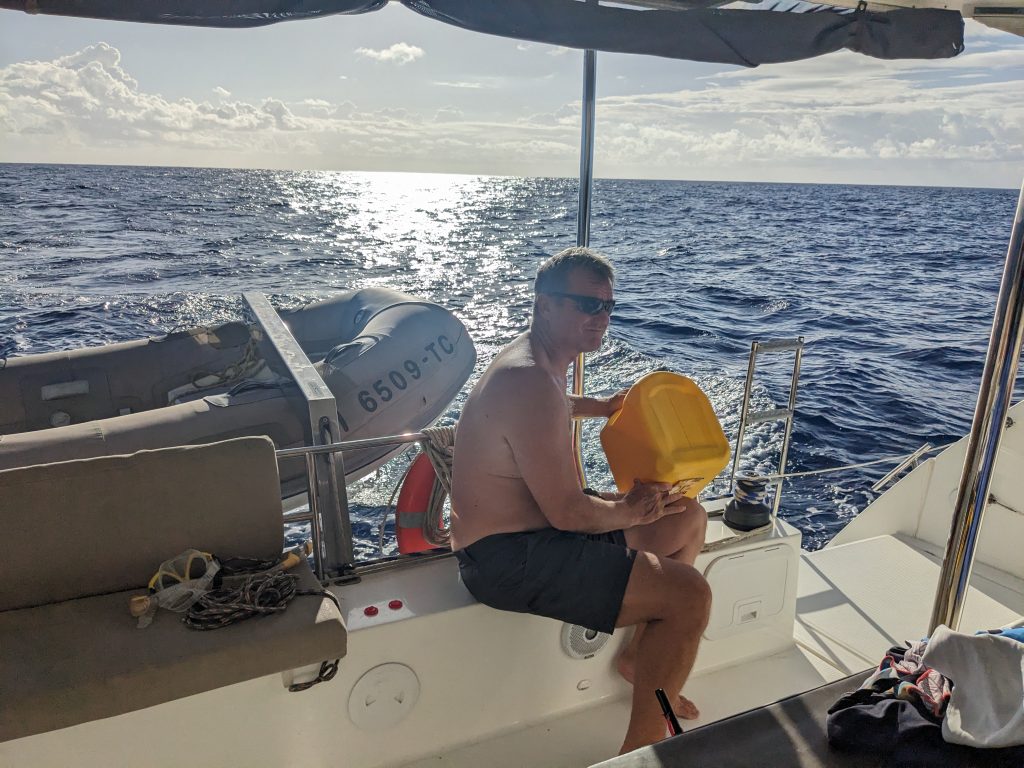
As I write this update this morning the wind picked up and we are now sailing again with the engines off. The biggest hazard on th seas now is all of thle floating lobster traps laid out by fishermen of the region. If we don’t spot them and we run over the traps, we risk getting our hulls and rudder caught in the lines, or even worse we could get the lines wrapped around the propellers if the engines wee running. So today is about keeping vigilant during your watch to make sure we steer clear of all of those traps.
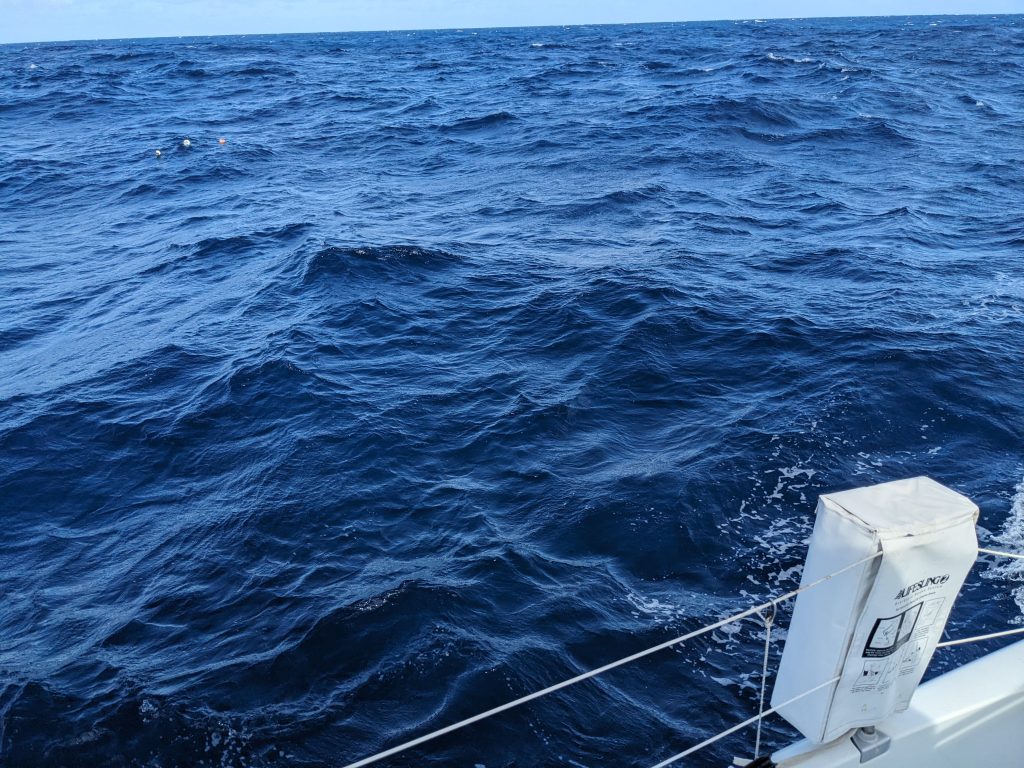
Other than that, this is the final countdown to landfall. Almost there now!

Here is our current location:

https://goo.gl/maps/BK3Mgg8xstCMQe9E9


Update 23-November-2023, 3:37 AM:

We have arrived at our destination of Road Town, Tortola in the British Virgin Islands!

🥳🥳🥳

We arrived at night and tied up to a mooring just off shore.
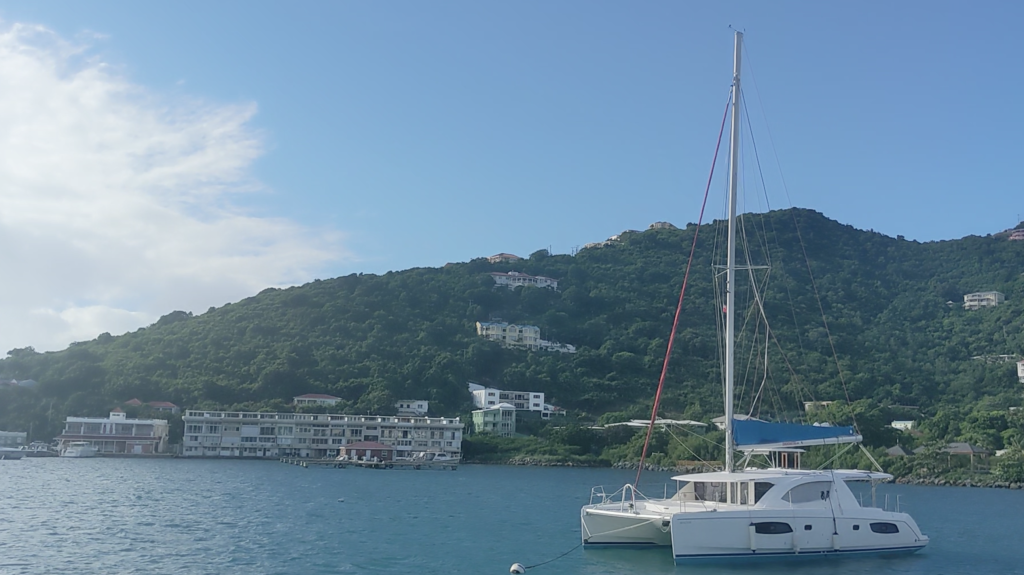
So the Atlantic crossing is now officially over!

I’m gonna go to sleep now, more updates tomorrow. 😀

Here is where we are moored:

https://goo.gl/maps/XAf34qpKVTYjQwjVA


Update after arriving: 23-November-2023

Okay! I woke up this morning to a peaceful, green landscape. We moored just offshore of the island of Tortola, in Road Town, the captial of the British Virgin Islands (BVI’s).
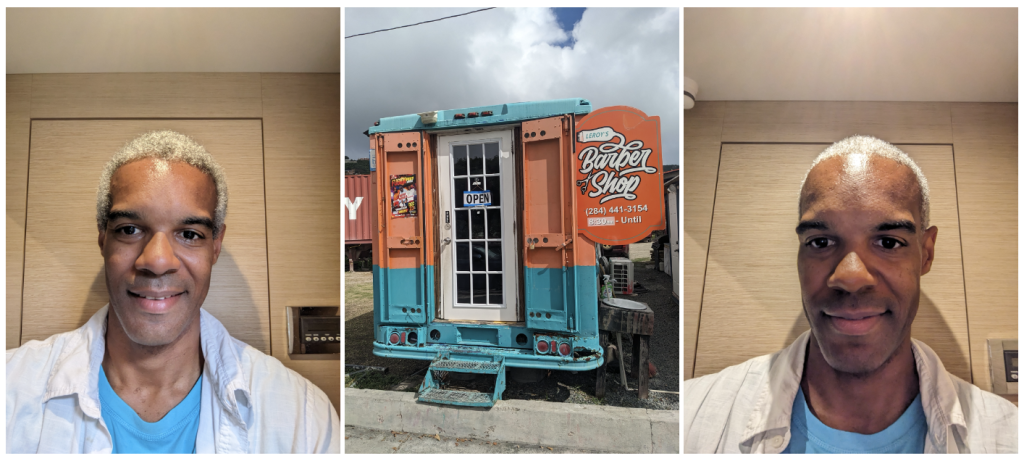
Yesterday was the 22nd and final day of our planned 3-week ocean passage which started in Gran Canaria, Canary Islands, and ended in the BVI’s. We started to see land from not too far away as we made our approach, as I showed yesterday. We managed to sustain about 6-8 knots on wind power for most of the day. This would have been great except for two things: first, we had entered an area where lobster trapping is big– so trying to spot and avoid running over lobster pot lines became a priority, but is very hard because the floaties on the surface are tiny and they pop up unexpectedly and always at the last minute. Second, the seas got very rough and swells very high, which made it even harder to spot those tiny lobster traps.

But we made it through all of that, and at such a good clip that we were able to make it in in just a little after 3am local time.

It was halfway through my night watch when I was joined by the captain, as he is the one who brings us in to port, especially if we are making landfall at night.

Instead of trying to find an anchoring point and dropping anchor in the dark, we planned to go to a spot where there were mooring balls to attach to. If you don’t know what those are, they are floating balls that are attached to some very heavy stuff on the ocean floor, which serve as a very solid and secure anchoring point. So when we show up, all we needed to do is grab the hook attached to the mooring ball, and connect it to a line coming from our boat. It was all over and done in about 30 seconds.

And that was it! There were high-fives all around, but we decided that 3am was a bit late (early?) to share some celebratory drinks 😁 So instead we all went down to try and get some much needed rest.

Now it’s morning, and I am torn between wanting to get up, walk around and expore the city, or just lounging round and doing nothing – just relaxing for the day. But either way, I’ve made it! That’s 2,984 total nautical miles logged on this crossing! Here’s me signing out for now 🤙🏾

I’m still at the same location :

https://goo.gl/maps/XAf34qpKVTYjQwjVA


Previous Post in series: << 2023 Atlantic Crossing Week 2

( Part of series: Europe to the Caribbean with Abundance, My First Atlantic Crossing )
2023 Atlantic Crossing Week 2

Note to reader: The below updates were originally posted to a group chat that I was using to keep my family and friends updated on the progress of my sea adventure.

Update 7-November

This morning I am reflecting on those who made this perilous journey across the Atlantic all those years ago. Trying not to cry.

😔

https://goo.gl/maps/pxmMbJiV3zaNQ4t4A


Update 8-November

Today is day 8 of my 3-week planned sea passage from the Canary Islands to St. Thomas, US Virgin Islands. So that is one week done !

We are currently travelling in a westerly direction, headed as straight towards our destination as the wind and weather conditions allow. At this point we are 710 nautical miles from the west coast of Africa, 500 nautical miles northwest of Cape Verde, and about 1,940 nautical miles from our destination. So we are truly in the middle of the ocean 🤣

Yesterday started out very somber for me, as I could not help to think about my ancestors making a similar passage, but under drastically different circumstances 😥 . But it is also uplifting in a way, to see that I am here reclaiming the past and making my own story now. And although we don’t see a lot of Black representation in the recreational sailing world, I am still standing on the shoulders of other great men who have already successfully made this or other longer crossings:

Bill Pinckney: circumnavigated the globe

https://www.nytimes.com/2023/09/01/sports/sailing/bill-pinkney-dead.html

Teddy Seymour: circumnavigated the globe

https://nshof.org/nominees/seymour-teddy

Now back to the sailing: in the last 2 days, conditions have been up and down. On Monday, the weather that we thought we had avoided caught up with us, so much so that we had to shorten up our sails (called “reefing” the sails) to prevent the high winds from overpowering the boat and enable us to continue sailing on wind power through the storms.

When these squalls pass through, the sailing gets exciting! The wind is literally whipping around you and the sailboat is sometimes cutting through waves, sometimes swaying wildly, and other times surfing down large swells that get your speed up to 11 knots ! And all this is happening both day and during night watch!

The wind finally died on us earlier this morning though, so we had to run on motor power for 3-5 hours, until the wind picked back up and we were able to let our sails back out.

There is currently another squall that caught up with us, so we are sailing again in the light rain. Hopefully once we are through with this weather, we will be able to get back to our steady tradewinds-powered passage.

Here is our current location:

https://goo.gl/maps/mbCdPFZ2NTqy2mCo9


Update 8-November

It is now day 9 of my planned 3-week sea passage from the Canary Islands to St. Thomas, USVI. At this point we have travelled a bit more than 1/3 of the way to St. Thomas, which matches up with the planned 3-week trip duration since 1 week has already passed. We are travelling west and slightly south, in a direct path to our destination.

As I said in yesterday’s update, some storms caught up with us late morning. Of course on a long passage such as this, you (I) would always prefer nice warm weather, clear skies, and steady winds. If there is any upside to rainy weather systems when you are under way in a sailboat though, it’s that the winds tend to be strong — so if you are a confident and competent sailor, you can make some great time by keeping your sails out and sailing through the storm.

There are exceptions to this: for example it’s best to avoid lightning storms (the mast can be very attractive), and if the seas or winds get too exciting then you might go from an invigorating sail to hunkering down, dropping sails and riding out the storm inside.

In our case, the winds were dying and we had slowed a lot just before the squalls rolled in. So aside from higher waves and swells, we were helped along by the wet weather.

Dinner was tricky though. Because of the wild rocking of the boat, we had to scratch our original chicken curry plan and just throw some tortilla chips in a pan, empty a bag of shredded cheese over the top and spoon over some canned chili to make a quick casserole of nachos. The nachos turned out fine, and was a good meal/snack given the circumstances.

By the time night watch started, we still had big waves but the major part of the storm had passed and we could see it moving ahead of us. We did make a changeover of sail plan again at night, but by now that is becoming somewhat routine so it’s not a big deal 😎

Now it is Thursday morning, we’re still sailing on wind power at about 6 knots (6 nautical miles per hour) and the sun is trying its best to peek through the clouds in the sky. Maybe we’ll have some pancakes today? 🥞🍳🥓😋

Here is my current location:

https://goo.gl/maps/5ubX4knsec57i7s26


Update 10-November

It is now day 10 of my planned 3-week sea passage from the Canary Islands to the Caribbean. The original plan was to sail to St. Thomas, USVI, but plans have changed — now we are targeting the British Virgin Islands as our destination. The captain has some business to attend to there, so it makes sense to stop there. Plus it is a bit closer, so there you go.

There are still 1,661 nautical miles left to go on our voyage. The winds have slowed down now, so we have raised our third sail again to try and get as much speed as possible with the wind.

Yesterday we caught another fish, this time a wahoo. It was not as big as the mahi mahi we caught last week, but still big enough to feed the entire crew for a heavy lunch.

It was also crew member Ezra’s birthday, so the first mate whipped up a batch of chocolate chip cookies, stuck a candle through a stack of ’em, and we celebrated his birthday with song and laughs.

The sun is out today, and clouds are starting to thin out. I can tell we are getting to tropical weather because I’ve switched to shorts– even at 7:30 in the morning it is pretty warm out 🌞

The seas have also calmed down, so it’s looking to be a much more relaxing sail today. It’ll be nice to just chill and catch up on my celestial navigation studies.

Here is our current location:

https://goo.gl/maps/NFFTxLYsXwzwtCr59


Update 11-November

Today is day 11 of my planned 3-week sea passage from the Canary Islands to the British Virgin Islands in the Caribbean. If you take our current location and look directly south, you will see that we are aligned with the eastern-most part of Brazil. That puts us in Sao Paolo time zone, or 2 hours ahead of New York time.

Which brings up the question of time: how do you manage time on a boat that is travelling from east to west, crossing time zones as it makes progress? And how do you know when you’ve crossed into a new time zone? Your phone can’t tell you the local time because you have no signal in the middle of the ocean. And does it really matter what time you say it is, until you get closer to your destination?

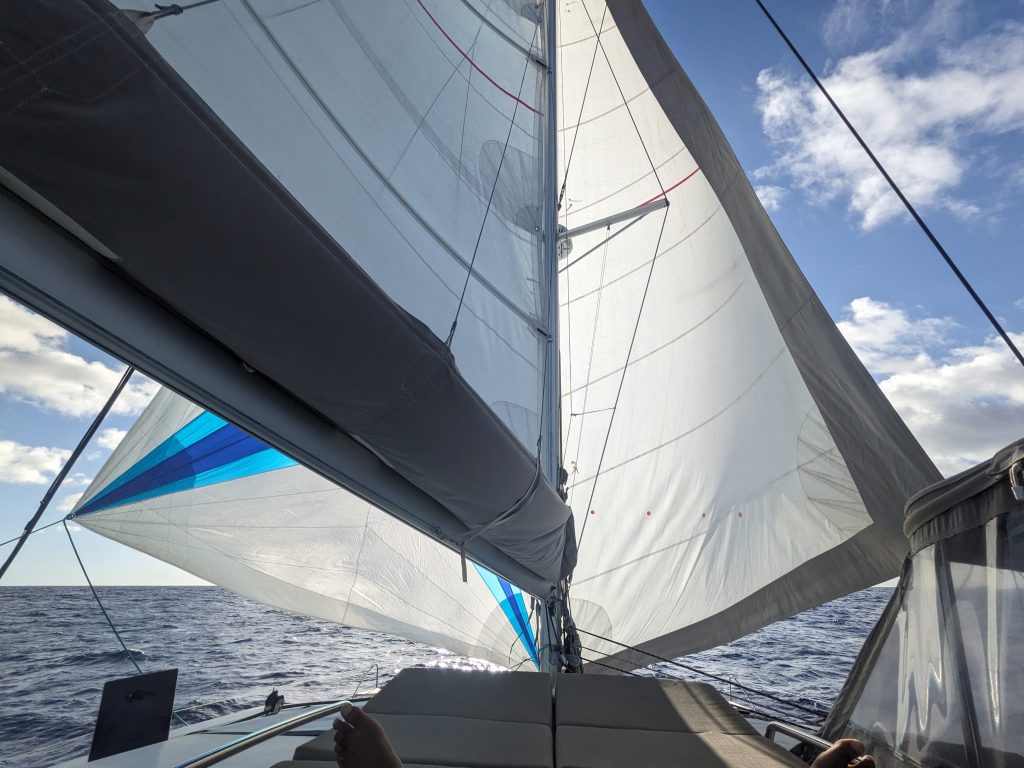
Image of a blue and white sail on a sailboat underway at sea
Flying that Code Zero

Well you have two basic options typically. Option one is to never change the clocks and watches on board until you are almost at your destination. Option two is to try to keep up with the time zones changing as you cross through them.

Option one, where you keep your clocks constant, is simpler. But then as you get further and further, the sunrise and sunset times will start to get strange. E.g. sunrise happened today around 6am. But if we hadn’t changed clocks since we left Gran Canaria, we would be seeing that the sunrise is happening at 4am then sunset at 4pm. And later we’d see a 3am or even 2am sunrise.

Option two where you keep up with time zone shifts may make more sense, but then you need to figure out when you’ve changed time zones, keep changing your clocks, and then figure out what the new times are for your day shift and night watches. On this boat we are using option 2.

When out at sea far from land, there is a nautical convention to determine time zones, related to your longitude. For every 15 degrees of longitude that you move west, the time moves back by one hour. So you can write out a table that tells you what the local time is compared to Greenwich, England time, based on ranges of longitude. Then when your logbook entry shoes that you’ve crossed into then next range of longitude, you know it’s time to change clocks again. These nautical time zones don’t always match up exactly with conventional country-based time zones, since most places prefer to not have one city span more than one time zone, for example. But the two time zone systems are close.

So there you have it– I know you were dying to know all of that detail 🤓

Yesterday was an amazing day of sailing! The sun was out, but it was not too hot thanks to the strong breeze. Waves were moderate in size, and coming directly from behind us so they gently nudged us along our course. And we were able to sustain a great pace of 5-7 knots (nautical miles per hour) on average.

Some crew members broke out cards for a game of cribbage, but I was on day shift so I kept with my celestial navigation studies while listening to the sounds of the boat cutting through the waves.

For dinner, I made a new recipe handed to me, called “Down Island Chicken Curry”. It uses an ingredient called “green sauce”, which is apparently very common in stores in the Caribbean…I guess you’re familiar with it, @Yohann ? Well anyway it is a quick & simple recipe, so dinner was on without too much trouble. (Sorry no pics of the meal, the plates emptied out too quickly 😀)

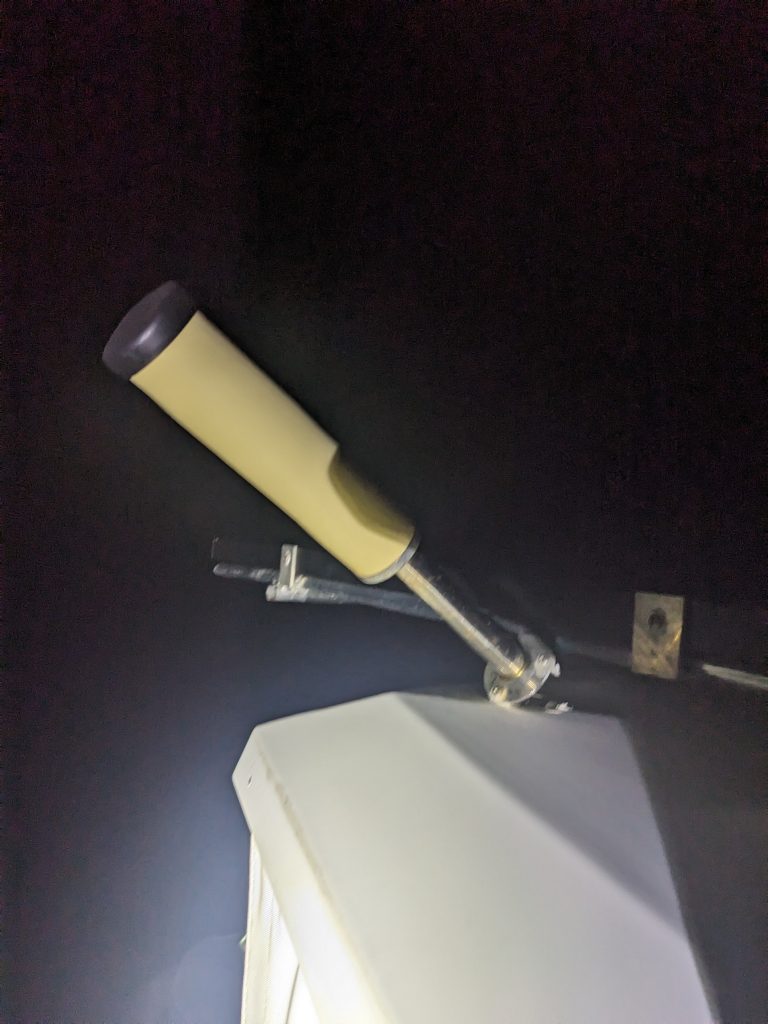
When my night shift started, I noticed that one of our rigging lines (ropes) had caught around the internet/cell phone network antenna, and had nearly ripped it off completely! 😱 Fortunately I noticed it before the mounting  screws had all fallen overboard. So I woke up the captain and we managed to screw the antenna back into place. That was a close call! 🙏🏾We had good winds through the rest of the night after that.

Image of an antenna coming off of its support mounts, taken at night
Antenna mounting which came loose in the middle my night shift

I woke up this morning to another beautiful sunny day, with winds moving well and an update that we have changed clocks again. Looking forward to another great day of sailing!

Here is our current location:

https://goo.gl/maps/Yznyichi6qLPGA2A7


Update 12-November

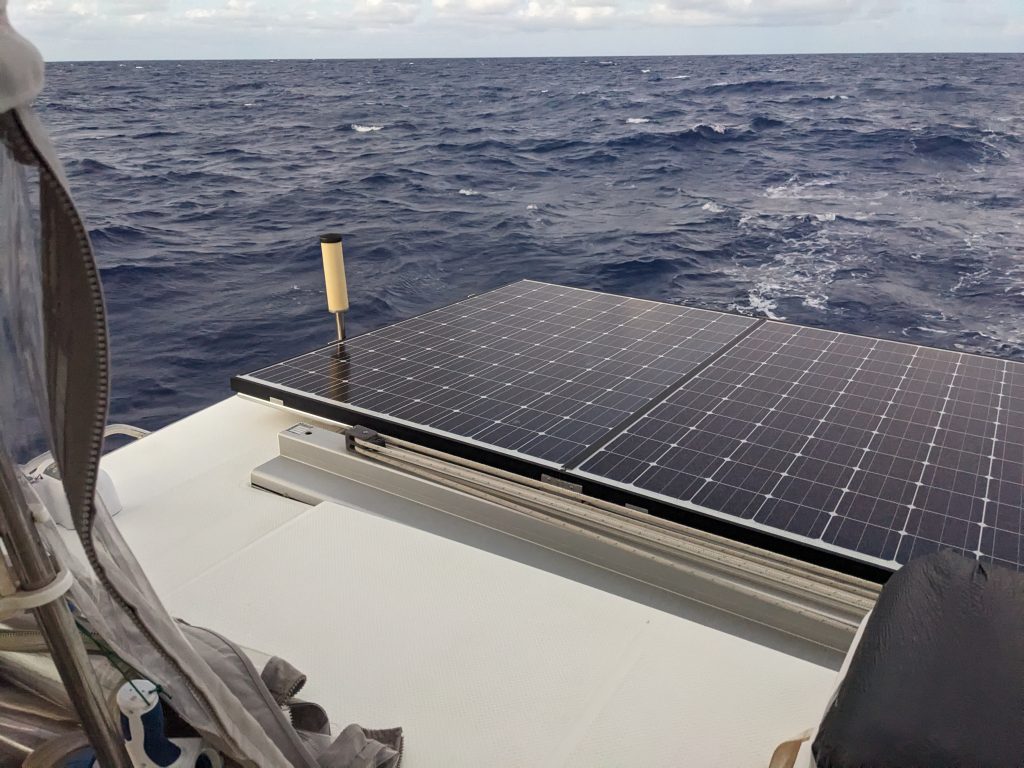
It is now day 12 of my planned 3-week ocean passage from the Canary Islands to the British Virgin Islands. At this point we are about 1,450 nautical miles west of the Canaries, and only 1,375 miles away from our destination. So I guess that means we’ve crossed the halfway point ? 🥳

Image of solar panel mounted on the stern of a boat, with an antenna sticking up on one end
The antenna repaired. Whew!

Yesterday was another great day of sailing! The closer we get, the more and more tropical it is starting to feel. So my long pants only come out for night watch these days, and my calves and arms are out for most of the day 😀

There’s plenty of time now in the day for me to make good progress on my celestial navigation course, so I’ve been spending a lot of time doing that 🤓

There is an “exercise challenge” we’re doing on board, to keep us motivated to stay healthy and fit. I am tied for last place 😥 due to my initial laziness…but I’ve decided to step it up so that if somebody else starts slacking off, I may have a chance. Loser buys drinks for the night once we land!

I normally like to do about 1 hour per day if walking as part of my fitness regimen. But in the boat that is not practical, so you gotta find some other way to get your heart rate up and stay fit. Enter our daily challenge: 50 push-ups (no knee push-ups for the fellas), 100 squats, 100 calf raises, 100 crunches, and either 2 minutes of planks or 100 hip thrusters/hip bridges.

Not my usual routine, but options are limited on the boat so I’m doing it 💪🏽

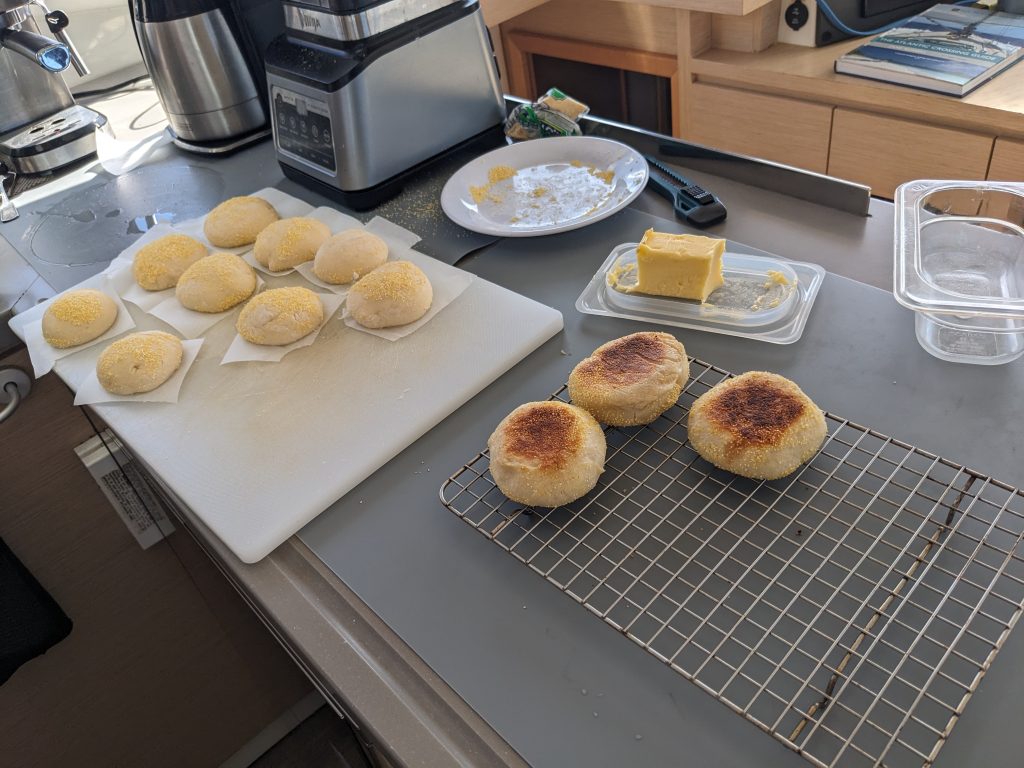
Nothing much more to report…captain made a beautiful set of English muffins from scratch, and night watch was routine except for a 10-minute downpour that got my hoodie wet.

Image of English muffins resting on a cooling rack
Success! Captain’s sourdough English muffins made from scratch

It’s yet another beautiful day out today, and we are flying our third sail again hoping to keep our speed up. 🤞🏾

Here is our current location:

https://goo.gl/maps/tHuXpQZSzwCTPb5V6


Update 13-November

Today is day 13 of my planned 3-week ocean passage from the Canary Islands to the British Virgin Islands. We are heading west in a straight path to Tortola, with about 1,250 nautical miles remaining to go.

Yesterday was an easy day, with great sunny skies. We hoisted our third sail again to catch more wind and didn’t take it down until sunset.

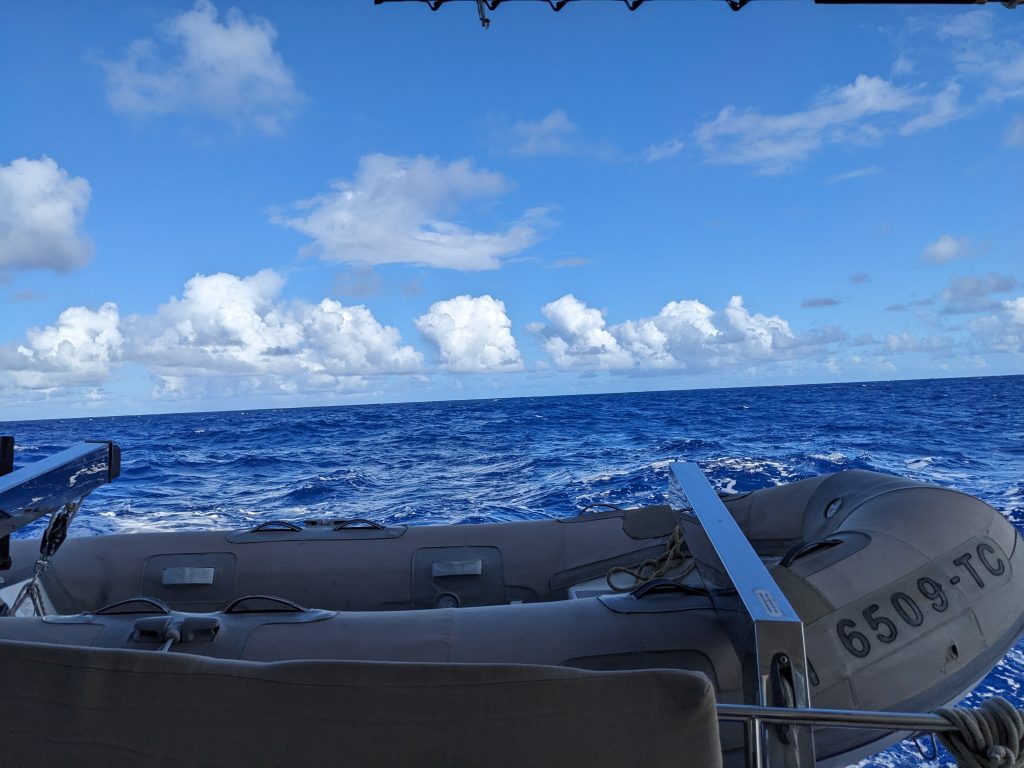
Image of the sea during the day with blue skies, taken from the back of a boat
Clear skies!

As we near the 2-week mark, I realized that the days are starting to run together in my mind…was that yesterday that we played backgammon? Or the day before? Did we cut on the engine yesterday? Can’t remember….I guess that is what log books are for 😀

During my night watch, I decided to start learning to identify different stars in the sky. I started with Orion which I know how to spot, then worked my way around to some of the brighter stars: Sirius to the left, Aldebaran of the Taurus constellation in the other direction and Jupiter below that. Not bad for a first night of stargazing…looking forward to learning more.

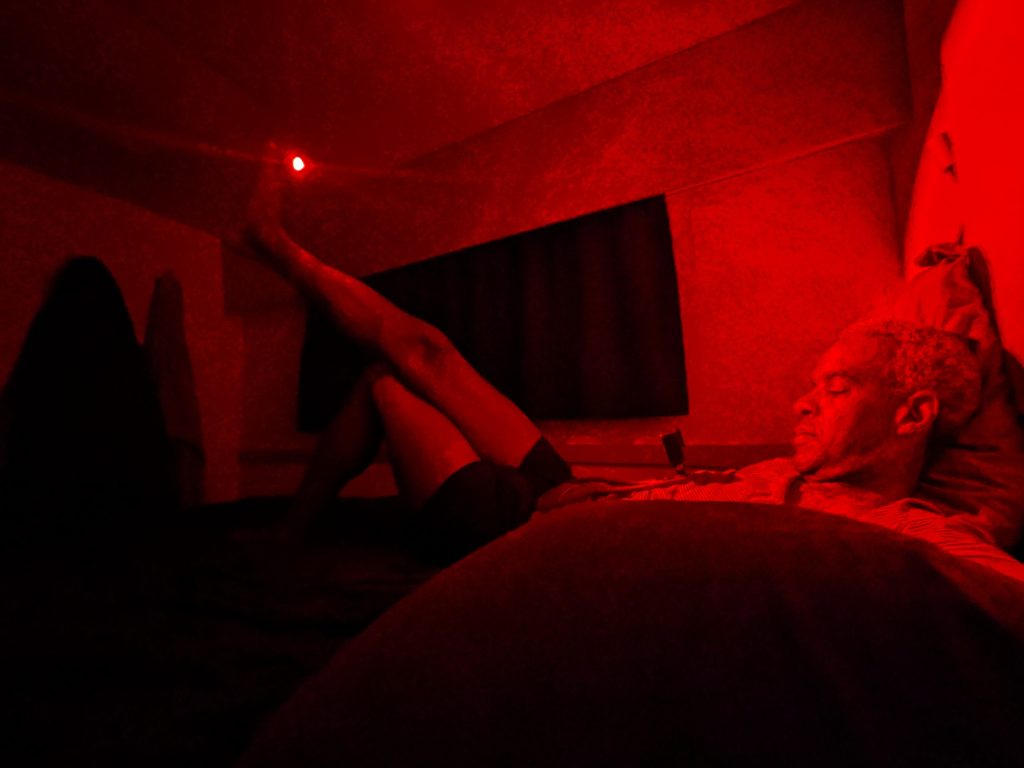
Image of man lying down in red light with a flashlight between his toes and camera on his stomach
What the hell…?? That’s me with my makeshift lighting setup for my post-night-shift video journaling 🙂

It is now late morning and pretty warm out. Winds have died down so we are now motoring, hopefully we will be able to get back to sailing before too long.

Here is my current location:

https://goo.gl/maps/nL4fT8D1BggvPADL9


Next Post in series: 2023 Atlantic Crossing Week 3 >>

Previous Post in series: << 2023 Atlantic Crossing Week 1

( Part of series: Europe to the Caribbean with Abundance, My First Atlantic Crossing )
2023 Atlantic Crossing Week 1

Note to reader: The below updates were originally posted to a group chat that I was using to keep my family and friends updated on the progress of my sea adventure.

Update 1-November

After following weather patterns the last few days, our weather window for starting the crossing from The Canary Islands to St. Thomas, US Virgin Islands starts today!

So the past two days we have been making preparations: food provisioning, refill of gas tank and cans, and various minor boat maintenance tasks.

The maintenance tasks:

  • Fix the leak in the water heater (for those nice warm comfy showers)
  • Remove all unnecessary equipment from the decks (nobody planning on doing any stand-up paddle boarding in the open seas)
  • Lubricate the sliding car used to raise the mainsail
  • Re-run the dinghy support line to prevent chafing
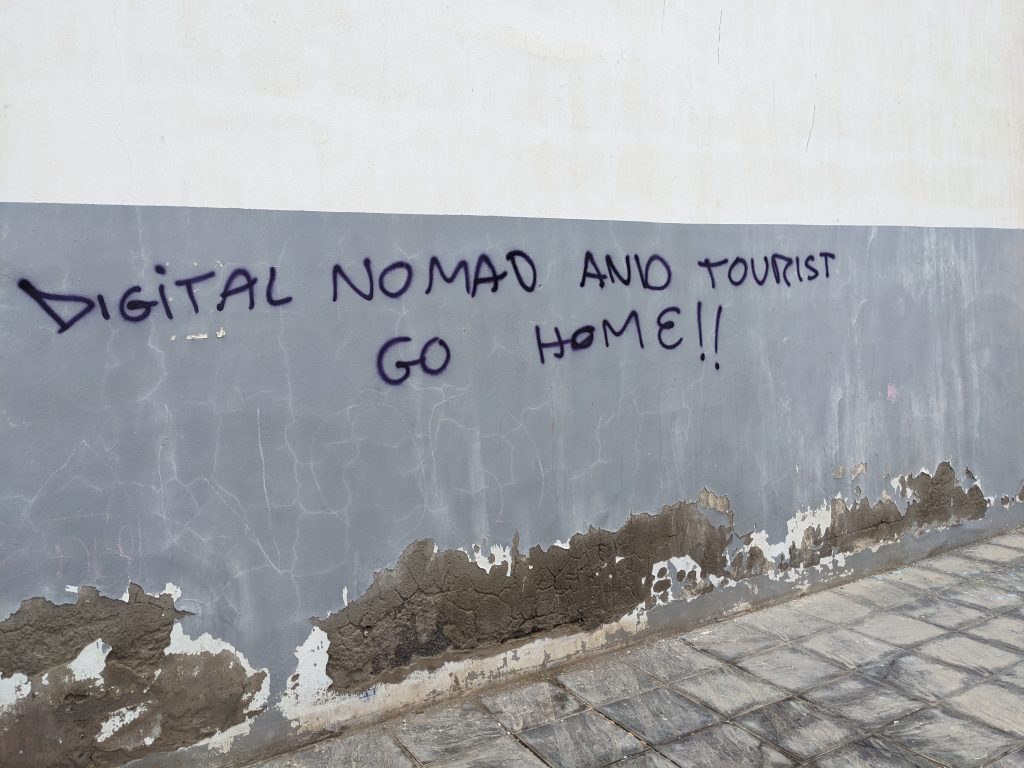
Image of a wall with graffiti reading "DIGITAL NOMAD AND TOURIST GO HOME!!"
Some of the locals seemed to be fed up with all of the tourist traffic on the island of Gran Canaria…

After all was prepped, we made one final shopping run before pulling up our anchor and starting our 3-week sea voyage to the Carribbean.

As of 11:35 AM on 1-November we have started our Atlantic crossing!

Here is our current location:

https://goo.gl/maps/pZMBj1KBAXZDeV3U8


Update 2-November

This is day 2 of my planned 3-week Atlantic crossing. We are currently sailing on wind power, heading west to southwest, targeting the final destination of St. Thomas, USVI.

Yesterday we left our anchorage in Las Palmas, Gran Canaria in the Canary Islands at about midday.

After we were clear of the harbor, winds were blowing pretty good! So we quickly put the sails up, shut down the engines, and started sailing.

Because the wind was pushing us from behind, we were able to put the sails out in a configuration called “wing-on-wing”. This is where the sail in front is on one side, and the mainsail is on the other side. In this way, the wind coming from behind literally pushes you forwards.

Image of sails out on a sailboat, in a 'wing-on-wing' configuration.
Sailing Wing-On-Wing! Two sails out in front and then the mainsail

The seas were very active, with medium sized waves moving us along from behind. If you’re not used to that amount of rocking, it can be a bit scary…but not to a salty sailor like your boy here 😎

When the waves come from behind like that, you get to “surf” the waves, where the wave lifts you up as it passes under, then the boat coasts down the wave as it continues on. We managed to get up to 11 knots when surfing down some of those waves! 🏄🏽🤙🏽That is almost as fast as we can expect to go in a boat of this size, in most cases.

After a dinner of beef tacos, we set about for our night watches. My shift is now from 1am-4am, so I was in bed by 8pm to try to get a few hours rest before my shift.

Night watch when you are sailing on wind power is a bit more active. This is because if you need to alter your course you can’t just turn the steering wheel — there are sails out that will not work if you turn too much in any direction. So you need to be vigilant to make sure the wind does not switch up on you, because if it does you need to react quickly or else you will slow the boat down to a crawl.

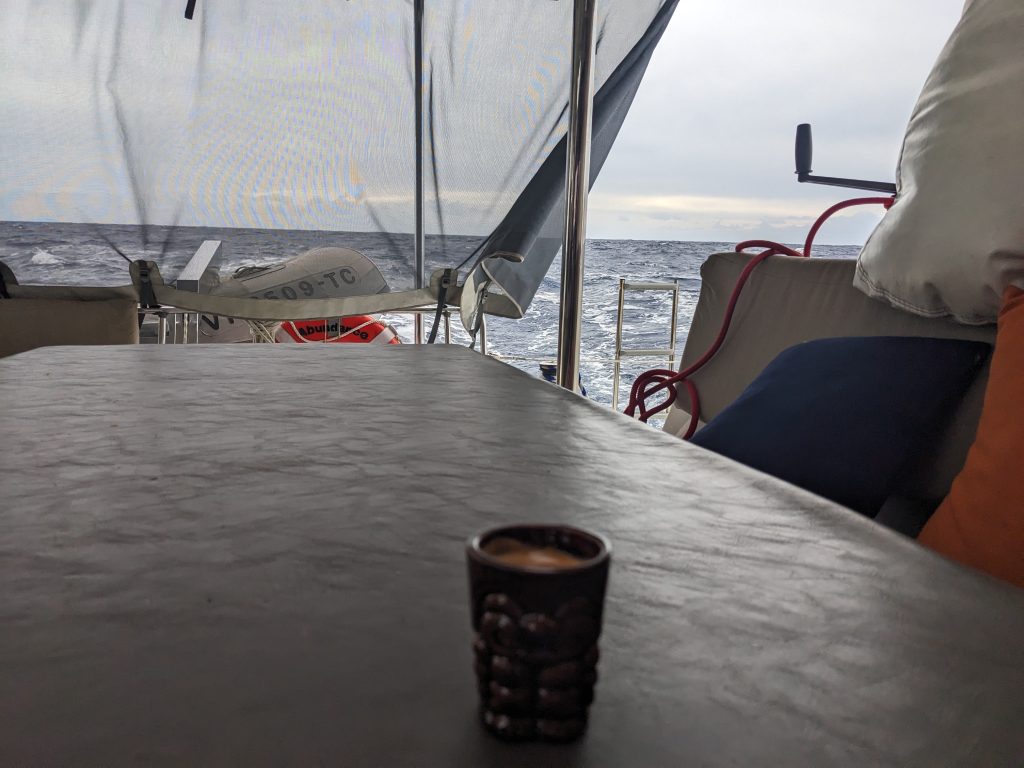
Imnage of a cup of espresso sitting on a table of a boat wohich is underway at sea.
Respect the ritual: my morning espresso

At the start of my night watch there was a mystery boat which did not appear in radar nor the AIS reporting system, which we had to figure out how to avoid a collision with. We managed it, but it involved untying and re-tying sails in the dark and a lot of maneuvering. A first for me, but I was able to represent and pull it off like I’m not new to this.💪🏽

It still is a mystery who that boat was, but our bets are on some sort of shady enterprise…why else would you be sailing the open seas at night with nobody able to see you on their navigation equipment?? 🤔

That’s Day 1 in the bag. Plenty more sailing to go, so I’ll be taking it one day at a time.

Here is our current position:

https://goo.gl/maps/hyAnA1i3mkce1AHC8


Update 3-November

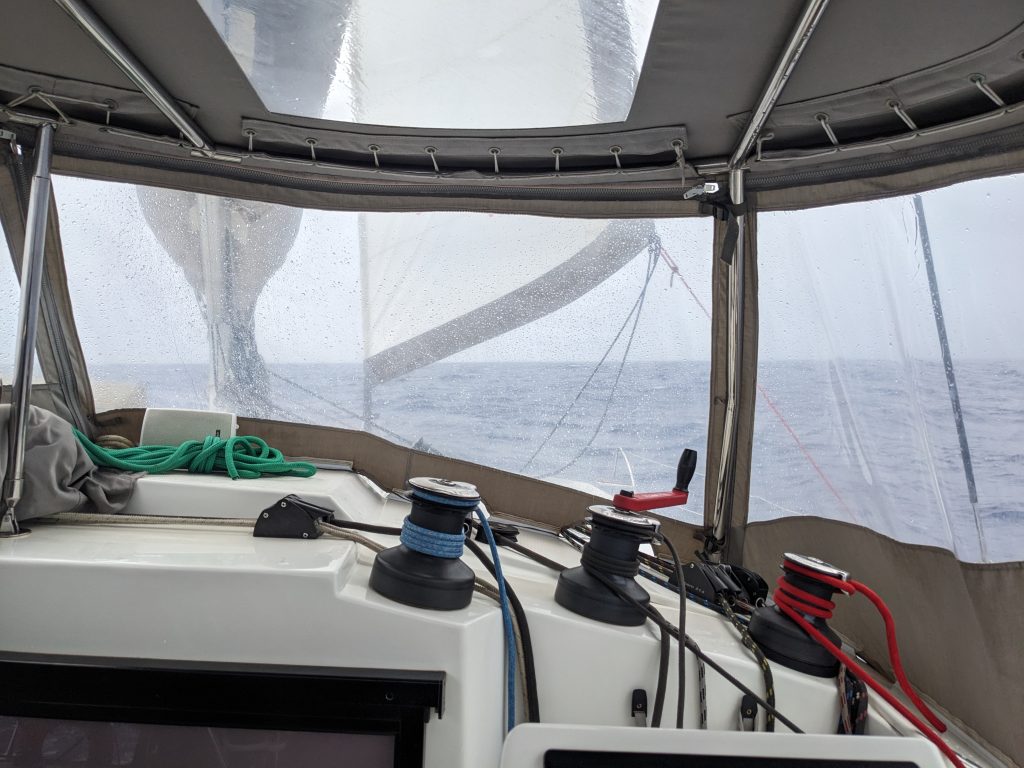
Image of the cockpit of a sailboat, with the winches and sail control lines visible, view of the sea out in front blocked by the cock[it covering, on which we can see raindrops.
Images from the cockpit: sailing in a bit of rain

It is now the start of day 3 of my 3-week planned ocean passage from the Canary Islands to St. Thomas, USVI. We are currently sailing on wind power, in a mostly westerly path in a direct course to our destination.

Yesterday was a good day for sailing. Skies were partly cloudy early on and it got clearer in the afternoon. We had a hot breakfast, since in a few days the seas may make it trickier to do serious cooking.

We were able to sail donkey’s ears (a.k.a. wing-on-wing)  all day, with the winds fairly constant. No high speeds, just a consistent steady course.

I volunteered for dinner duty, so I made some curried red lentils with rice and carrots. But that was a delicate process — with the boat rocking around, a simple task like boiling a pot of water can be dangerous! So how do you cook safely with the boat making huge sways back and forth and side to side? Very carefully …

Well to cook with one pot at a time, there are screw-in supports that can keep the pot securely in place above a burner. So that simmering pot of lentils is safe. But for that second pot? There is no magic there, the only strategy I came up with is the “stay close and don’t take your eyes off that skillet” method 🤣 I also paired that up with the “Gumby stretch and reach” method to grab a missing utensil while keeping one hand on that pan 🥴

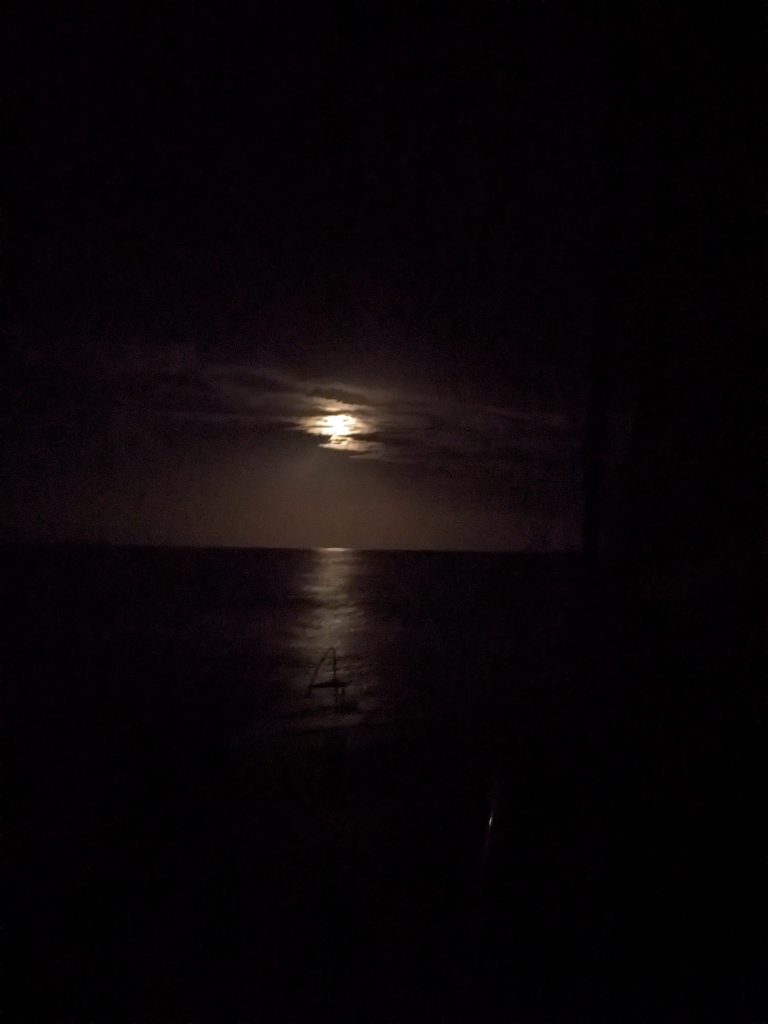
Image of a dark sky with the moon ahead
Typical view of the sea during night watch

But I got through the dinner cooking without spills or burns, so I call that a win 👍🏾

The night shift was calm and uneventful, no boats anywhere near us and consistent wind so no need to tinker around with the sails either.

As we get further west and further away from the Canary Islands and the west coast of Africa, I suspect the wind and wave patterns will start to stabilize, so that each day of sailing should become more and more similar to the previous day. Or at least that would be the desired conditions. But I’ll keep giving daily updates anyhow, to let y’all know we’re still doing well and moving forward.

Here is our current location:

https://goo.gl/maps/SZwrYc6L1RqbVEaK9


Update 4-November

It’s now day 4 of our 3-week planned sea passage from the Canary Islands to St. Thomas, US Virgin Islands. According to the GPS projection, we still have 2,450 nautical miles to go…so it’s still early days, but we are well on our way.

We are now travelling on an almost direct west trajectory. We have gone a few days now with the engines turned off, so that is great for fuel conservation. Ideally we would go the vast majority of the trip without firing up the engines at all, but that would also mean that if the wind dies for awhile, that we are okay to extend the trip’s duration by at least another full week. So it’s a balancing act we are playing to sail on wind power alone for as long as we can, without delaying us too much when the wind dies down.

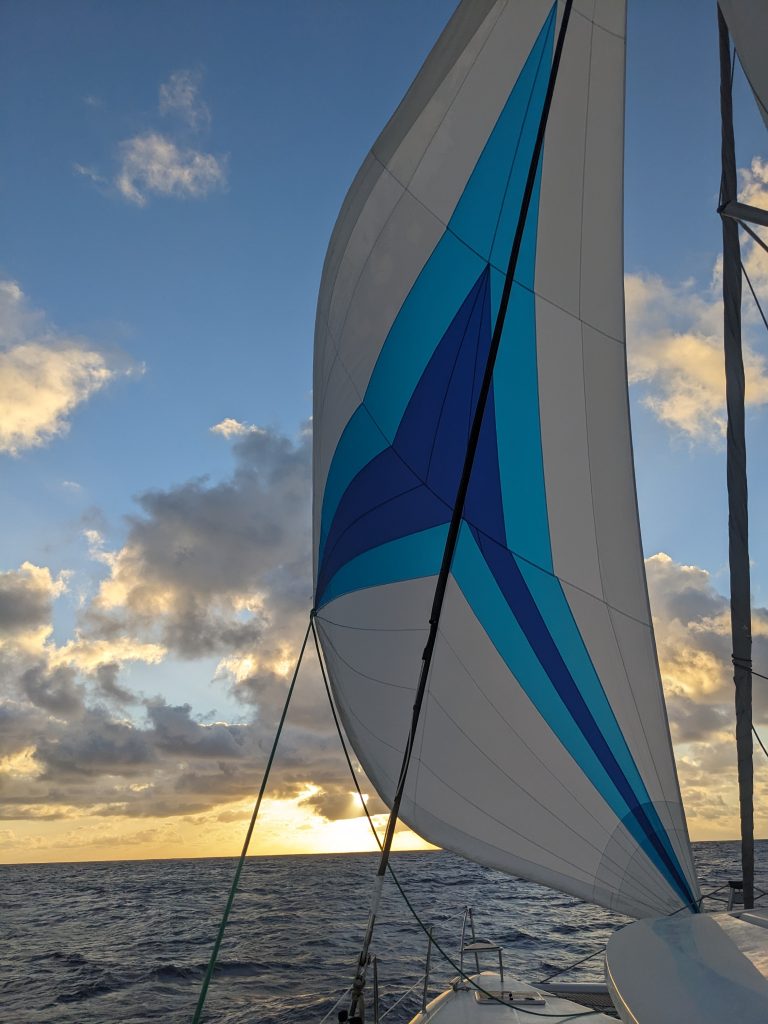
Yesterday was a cool learning experience because in the early afternoon the captain decided that we would raise our “Code Zero” gennaker sail. The winds had slowed a bit, and the extra large sail out in front could help coax a bit more speed in those conditions.

Image of a blue and white sail, hoisted on the bow of a sailboat underway.
Flying the ‘Code Zero’ sail

If you look at the common 2-sail “sloop” rig setup, you see one foresail (jib/Genoa) in the front, and one larger mainsail behind. This third sail, our “Code Zero”, is mounted on the opposite side of the Genoa. It takes a bit of work to install the roller furler support, hoist the sail to the top of the mast, and run the control lines to the back of the boat. But once we got everything rigged up, man did that new sail look pretty 😍

In the end we did not get as much wind as we were hoping with that third sail deployed 🤷🏽‍♂️. So after a photoshoot session involving everybody’s camera plus one drone, we dropped the Code Zero around sunset and moved back to our original sloop rig.

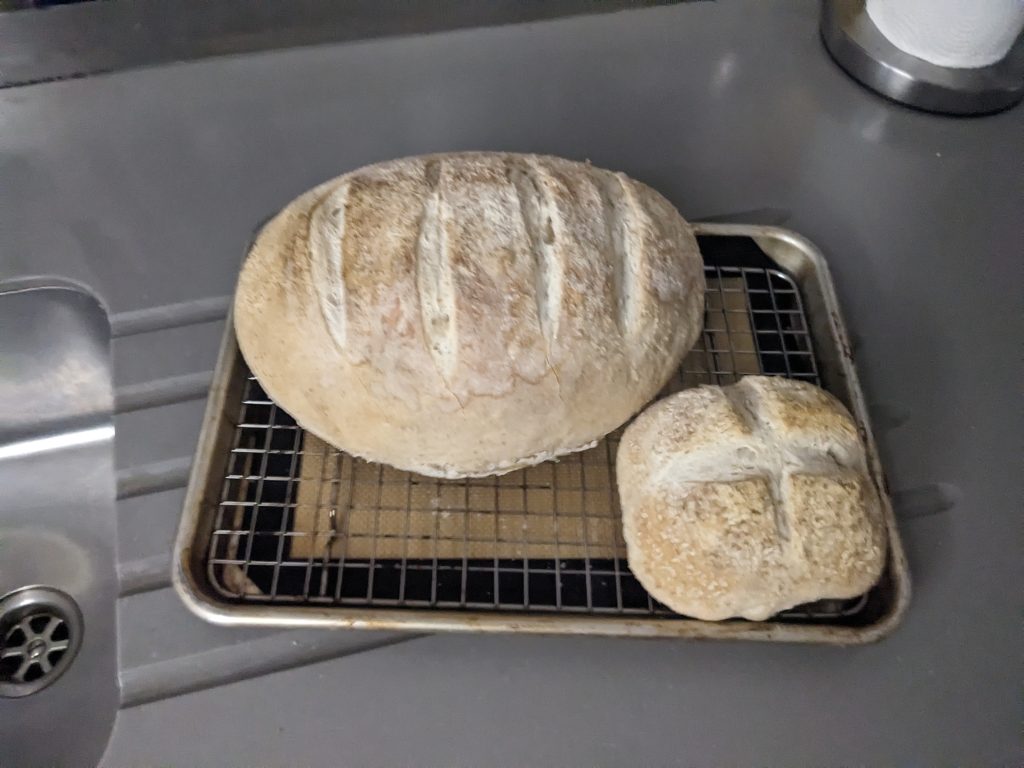
Between sail changes, I had been preparing a couple of sourdough bread loaves in the galley. If you saw me from 2013-2017, you will have seen that I was pretty obsessed with bread making back in those days. My first onboard attempt at bread a week ago was a bit lackluster, but this go ’round I managed to pull off an impressive pair of loaves! And this morning that bread toasted next to some eggs was pretty dang delicious 😋

Image of two loaves of bread resting on a rack.
Sourdough loaves baked from scratch

Night shift was calm, with pretty steady winds to keep us going at a good clip of around 6 knots on wind power. Hopefully this keeps up for days to come!

Here is our current location:

https://goo.gl/maps/BGLpNjWS2YmSH4mU9


Update 5-November

It is day 5 of our planned 3-week sea passage from the Canary Islands to St. Thomas, US Virgin Islands. We are currently sailing on wind power alone in a mostly westward course towards our destination. We are also about 420 nautical miles west of the nearest African shore.

Yesterday was a nice sunny day for sailing, with the tradewinds keeping us at a 6-7 knot boat speed — which is our ideal cruising speed to get us to St. Thomas as planned.

With our engines off, that cruising speed made it ideal for trolling, in other words, for putting fishing lines out. As long as the engines are off, the risk of getting line caught in the propeller goes away, so the captain decided to out our fishing lines out again.

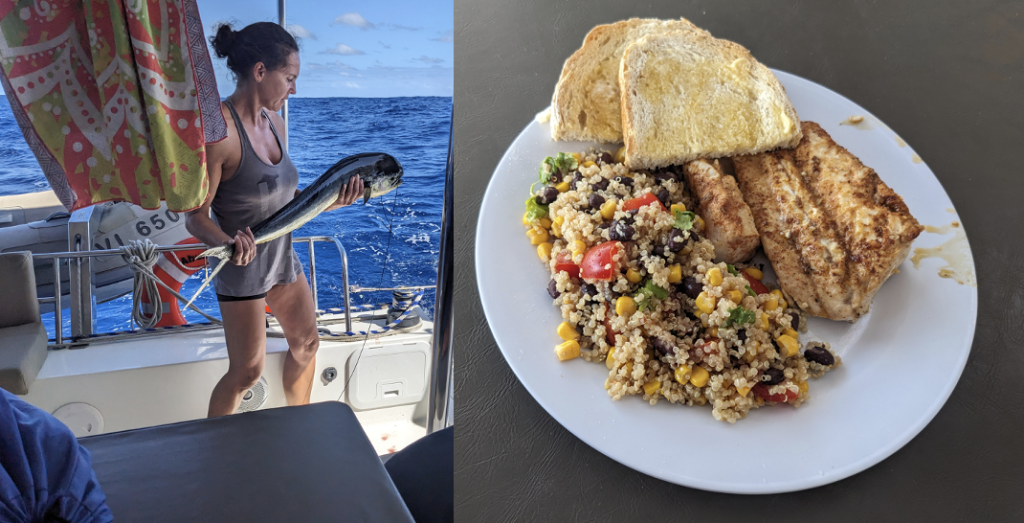
And after a few hours, we got a Mahi Mahi on the hook! First mate Vanessa reeled her in, and once inside the boat we were able to see what a beauty the catch was.

Image of a woman holding a large fish on a boat, next to a photo of a filet of fish on a plate with quinoa.
Sea to Table! Fresh mahi-mahi

That changed our meal plan for the day, of course, so we had an early dinner of blackened Mahi Mahi and quinoa salad — the other half of the fish fillets we put in the freezer for another day.

The fish was about as long as my arm! It was a big ordeal to get the fish cleaned, prepped and filleted, not to mention the work of cleaning up the deck afterwards … I’m pretty sure that if another fish caught the lines that day, we probably would have let her go to avoid all that work a second time that day 🤣

Night watch started off slow, with winds slowing us down to a crawl, but we sped up eventually and kept that up through the rest of the night. So we are going on 3-4 days now under way with our engines off — here’s to hoping that keeps up!

Here is our current location:

https://goo.gl/maps/s111NE5LfrRV9baQA


Update 6-November

It is now day 6 of our planned 3-week sea passage from the Canary Islands to St. Thomas, USVI. We are travelling in an almost directly west course towards our destination at this point.

We have been able to harness the tradewinds for the past 3-4 days now, sailing on wind power alone with boat speeds averaging from 5 to 6 knots (5-6 nautical miles per hour). We still have just under 2200 nautical miles to go, so an optimistic 15-18 days remaining if the weather conditions allow us to sustain this pace.

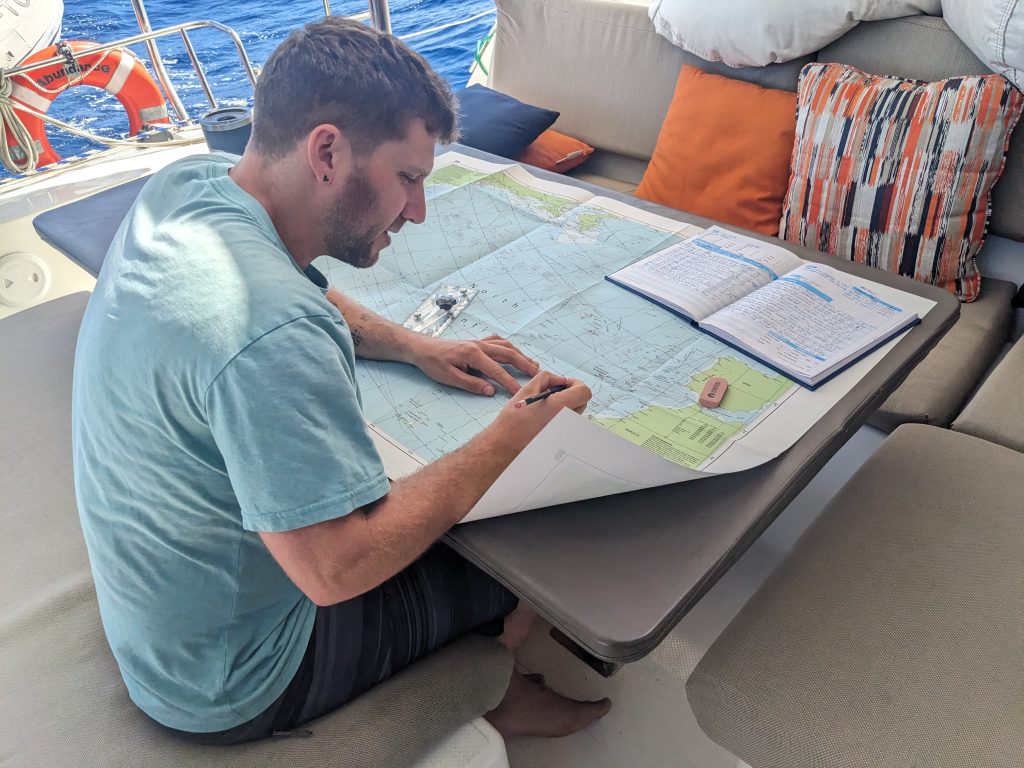
Image of a man seated on a boat at sea, plotting the boat's position on a paper-based nautical chart
Practice charting our progress on paper charts

With the winds so steady, the weather relatively warm and the seas (waves) moderately active, the day passes in a very relaxed atmosphere. This is of course thanks to the autopilot! 😃 Currently the waves are 5-6 feet high. But they are not waves craahing over the deck, they are more like large swells tha the boat rides as they roll through.

If you are steering by hand, keeping a steady course while riding waves that come at you from the back, sides, or at odd angles, is a lot of work! I know this because we were hand-steering for the first week of this sailing excursion, before Captain Blaine managed to install a new autopilot module back in Gibraltar. But the autopilot can handle all of this steering with ease, and does not get tired or complain about how long his shift is 🤖

That makes your day shift a lot more hands-off, freeing up the crew for other  important activities such as fishing, playing chess, reading, learning new languages à la Duolingo, studying for a celestial navigation exam, and working on your poker-face during the Texas Hold-em tournament 🤣

This night shift was the first one where the winds kept us going at 6-7 knots throughout the night — with these speeds in that wind it feels like you are zipping along very fast.

It is a sunny day today, I’ve had my morning espresso dosage, and the winds have not let up on us yet. Onwards!

Here is our current location:

https://goo.gl/maps/9AyJAvtmvkBLbk9m7


Next Post in series: 2023 Atlantic Crossing Week 2 >>

Previous Post in series: << My First Atlantic Crossing

( Part of series: Europe to the Caribbean with Abundance, My First Atlantic Crossing )
Europe to the Caribbean with Abundance

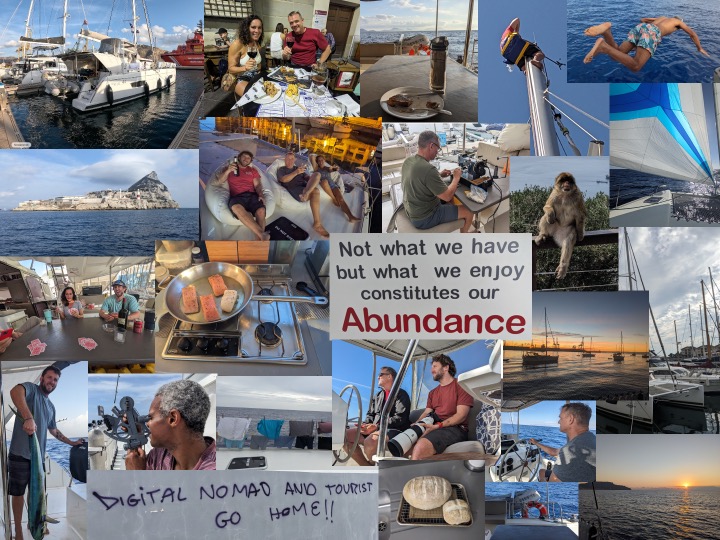
Collage of various photos taken of a sailing adventure
Great adventure, great memories!

Posts in this series (legs of the trip)

  1. Cartagena to Playa Cala de Enmedio
  2. Playa Cala de Enmedio to Las Roquetas De Mar
  3. Las Roquetas de Mar to Gibraltar
  4. Gibraltar to Tangier
  5. Tangier to La Graciosa
  6. La Graciosa to Las Palmas
  7. My First Atlantic Crossing

How did this come about??

My wife and I had been discussing our plans to start sailing in the Caribbean, when she hurt her ankle and so was “grounded”, so to speak, for a few months. We said that it could be good for me to get out and go sailing anyway, if I could find a good captain or crew or opportunity.

I connected with a captain who was in Spain and looking to get his boat all the way back to the U.S. Virgin Islands, in time for the sailing season to kick off (he captians professional charters there in the high season).

He agreed to let me join his crew, and I agreed to accompany him on this 2-month long sailing excursion.

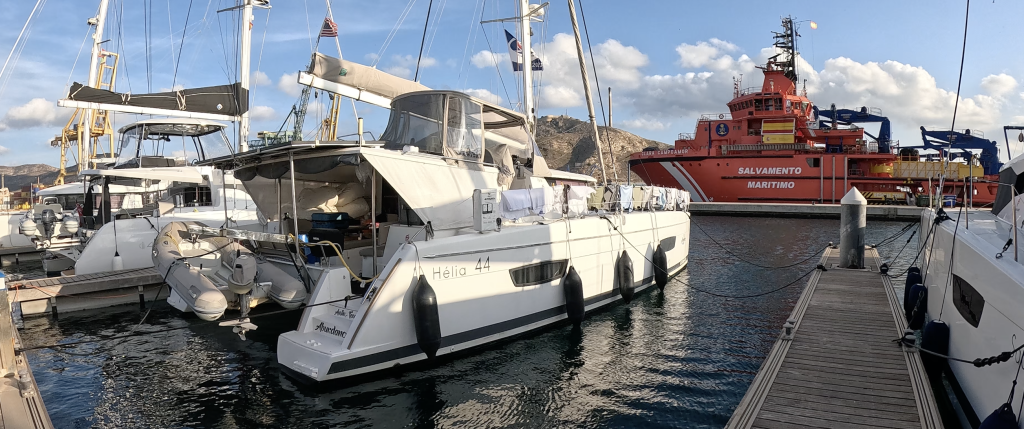
In the end, I boarded his boat, s/v Abundance, in Yacht Port Cartagena, Spain, and did not part ways with his boat until we landed safely in the Virgin Islands.

Image of sailing catamaran in its marina slip, with red commercial vessel in the background
Where my adventure began: Yacht Port Cartagena, Spain

What was the actual journey??

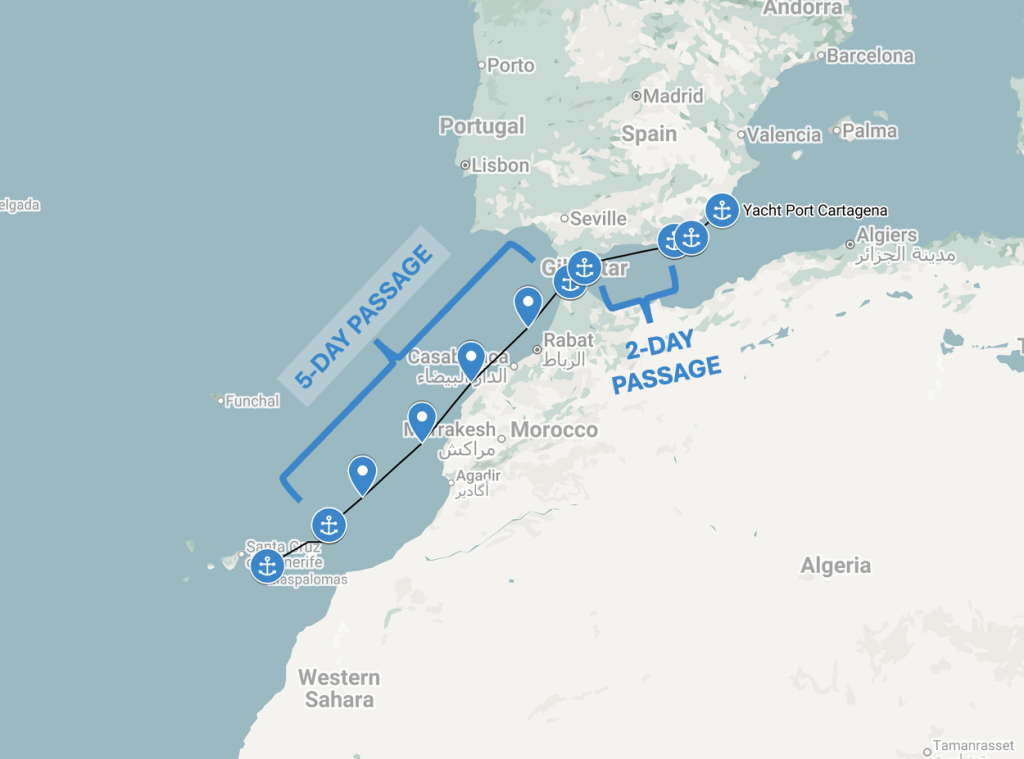
The trip had us sailing down the east coast of Spain all the way to Gibraltar, then across the Strait of Gibraltar to Tangier, Morocco, then down the west coast of Africa to the Canary Islands. From there, once we found a good weather window, we embarked on the final leg of our trip: a 3-week Atlantic crossing ending in the British Virgin Islands (BVIs). I boarded the boat in Cartagena, Spain on 10-October-2023 and we arrived in the BVI’s on 23-November-2023.

This was my first time doing an Atlantic crossing, and in fact my first glimpse into what the “live aboard” lifestyle is really like. All in all it was a great experience and humbling adventure.

My wife and I started a WhatsApp group chat with friends and family, and as the trip progressed I posted updates to the group chat almost every single day. I’ve collected all of the updates and consolidated them into the above posts, which serve to document the journey. Happy reading!

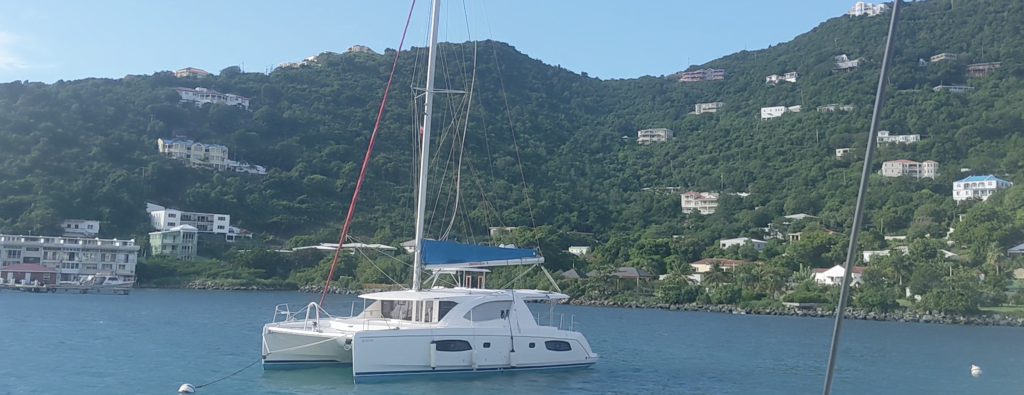
Image of sailing catamaran moored offshore, with green foothills in the background.
Final destination reached: moored in the Caribbean

Maps of the Sea Passages

Passages: Cartagena, Spain to Canary Islands via Gibraltar and Tangier, Morocco
Passages: The Atlantic Crossing– Canary Islands to Tortola, British Virgin Islands

Next Post: Cartagena to Playa Cala de Enmedio >>

2023 Greece Flotilla Part 2

Day 6 (Thursday)

This is the 2nd to last day on the boat. The plan for the day is to head back towards Poros, and raft up for the flotilla’s last night out at sea. We started out and crafted a plan for a race, and in the end it was us against another sailing catamaran from the flotilla. I was at the helm by then, and so captain and I did our best to keep a tight course and keep the sails full. We also needed to keep fairly close to one another and maintain a steady heading, so that the videographer would have a chance at some cool shots and clips. I was able to sail on an upwind course for a good long while, providing the crew with beautiful views of Hydra on our starboard side. As we started to slow down finally, captain fired up the motor so we could head over to our anchorage destination just past Poros. 

The main learning point here was that with a cruising catamaran not set up for performance sailing, the sailing experience is nowhere near as exhilarating as on a monohull. In the monohull you can sail on a course much closer to the opposite direction of the wind (sailing directly into the wind is impossible), so the racing sensation is that much more hieghtened in a monohull. Plus the monohull’s heeling angle also adds to the excitement, as the crew piles on the windward beam of the boat to balance it out. Since you cannot sail as close to the wind in a catamaran, the speed sensation is less intense. Because you have a wider angle to the wind on a catamaran, that makes it even harder to perform a full tacking maneuver under sail power only– much more ground to cover to get the bow through the wind and enough angle on the other side to prevent the cat from getting “into irons”– that is when you try to tack, but are unable to swing the bow all the way across, and the boat slows and sails luff because the boat gets stuck facing directly into the wind. If you don’t mind using the motor a bit though, on a cat gettbng out of irons is quite simple– a quick jolt from the port or starboard propeller swivels you around enough to fill the sails up. This is obviously not an option fo racing, but while sailing leisurely it is a nice compromise to keep the sailing fun. 

IALA-A vs. IALA-B: Guess they weren’t lying!

As we motored through the channel on Poros harbour, I got the visual reminder of the IALA-A system and how in Europe the color-coding of channel markers is opposite to the IALA-B system used in U.S. waters. In the U.S., you lean the mnemonic “Red, Right, Returning”, which means that as you are entering a port, you must ensure that you are keeping the red-colored channel marker buoys to your right, if you wish to remain safely in the channel. Well, clearly in Greece this does not hold, and you see that red buoys need to be kept to your left to remain in the channel. Cool!

Just 20 minutes oir so more of motoring brought us to the raft-up, and so after tying up we all let ourseves go for a biut and had a great night!


Day 7 (Friday)

Aww, so sad to know that this is the last day of the Greece flotilla week. The night before, I had a chance to catch up with one of the captains who was also an experienced instructor, and I lamented to him how even though I made it all the way to ASA 106 certification, I never had any practical experience reefing. He told me that since Friday was an upwind cruise it should be easy for our captain to put hoist the mainsail and put me through some reefing drills. Great! I made sure to mention my request to our captain in the morning, and he said “sure!” 

The plan for the day was simple: late start, stop around 2PM for a swim, then pick up anchor and head back to our starting marina. We had a nice and easy motoring up to our anchoring point, and with our Mediterranean moor in place we swam. Wifey asked me if I would go with her to untie the mooring line when it was time to go, and I sad “sure!”. it all went smoothly, until I got a bit too over-zealous with my aggressive swimming back to the boat with the mooring line– I did not keep a safe distance from the boat, and with too much line swinging around I got a glimpse underwater of the RUNNING port-side propeller! At that point I started to realize that I was in some danger, but the captain fortunately noticed and got the motor off. So I was safe, but it was clear that I managed to get the mooring line caught in the propeller. Captain handed me a mask and snorkel and said (nicely) get to cleaning that line! It wasn’t too hard at first, except for my extremely limited lung capacity– with 10 wraps around the propeller it took me 1-2 tries per wrap to get it all untangled. Well at least I was able to clean up my own mess. With the line cleared, we were quick to get out of there and finish the last leg of the flotilla week. With 1 1/2 hours left in our trip, I reminded the captain about our reefing drills. He said yeah thanks for reminding me! Let’s get to it. 

REEFING

So reefing, in concept, is pretty straight forward. There are three points in the sail, both at the front and back of the sail, at different heights. These points all have re-inforced rings in them, where lines can be threaded through, If you have prepared reefing lines before getting under way, then the reefing line is tied to the back of the boom, run up thed back side of the sail to the first reefing point, run back down to the boom, through a block (pulley), and run along the boom to the tack if the boom / mainsail. The reefing line then goes up the front of the sail to the first reefing point, then back down to the clutch where it is secured. Two other lines are then run similarly for the 2 other reefing points. 

With the reefing lines all set up, now when it is time to reef, the procedure is as follows. First, if you have not yet started sailing, point the bow into the wind; if uyou are already sailing with the job out, then let out the mainsheet to allow the mainsail to luff. Next step, put the halyard on the winch, and east eh halyard to drop the mainsail until the first reefing point of the sail is almost at the boom. As the mainsail is lowered, the reefing line will go slack– so as the mainsail is dropping, it is ideal to pull in the slack of the reefing line at the same time. Once the reefing point at the front of the sail is almost at the boom, there will most likely still be slack in the back of the boom– so here pulling out the slack of the reefing line by hand is the most efficient way to get the slack out of the reefing line. With the reefing line now tight, east the halyard a bit more until the reefing point is squarely at the boon, and now do a final tighening of the reefing line to get the line taut — being mindful of the tightness of the reefing line both at the front and also at the back of the sail. With the reefing line now secured, the final step is to put the halyard back on the winch and slowly raise the halyard to remove any slack and/or luffing at the front of the mainsail. Now you can fix your heading and trim the mainsail as needed. That’s it, you’re now sailing with one reef in the mainsail. It would also make sense to reef in the foresail / jib — this is simple in most cases, just haul in the jib furling line a bit so the job exposed is smaller. Now you can adjust sail trim and get to sailing. Now mind you, you have only put in a single reef at this point– if you need to reef more yiou repeat the process for the second and third reefing points. Is it possible to skip the work of the first two refs and start reefing directly with thr 3rd (topmost) reefing point? The short answer is yes. The only problem with that is that once you’ve put in that 3rd reef, since you never hauled in the slack of the other two reefing lines, you’ll see that you now have one or two looping reefing lines hanging down, both at the front and back of the boom. Not only is this poor seamanship, but depending on ho the slack lines are swinging they may also be a hazard. So use the quick reefing method at your own risk.

TAKING THE REEFS OUT

Okay! So you are sailing with a reefed mainsail and foresail, but now the wind conditions have changed and the wind has died down, and now you need to remove the reefs. At a high level, again the concept is simple– raise the mainsail back to its full height while letting out the reefing line, until the full sail is out. The first step to removing the mainsail reef is to let out the mainsheet until the mainsail is luffing freely. Now let out (ease) the reefing line– if you don’t do this, the main halyard will never be able to raise the sail up. With the reefing line eased out, now put the halyard on the winch and haul in the halyard to ease the mainsail. As you are raising the halyard, you need to continue easing the reefing line so that it does not block progress. Once the sail is raised up to its full height, now haul back in the reefing line to remove any slack left. With the reefing lines tidied up and the mainsail up, you can now get back to your desired heading and get to sailing again. As a final step, if you also reefed the jib and didn’t let it all the way back out, let out the furling line to get the jib all the way out. Now trim the sails and get to sailing!

THE TRAINING SESSION

It was only me and the captain participating in the reefing drill– so it was like a private lesson. I can explain it well now, but when he asked me to guide him through putting in the second reef, I froze up and struggled through whether to start with the halyard or reefing line. Now that it is clearer in my mind, I should be able to execute the reefing without too much trouble. Thanks for the lesson, captain!

BACK TO THE MARINA

After the drill, the rest of the way home was upwind, so we dropped the sails and motored all the way back to our starting marina. A smooth docking by our captain, and our sailing adventure was brought to an end!


FINAL THOUGHTS

This was my first tine participating in a flotilla, and also my first time sailing in Greece, and also my first time serving as crew in a catamaran. 

How did I like the flotilla? 

The social aspect of it is great– you get to meet and interact with lots of new people at various stages in their lives, and you get some great conversations and connections that way. In general, the flotilla’s main priority is to provide a fun week for the paying participants. So if there is a desire to get a lot of swimming/snorkeling in and also some pressure to see a few key sights like Hydra and Spetses, then sailing can become a sort of ‘nice to have’ feature– great if we can get in a great sail or two, but sailing can take a backseat to getting to the next destination at a reasonable hour. Granted, in a self-guided bare-boat cruise, you will certainly be confronted with similar dilemmas– I’d love to sail to the next spot, but we won’t get there before dark, or before the good moorings are all taken up. Wifey and I agreed that the flotilla was a great experience, but next time we’d opt for a more sailing-centric excursion like a performance sailing week, or otherwise some sort of regatta. 

What did I think about sailing in Greece?

Well it was my first tropical island-type of sailing excursion, so it was very different from what I grew accustomed to sailing in Galveston Bay and the Gulf of Mexico. First off, all of the dockings, whether in a marina berth or anchorage, were all stern-to– in other words you back the boat into its parked position. Next, anchoring was always done with a Mediterranean moor. Both at marina berths and also at anchorages. At marinas, the moor makes sense because there were not individual berths– so an anchor out at the bow is the only way to prevent swing when he boat is perpendicular to the dock. At cove-like anchorages, the mooring lines secured to the shore are more for comfort and safety– it’s simpler to swim when you know that the boat will not be swinging around. Also the boat will be much more stable when you’re trying to sleep. The last thing about sailing in Greece is the swimming! Ain’t nobody getting in the water to swim in Galveston Bay or even the Gulf of Mexico, for that matter. But the water is so clear, warm, and inviting that you cannot resist jumping off the boat for a dip in the sea. 

How did I feel about cruising in a catamaran?

Well without a doubt, in the comfort area the cat wins, no debating that. Huge salon area, kitchen bigger than any apartment I’ve ever lived in, and each of the four main cabins with a double bed private toilet and separate private shower. All monohulls I’ve seen have a shared head and shower, and if you’re lucky one en-suite head for the captain’s quarters. Also there is so much outside area to lounge in– up front on the nets, on the foredeck lounge sofa area, behind the cockpit in the upper deck, and of course at the stern in the dining area where there are multiple cushioned benches to lounge in. Wow! Compare that to a monohull, where if you are not belowdecks your only options are crowding in the cockpit at the stern, or else sitting near the beam with your legs hanging off the side if the boat. No comparison! For me though, it is quite a huge vessel, even at 46 feet in length. To cruise around with that level of comfort, I would seek out a smaller boat that has the same private head & shower cabins.

As far as sailing goes, the monohull for me wins in all areas, except for maneuvering under power. I did not helm any docking or anchoring on this flotilla, but it did seem to be a lot more convenient to be able to spin the boat at will via the port and starboard propellers. Other than that, sailing in the catamaran is a lot less rewarding for my taste– at least in a catamaran built for cruising and not for performance. Maybe if I join a racing crew with a catamaran, I might feel differently about sailing the multi-hull. So to wrap it up, as a day sail, I wold opt for a monohull– I get the exhilarating upwind heeling, and can sail more on the upwind courses. But if the wife is coming along for a multi-day cruising adventure, it is hard to argue against the comfort of the catamaran. 

So there you have it! Many thanks to Vagabonde Adventures for organizing the flotilla!

— FIN —


Previous Post in series: << 2023 Greece Flotilla Part 1

( Part 1 of 2 in series: Vagabonde 2023 Greece Flotilla )

2023 Greece Flotilla Part 1

DAY 1 (Saturday)

The starting point for the Greek Flotilla organized by Vagabonde Adventures is Agios Kosmas Marina, on the west coast of Athens. The taxi from our hotel near the Acropolis took 30 minutes, and we got dropped off at what looked like a nondescript marina. We waited for awhile until folks from our flotilla started to show up. Wifey and I brought one big duffle bag, which next time we”ll definitely bring 2 smaller sacs– the huge duffel is hella cumbersome.

The boat, once we boarded, was pretty big — a Lagoon 46 catamaran. We let the two other couples choose their cabins, then took what was left– the port side forward cabin. Private shower and toilet, so not too shabby!

Our captain is 25 years old abd looks crazy young. Also our chef is a young lady. But when it was time to get under way, it was clear that with our captain we were in good hands — and our cook is also is a great first mate!

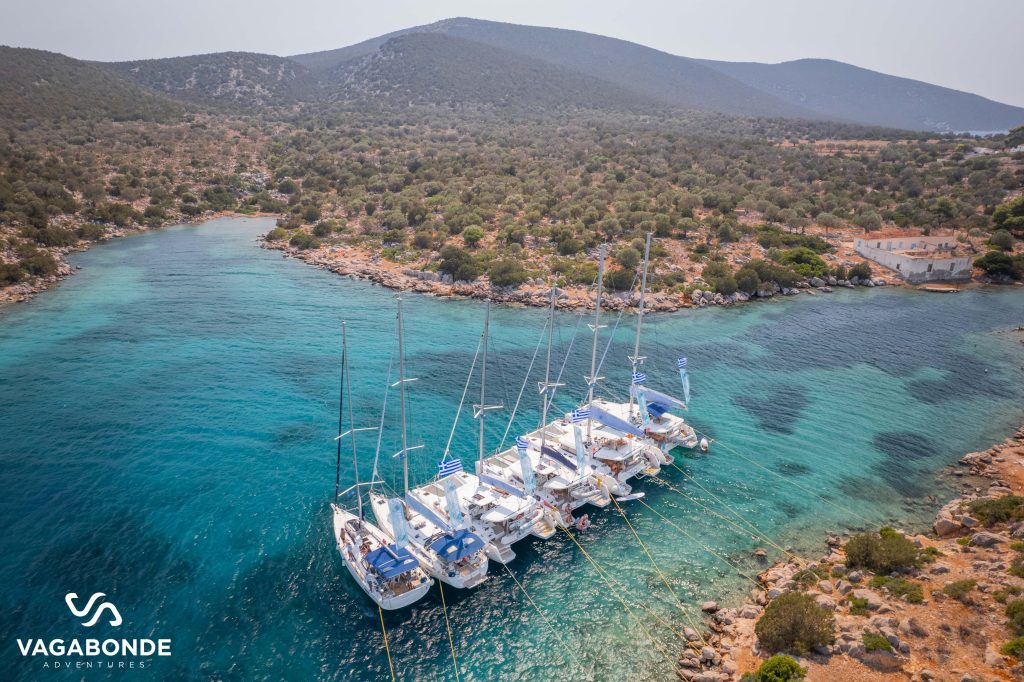
It was a bit odd to leave the marina in Athens at 5PM, but it was okay for us bcause we left with plenty of sun and wind, and the trip was under two hours. We stopped and anchored in an anchorage, where we could jump off the back of the boar and swim, both at the end of the evening and also in the morning. Sailing there was fine, mostly motor-sailing, but we did shut off the motor for 5 minutes or so to sail. But since we were in a hurry to get a good spot in the anchorage, we motor-sailed the rest of the way in. Anchoring in was cool, because as I learned it was a “Mediterranean mooring– this is where you drop anchor, then back into the anchoring spot stern-first, and then somebody runs a line or two from the stern to a secure tie-in pount such as a mooring post or heavy boulder. Our lady chef swam the line to the shore in a Stand-Up Paddleboard, it was cool to watch!

Dinner on board was great, it was a Greek spinach and rice dish called “spanakorizo”. When it was time to get to bed, the bed was roomy enoughj to fit us both comfortably– it is just perhaps a biut warm, until the cool breeze rolls in around 2-3 AM. Fine start to the flotilla!


DAY 2 (Sunday)

We woke up to a good breakfast and french-press coffee. After a quick swim we slipped the mooring lines, lifted anchor, and headed over towards Poros. We mostly motor-sailed so that we could reach the harbor before all of the cheap docking areas were taken up. There was a bit of drama at the dock: we flubbed out first stern-to docking, abnd while we were resetting for a second try, a Spanish-speaking boat tried to park adjacent and and also was un-successful. The funny thing is, though, as we backed in for our second attempt, the Spanish group got all pissed, like “Can’t you see we are parking here!!! Get out of the way!!!” As if they were here first…smh. Well anyway they were nearer the dock so we had no other choice but to let them finish before we finished our docking. Our second docking attempt was fine, and we had a nice lunch before going land-side for a stroll along the cobblestone boardwalk.

A shot of espresso for me and a smoothie for the wife gave us a jolt of enrgy for our stroll. I learned in the morning that my swim trunks no longer fit (I lost 15 pounds this year), so on the shopping list were swim trunks and a phone charging cable. I settled on a pair of hoochie-daddies for the trunks, I figured after 40 years of knee-highs, a change wouldn’t hurt. Jenn started to feel a bit under the weather, so she decided to go rest while I wandered around a bit more in town. Wile she was out I picked up a small Canadian flag, the type that you fly at the back of the boat (wife is Canadian). Back on the boat, we shared a quick aperitif with our crew, then after a wardrobe change we were off to dinner.

Dinner was fun, we met our full flotilla that evening – six boats total. Some of them I met at the dinner, and others at the after-party at the bar. I made it back to the boat at 1:30 AM, wifey had already left before the after party started. I managed to ninja my way to bed without waking her, but then of course I managed to elbow her in the eye an hour later so I screwed that one up. Doh!


Day 3 (Monday)

Since our boat prefers anchorages and swimming over dockings at the ports, we shoved off early and alone to a nearby bay, moored up and were able tto swim a bit and have breakfast before picking up anchor and starting on our way to Ermione. WOW the wind was gusting up to 30-40 knots! Sailing was exhilarating and fun, but I’m glad we were in the capable hands of our captain. We had all reefs in the mainsail for safety, and we sailed mostly downwind to just before the harbor. The harbor at Ermione was CROWDED!! There were no places to park, so our captain told me to ask the boat docked parallel to the  at the marina if they could move their boat back 6 feet so we could park in front of them. Well the guy spoke French, so fortunately for us I was able to be of use– I don’t think our captain had any idea that I spoke French 🙂 After some negotiation and back and forth, the Belgian frenchie actually agreed to let us “raft”up next to him. Amazing! This docking was extremely difficult due to the 20 knots or so of wind blowing off the dock. But our captain made it, and once secured wifey and I chatted up the captain in French to make sure he was okay with us tied up to him. He was cool, so great! 

One of the other captains needed to take a dinghy out to help the two bare-boaters with their anchoring, and I agreed to tag along in case she could use an extra hand. So we motored off in the dinghy to the monohull skippered by Ollie. The captain has two main questions for the crew: (1) How much anchor chain did they let out, and (2) how many RPM’s did you reverswe with to ensure that the anchor was sufficiently dug in? One or both of their answers was insufficient, so they reset , set the anchor good again, and they were all set. During this resetting, a neighbor boat (not in the flotilla party) started to complain that we were getting too close to them; but by the time the reset was complete, the boat was fine. So with this first anchoring all set, we jetted off to the next boat, skipper Jack’s boat. He had a problem with his anchor chain, but between him and the other captain they got the issue sorted. The main thing I observed there, was that there is a line securing the anchor chain to the boat, inside the locker where the anchor chain is stowed They actually tied a new line for the fix, as the old line was a bit chewed up. Before leaving the bot, we had a colorful exchange with a nearby boat who claimed that we tripped his anchor line. That wasn’t true though, so we left for the other bare-boater, a catamaran skippered by Michael. They were actually in good shape, sop we left them and eventually got back to my boat. There I met my wife and we went onshore for a wine tasting, then back to the boat. We un-rafted and left our Belgian friends, then moored the boat in a sneaky cove just acoss from the crowded harbor. We enjoyed a great dinner of roasted whole Amberjack fish accompanied with local wine we just bought, a few minutes of night swimming, then it was lights out!


Day 4 (Tuesday)

Hmm…apparently our crew woke uo to a biug surprise: the boat was almost in the rocks! The wind and waves cicked up early morning, quite possibly exacerbated by the wake of the morning ferry, and the disturbance was big enough to dislodge the mooring line from the rock it was tied to. Whoops!  But by the time I had brushed my teeth and got dressed, the line was reset and we could get on with breakfast. after picking up anchor, we headed out towards Dokos. 

We did a bit of sailing, and also some motor sailing to get us to the cove where the full 6-boat flotilla was to “raft up”. With two catamarans settled in, our captain got us a sweet spot nearest to the beach…great spot, but we would learn lated that we were also rafted up next to the “party boat” of thge flotilla. But no worries, we were all having a great time. With ther three captained catamarans secured, the first bare-boater showed up. The rafting up business is not trivial, so the captains were a welcome help to get ‘our’ bare-boat catamaran settled in. Next in, the only monohull with an experienced captain. Once she was parked, the last bare-boat monohull was left. The wind had been gradually getting stronger and stronger, and by the time this last flotilla boat was ready to raft up it was quite the challenging environment for a new skipper to handle. As she was on her 2nd or 3rd parking attempt, a new boat rolled up and asked if they could raft up alongside us. We said “no”, then proceeded to park our last flotilla boat. 

As this final boat rafted up and secured their lines, here comes the previous boat, who will now try to do a mediterranean mooring about 50 meters or so from us, but with this now crazy 20 knot wind blowing parallel to the shore, from the sea towards our rafted up setup. This means that the wind would be pushing this new boat into our boats as they attempted to park. And sure enough, we could see them starting to drift our way. Fortunately, we had a captain in a motored dinghy waiting, and now he is the only thing keeping this boat away from us– by keeping his bow pressed against the side of the other boat and pushing with full throttle. Wile all of this disaster was in progress, the girlfriend/wife/daughter of the skipper tells us “stop yelling at us, everything is under control!!!” Of course nothing was in control, and by now our dinghy had to get out of way– the boat is now only 20 feet away and drifting towards us, and also now the stern of his boat is sitting on the flotilla boat’s mooring line. This is now getting scary because the propeller is under the boat at the stern, and if the line got stuck in this boat’s propeller, we would be looking at a broken boat. I was closest so I released the mooring line. As the skipper finally heeded our screaming and yelling and started to motor away, his stern came to collision distance to our stern– and in fact the only thing that prevented permanent damage to one or both boats was a fortuitously placed fender– it wedged between both boats, and thus saved the day. Of course as the boat finally motored away, the skipper looked hurt and left us with a passionate “but I am trying to leave!” Poor guy. Oh– as they were leaving, we noticed that their mate was still stranded on the rocks, the guy who swam their mooring line out to the shore. Whoops! But they did reverse to pick the guy up, then finally left for good. 

Man with all of that excitement it was definitely Miller time. Well now that all the excitement is subsided, I look around to see one or two ladies walking around on the boat topless. Of course just as I turned around to say my good-byes, here I see my wife is in front of me!! LOL 🙂 Well needless to say we left together, and back to our non-nudist vessel to chill. At this point we have a full six-boat flotilla raft-up, and igt looks pretty cool. The “raft” is when all the boats are lined up parallel to each other, and in our case with all sterns facing the same direction. So everybody dives in the water from the back, and we have a great time out. 

Plans for the evening are to take private water taxi’s into the town of Hydra. Damn those things go WAY to fast! 25 knots! We had a pleasant stroll around Hydra, then a glass of Ouzo, dinner, then a terrifying night ride in the taxi back to our flotilla in Dokos. Lights out!


Day 5 (Wednesday)

As we all broke up the rafting and headed our different ways, our boat’s plan was to fill up our water tanks back in Ermione, then start making our way towards Spetses. This parking at Ermione was much less dramatic because there was now plenty of space at the sailing yacht docking area. So after filling up the water and hosing down the decks, we were ready to shove off. There was a bit of a scare when one of the bare-boat skippers slipped off the plank while de-boarding and fell into the water, but only pride was hurt and he was okay with just a few band-aids (plasters). 

After a bit of motoring, our captain stopped the boat in the middle of the sea so that we could go for a quick swim! I’ve never seen that, where you just stop the the boat in waters so deep that you can’t anchor, and for that setup to be stable enough to hop out and swim! I’m pretty sure that if you heave-to you’ll still have the boat slowly drift and spin around? Maybe not? I asked the captain why it was safe to stop like that, and he said that it was mainly because the wind and current were so light. So we all jumped in and had a great time! I even managed to get a high dive off the upper deck! Our crew member from Australia was stupefied becuase she said that never in a million years would you jump in the middle of the ocean like that in Australia– too many sharks. We didn’t linger for too long, though, before picking up and continuing on to Spetses. It was calm motor-sailing to an anchoring point around the corner from the Harbour, and we swam there for a bit before heading to our spot in the harbour — another Mediterranean mooring. With the boat tied up, we were ushered into town for ice cream and a stroll– we ended up having our lunch so late that nobody was super-hungry. The skippers all went out after us for their evening out.


Next post in series: 2023 Greece Flotilla Part 2 >>

( Part 1 of 2 in series: Vagabonde 2023 Greece Flotilla )

Vagabonde 2023 Greece Flotilla

>> View Map and Log Entry Details <<

After restrictions were lifted following the COVID pandemic, the wife and I were ready for an outdoor adventure. She found out about a flotilla that was being organized by the same group responsible for the Sailing La Vagabonde YouTube channel, which has a cult-like following– as I would soon find out.

We signed up for a cabin on a Lagoon 42 sailing catamaran, for a 7-day flotilla to take place in the Saronic islands in Greece. We had a great time, and so I’ve chronicled our time out in the two below posts. Enjoy!