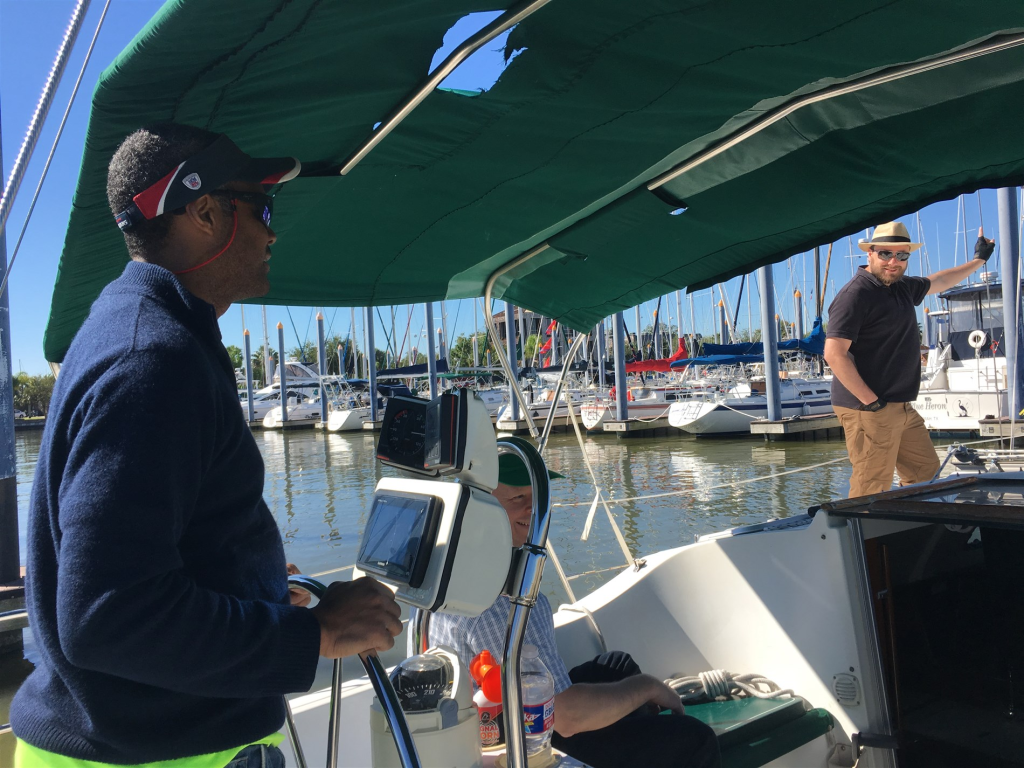
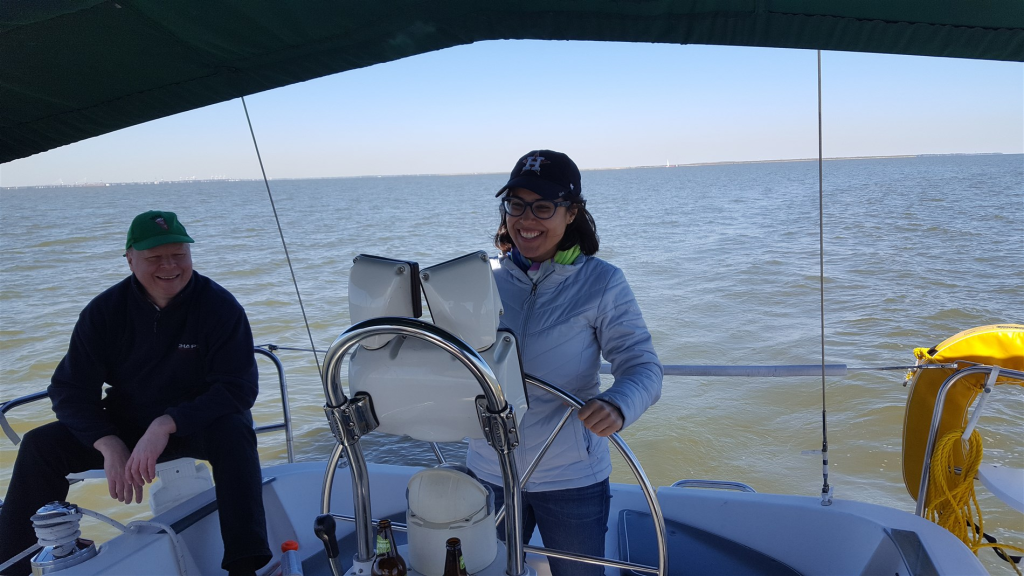
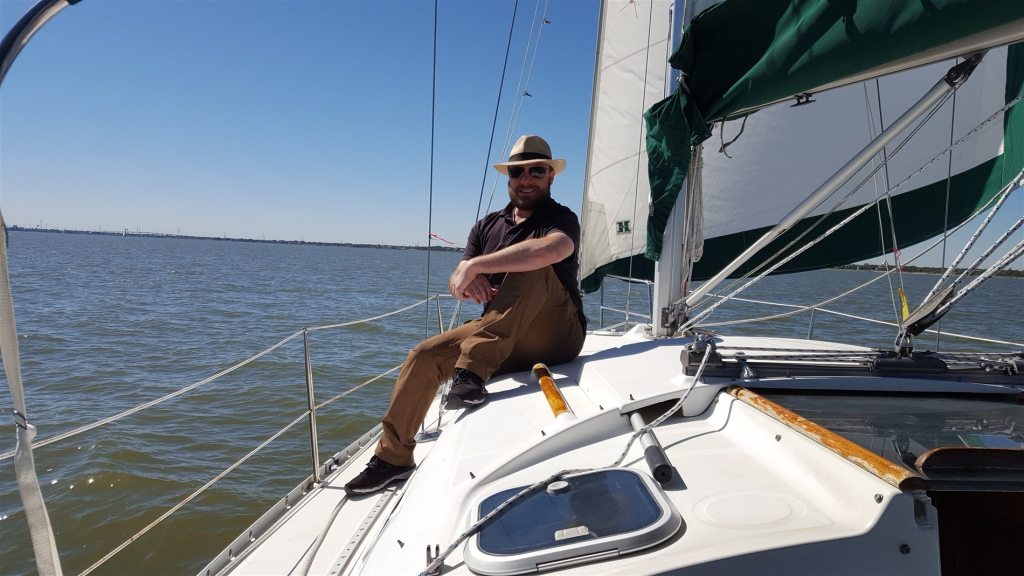
The journal entry for this regatta was lost. A summary follows.
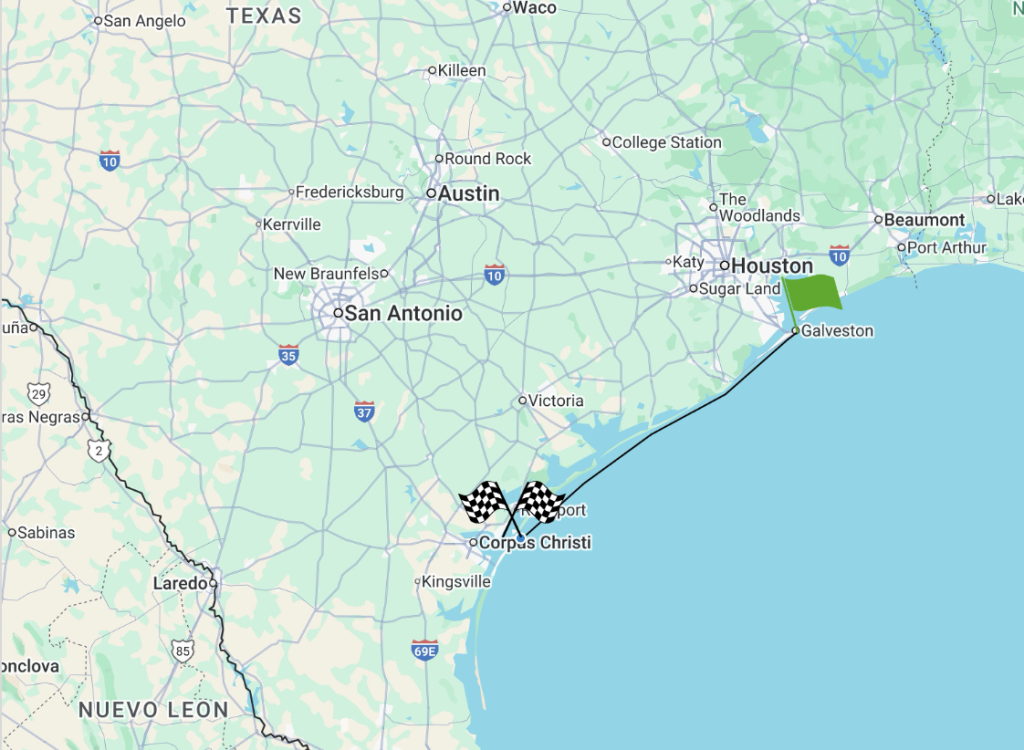
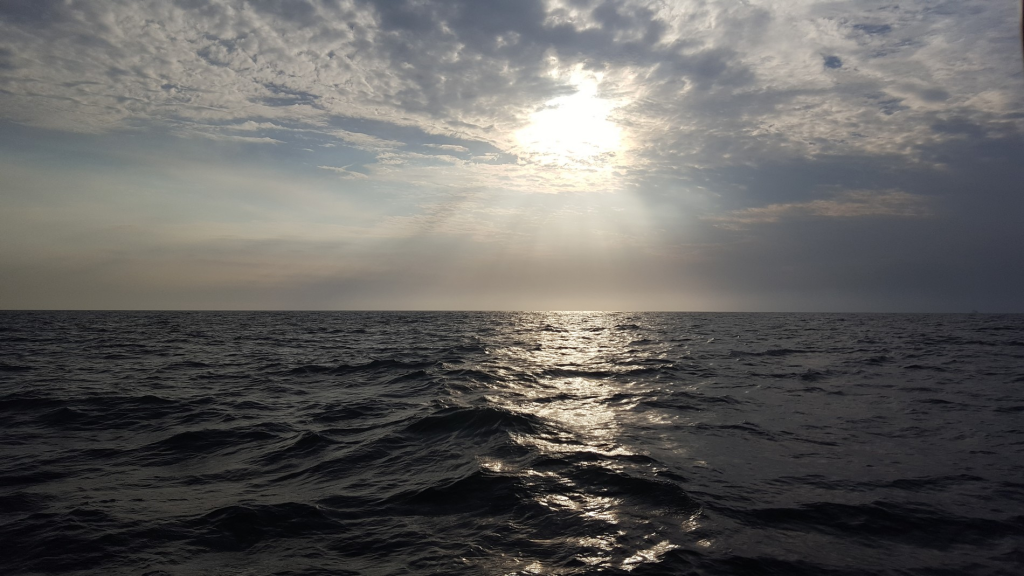
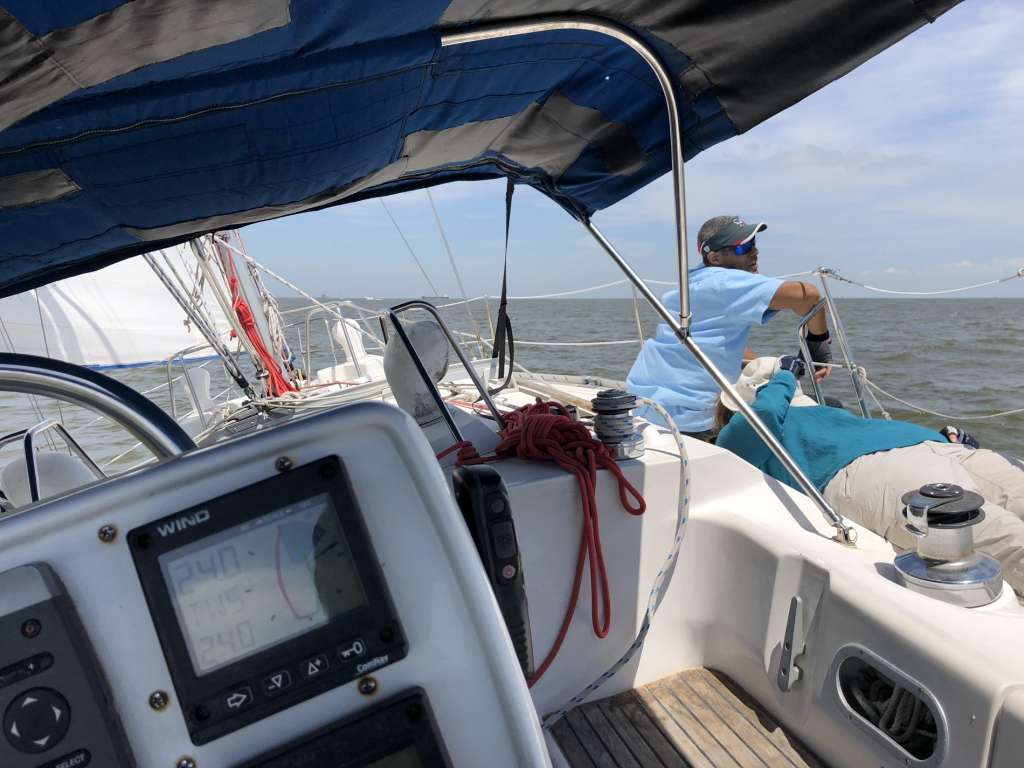
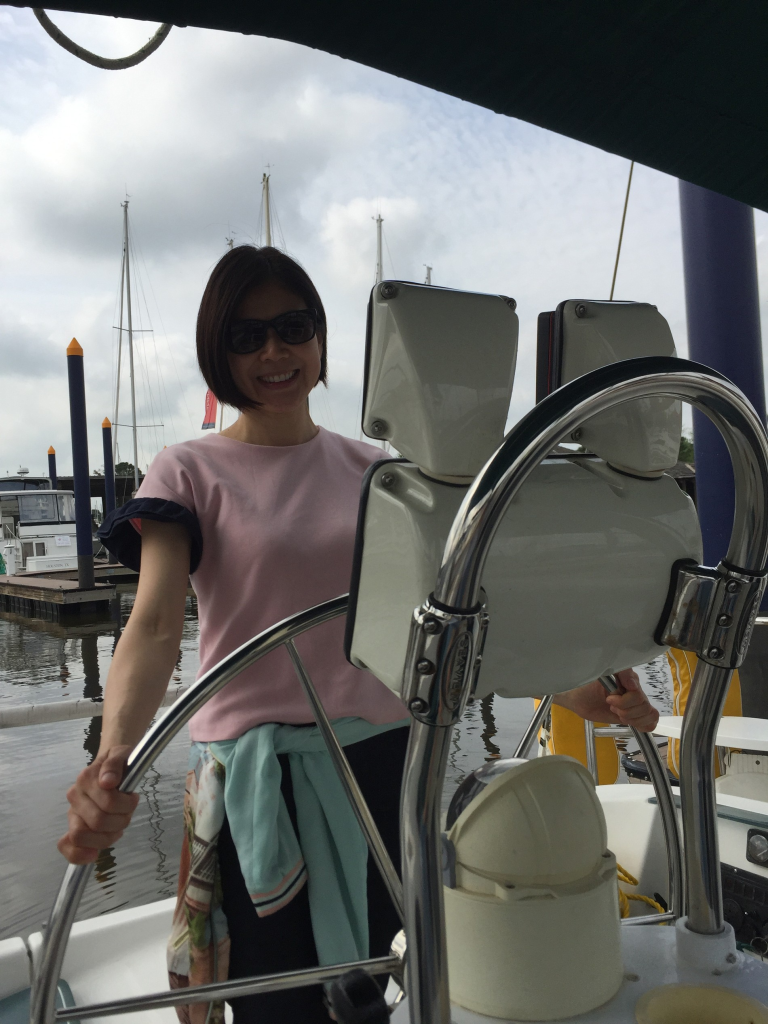
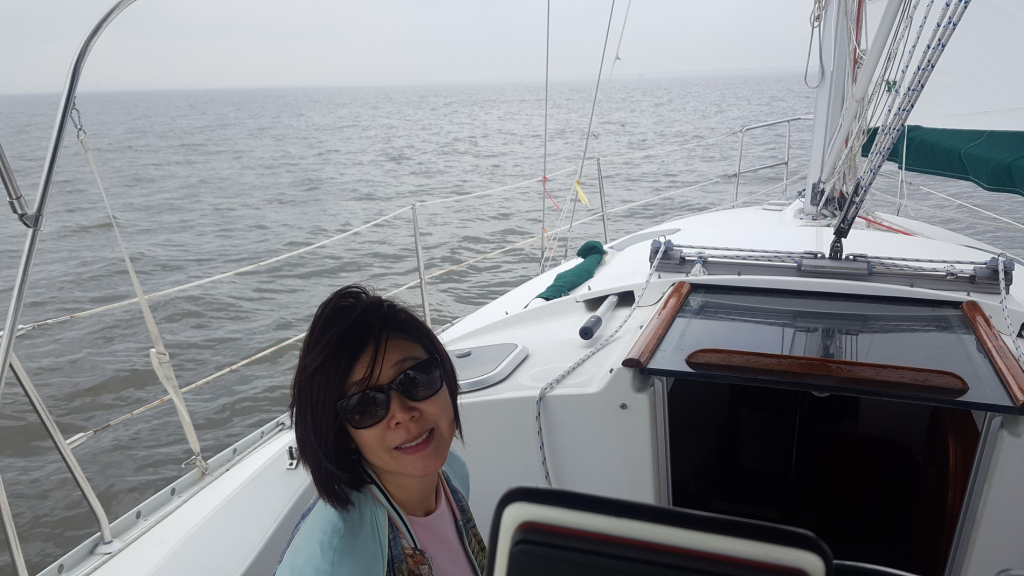
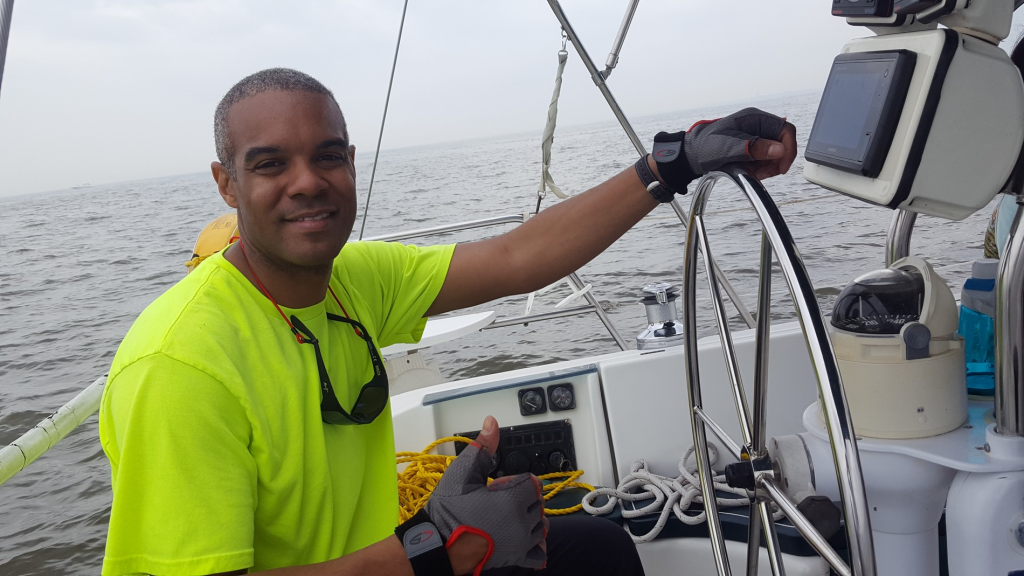
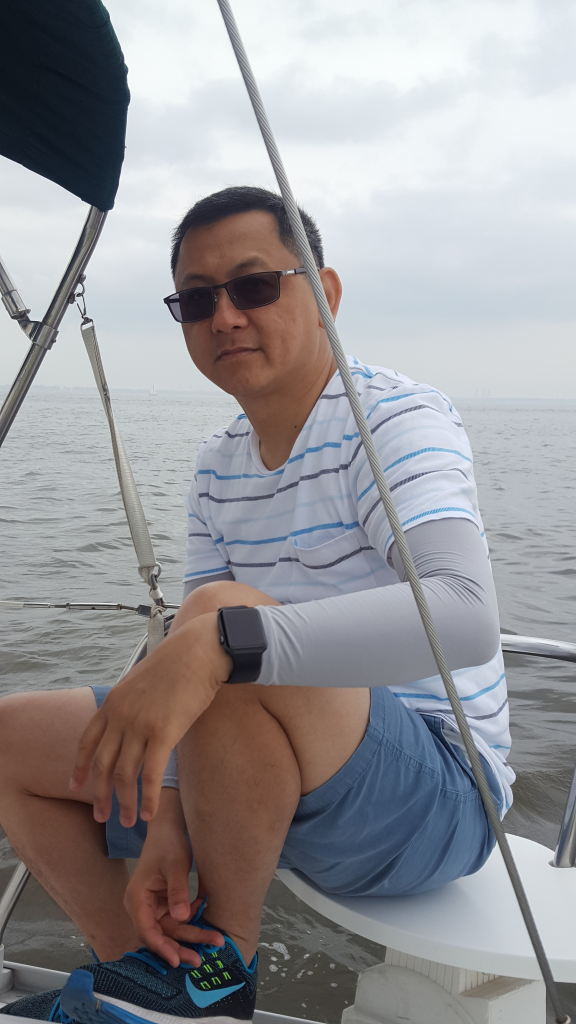
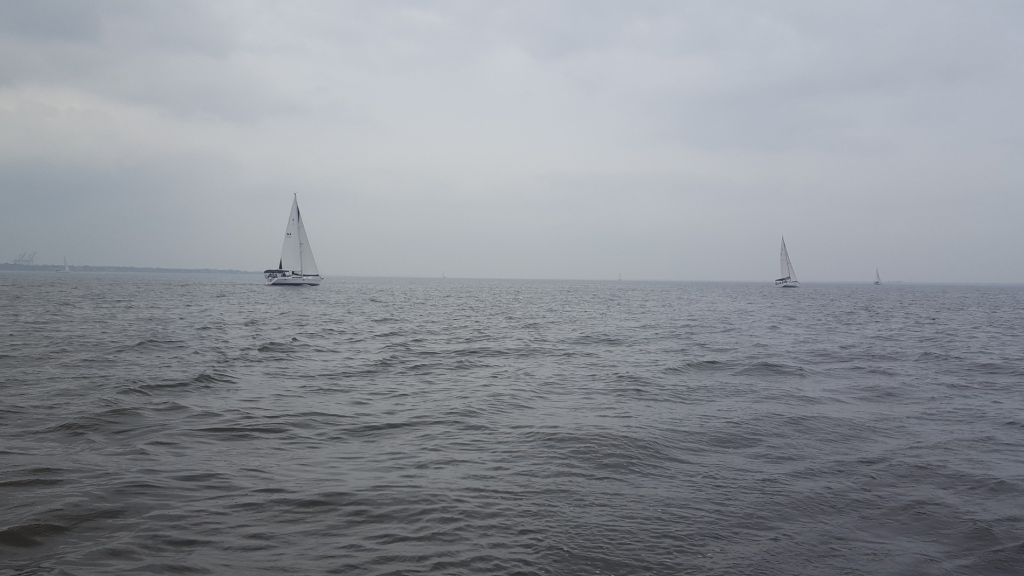
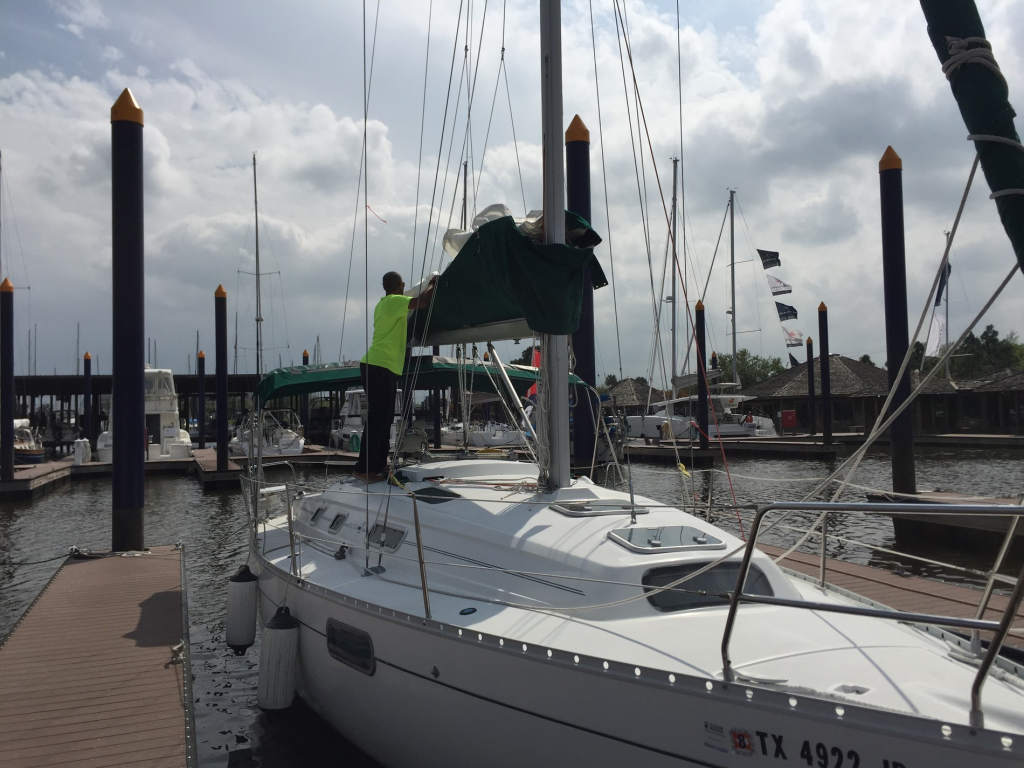
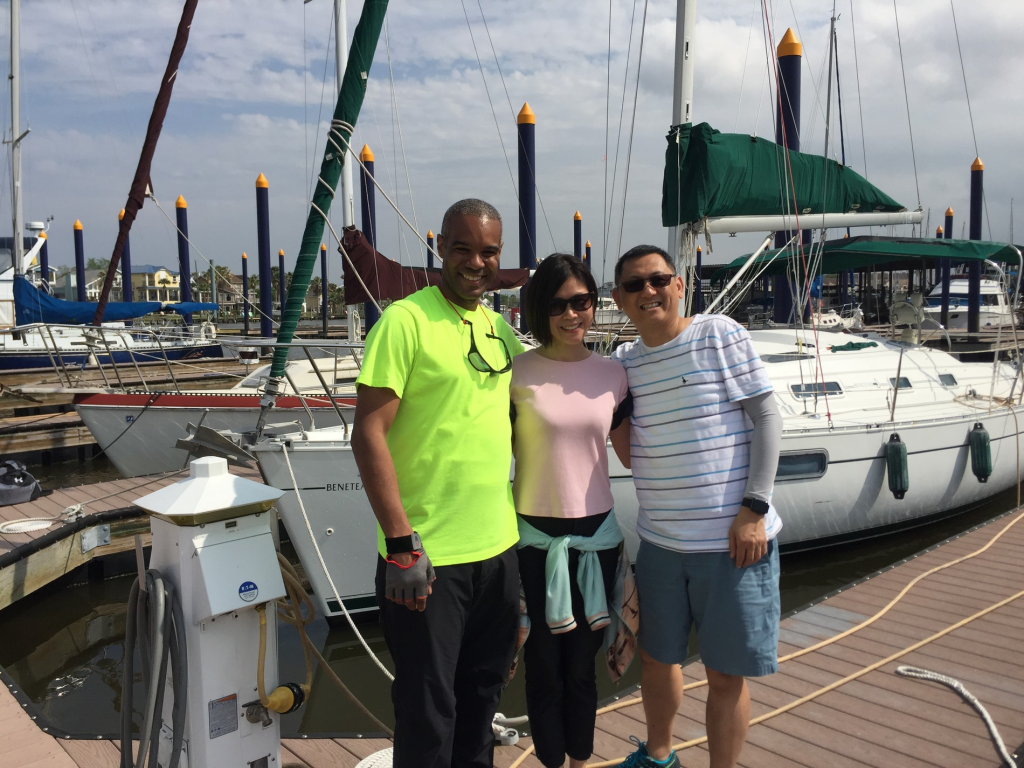
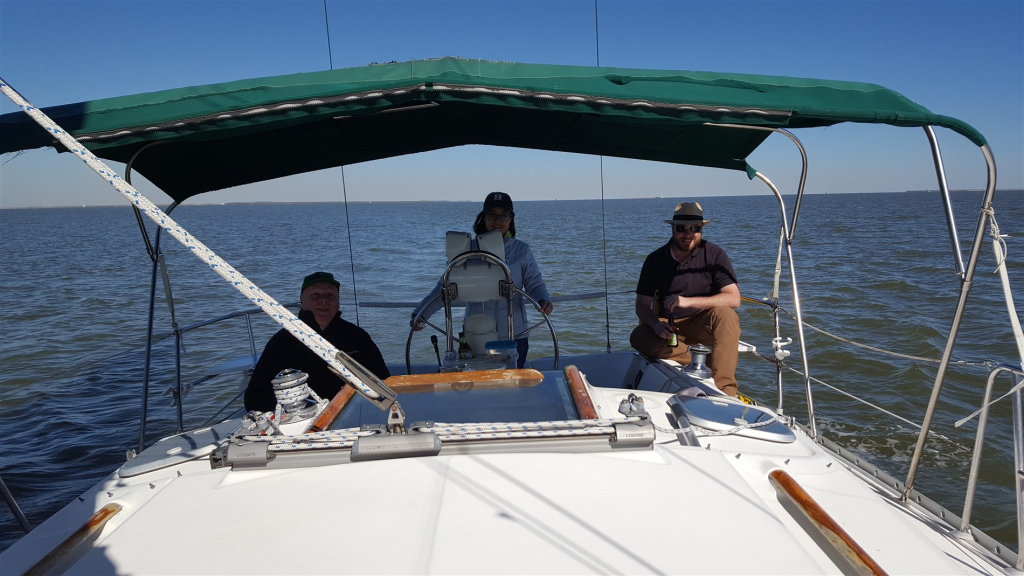
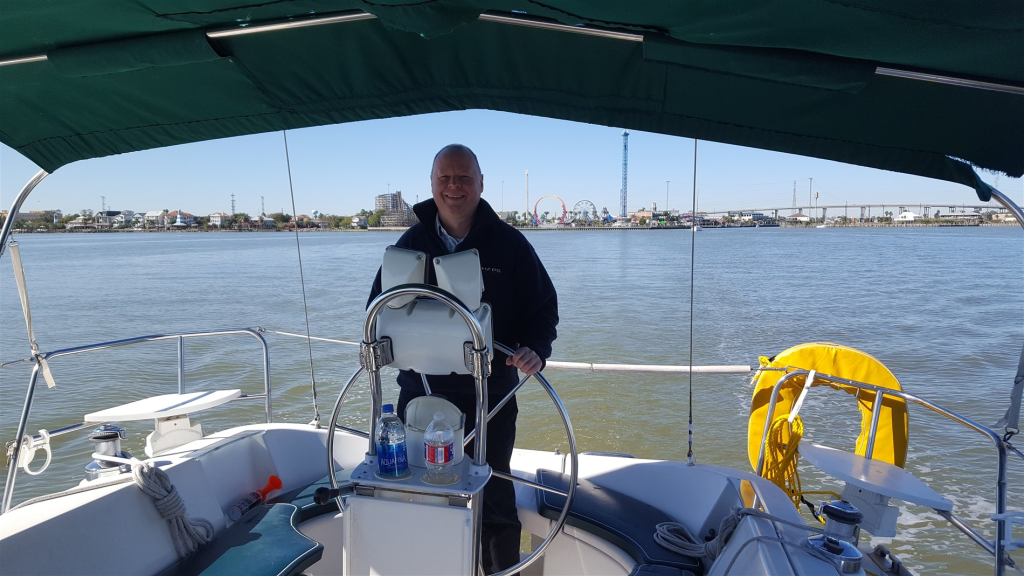
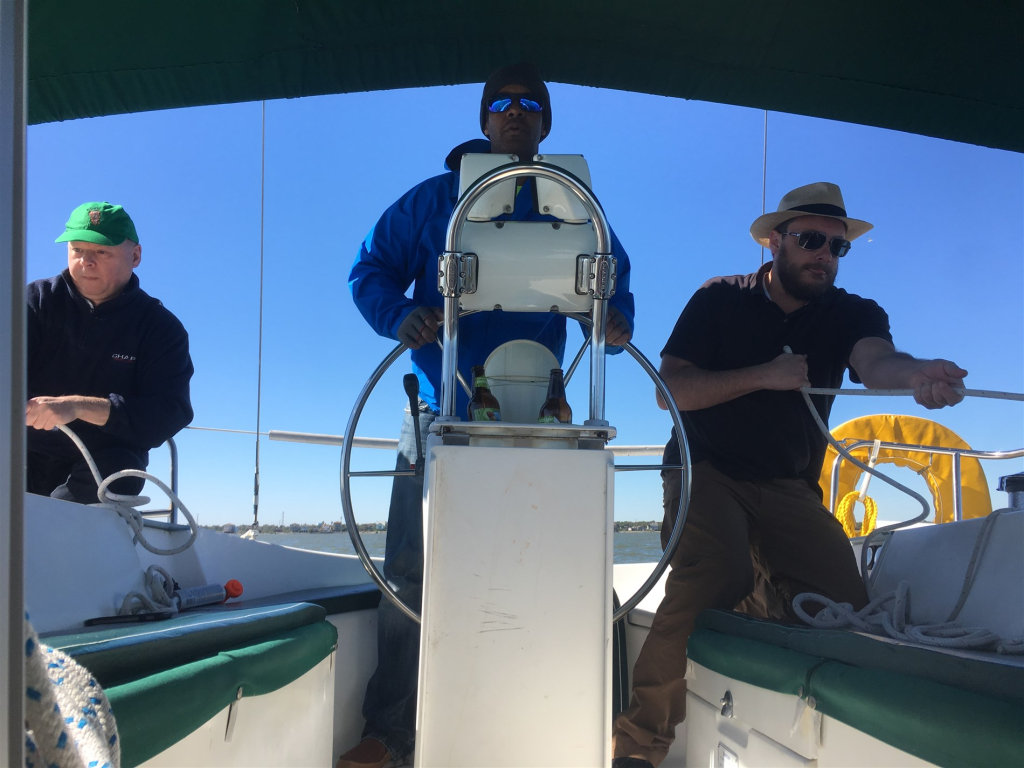
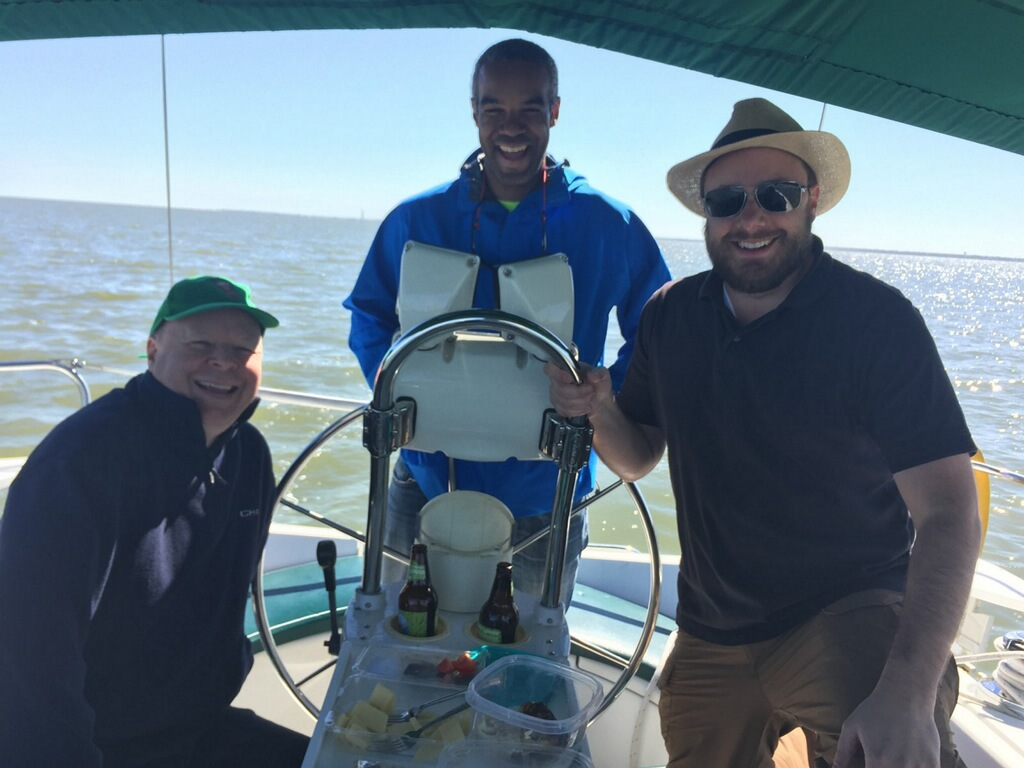
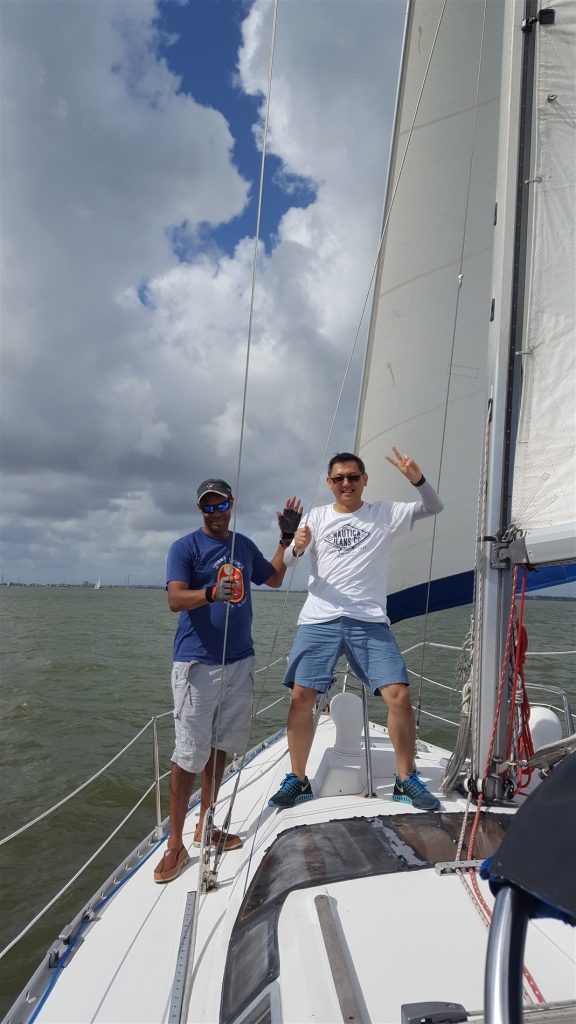
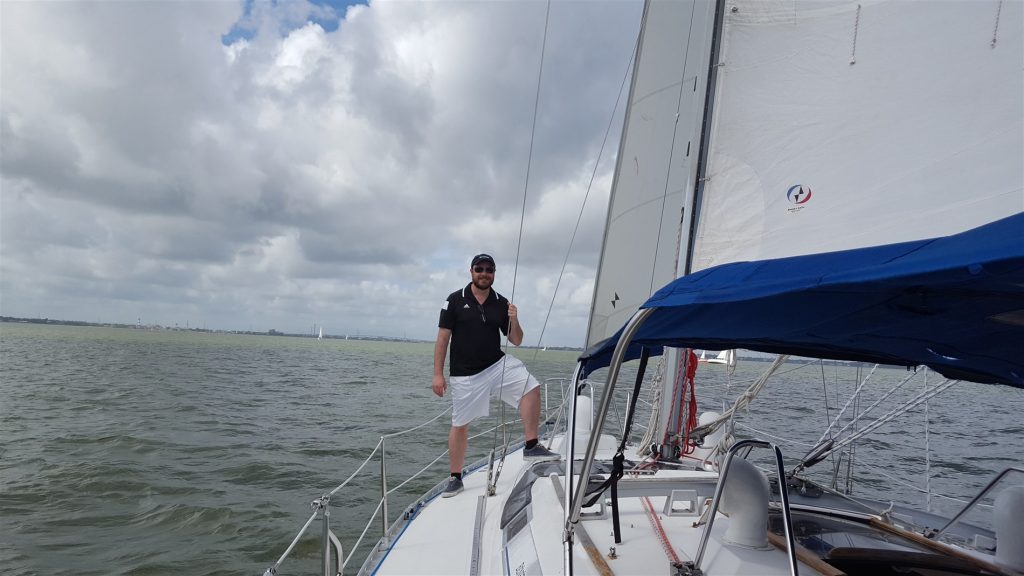
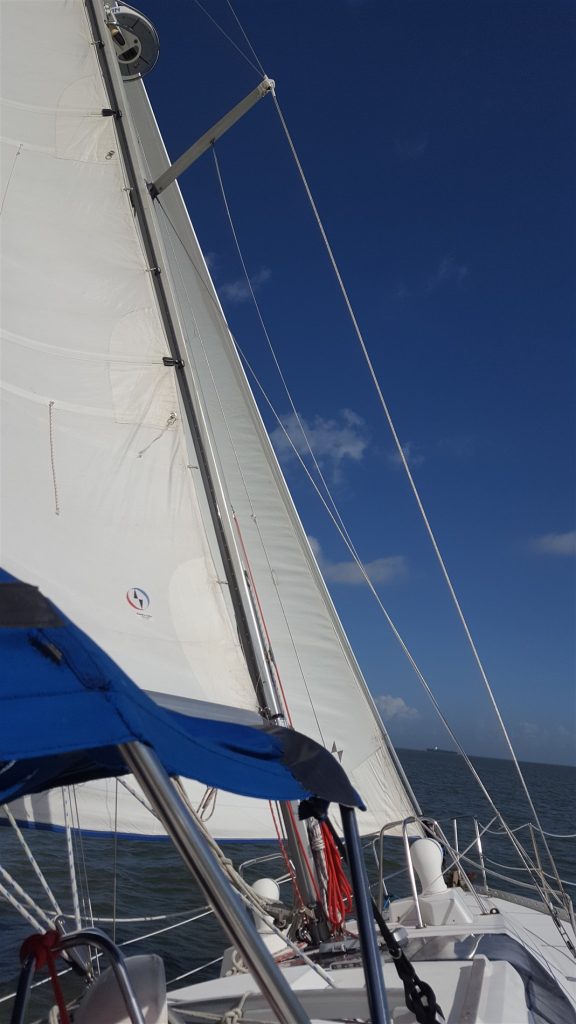
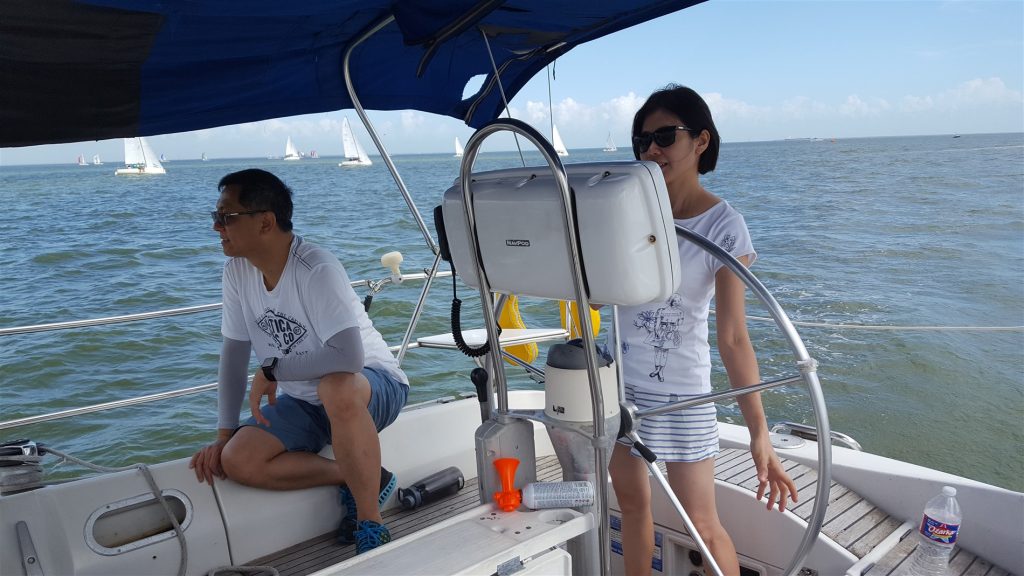
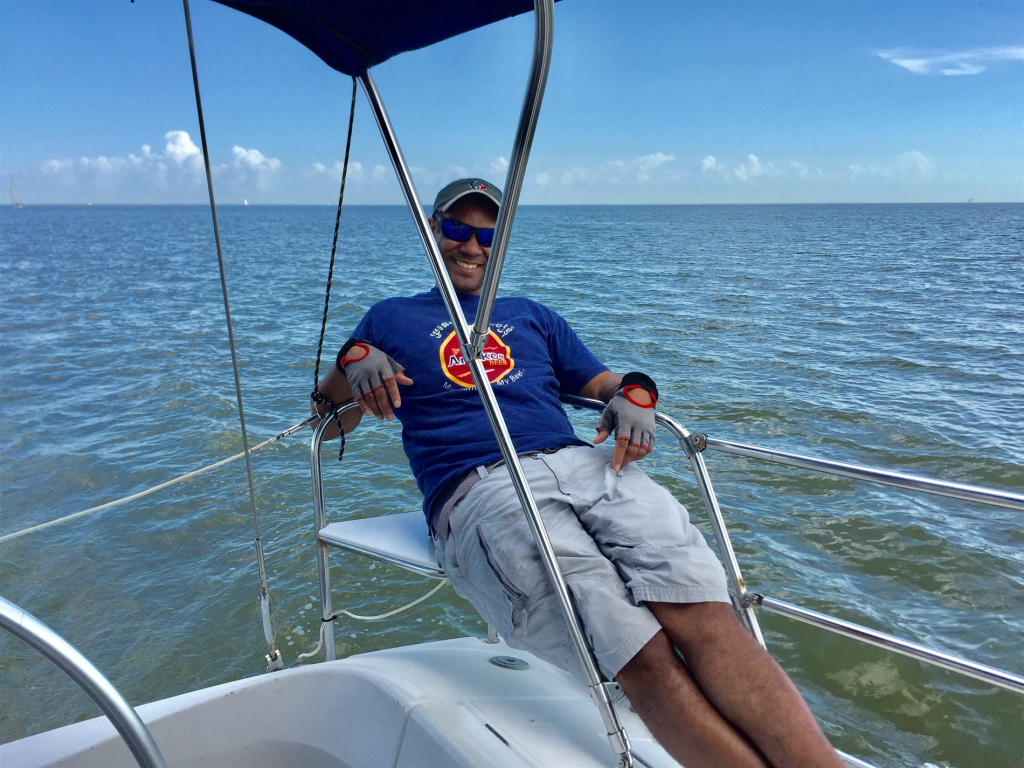
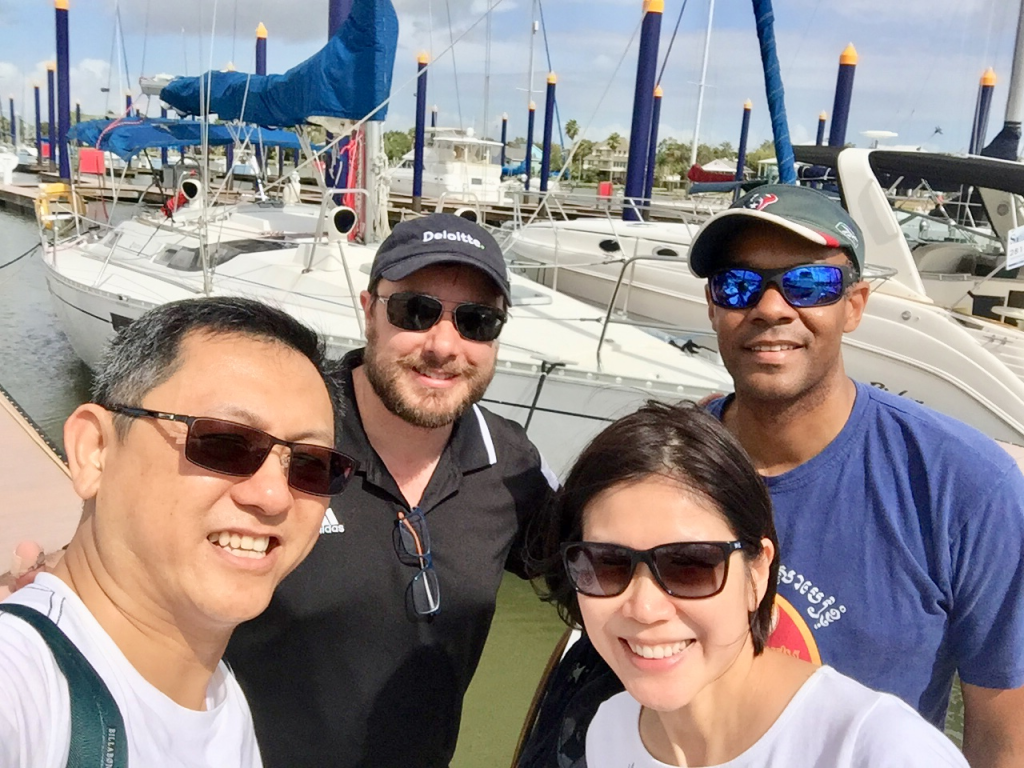
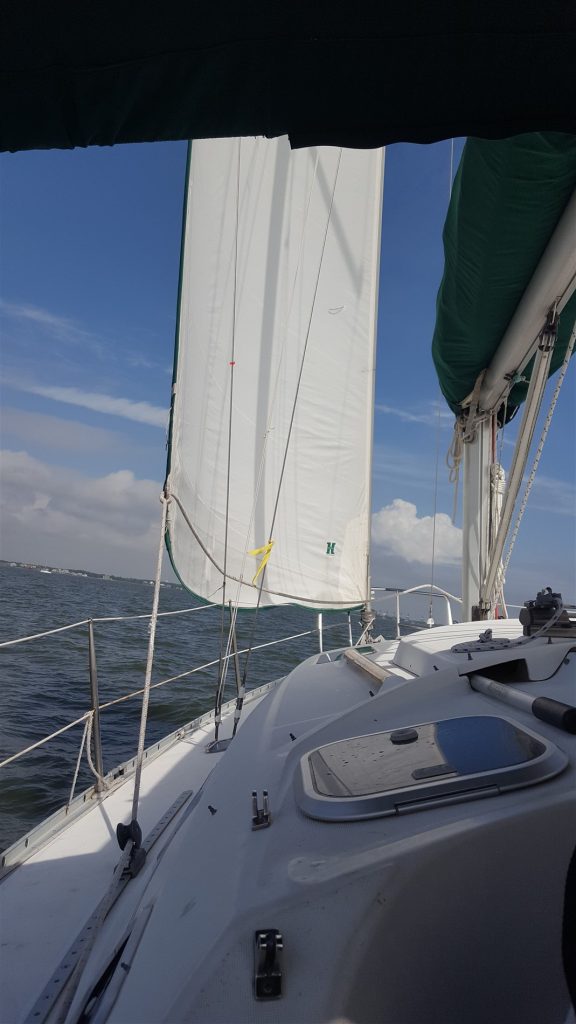
Rotating Crew and Helmsman for the 2018 Harvest Moon Regatta (7- person crew). Motored from Kemah to Galveston, then sailed the race from Galveston Pleasure Pier to Port Aransas, offshore. Night watch in shifts on Thursday night/Friday morning. Good winds on Thursday, but wind died on Friday, extending the race by 8 hours or so. Sailed in to the finish line well after dark. Won 1st place in our division!
Map of the 2018 Harvest Moon Regatta – start off the coast of Galveston and ending in Port Aransas, Texas
The journal details of this anchoring practice session were lost. What follows here is a brief summary of the details that I can recall 8 years later.
After being trained with all ASA sailing training except for long passagemaking, I felt imexperienced in one particular skill that is crucial for sailing in he caribbean and elsewhere: anchoring. I had exactly zero experience in dropping anchor after all of those hours of ASA trainig.
I asked the sailing school about this, and they offered to give me a 3-hour private session on anchoring,
I decided to bring my father with me, as he was in town for a visit.
The session was very quick– all that we did was motor out to the first open area accessible from the channel, and then started to do several drop anchor drills. it was a short practice session, but I suppose it is about as good as I could have hoped for– in Galveston Bay, there are not very many places to safely anchor, so it is not a very commonly used skill when sailing in that area.
That’s it– hopefully I can track down the original journal where I noted some key learnings about the anchoring process. But if not well, life goes on.
The ASA106 Advanced Coastal Cruising certification is the course which is recommended for people who anticipate owning a boat in the near future. In this course you learn more about the finer points of sail trim, engine maintenance and water & fuel planning, heavy weather sailing and techniques, and, most importantly, night sailing. The ability to come into a port at night is the key skill that the ASA 106 teaches above all others.
So whereas I did not have any urgent need to take the advanced training, and on the contrary I thought that I would be better served by waiting to take the course at a time where I had much more sailing experience under my belt, I decided to take the course early anyway. The main motivation was that I originally thought that my wife and I would be moving out of the country, and so I wanted to get this last course in before I went abroad where the ASA curriculum was not taught. Since then our travel plans changed, but I figured that I should go ahead and keep to the plan, So that if our plans do change suddenly, I will have gotten this last bit of training out of the way.
The course actually starts in Galveston, Texas. The students and instructor initially met at the Bay Area Sailing School in Seabrook, but after a short introduction we all piled in our cars and drove down to the Galveston Yacht Basin, where the boat was docked. The course is a 3-day, 2-night course with a practical portion which involves coming into the port after nightfall.
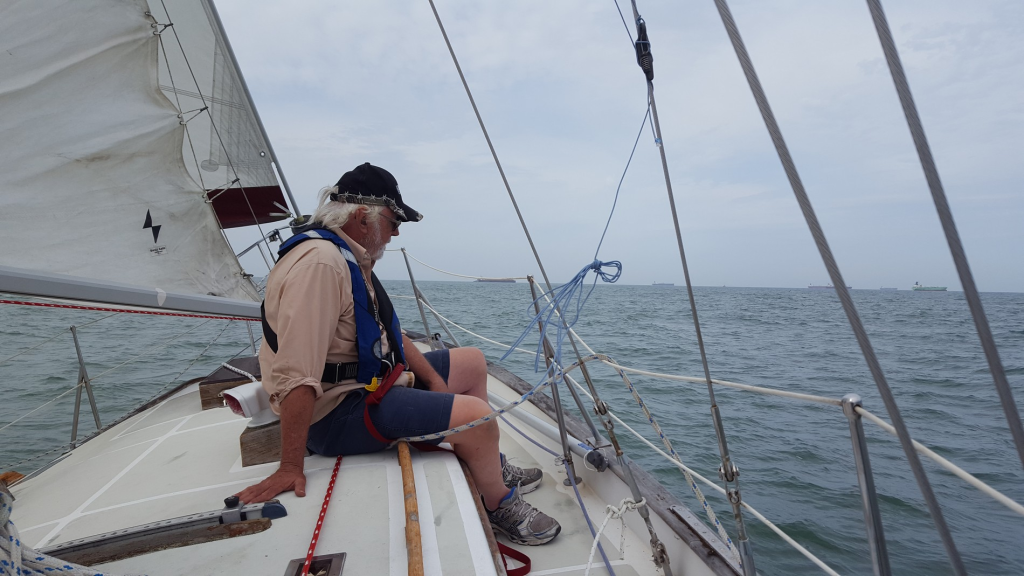
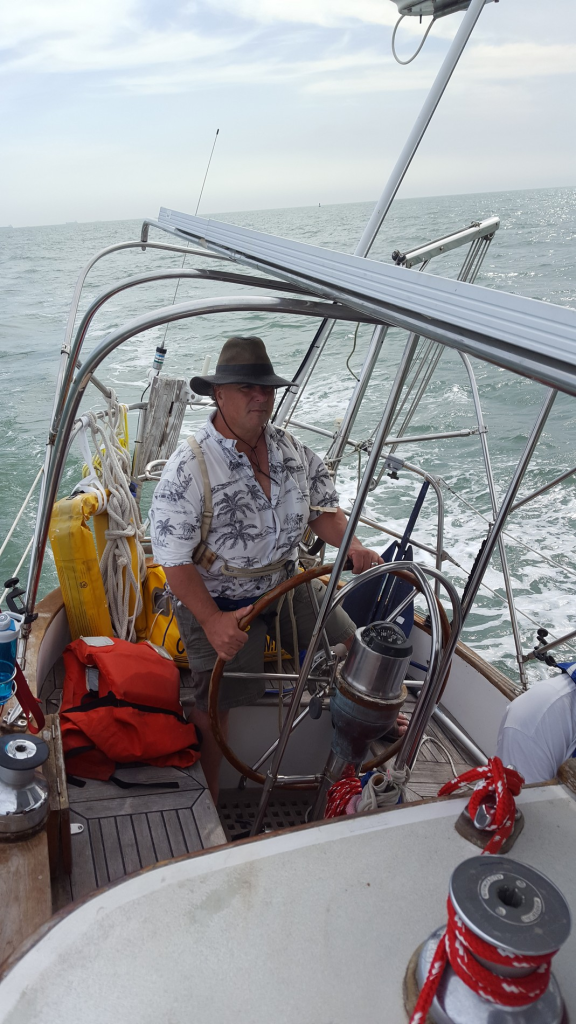
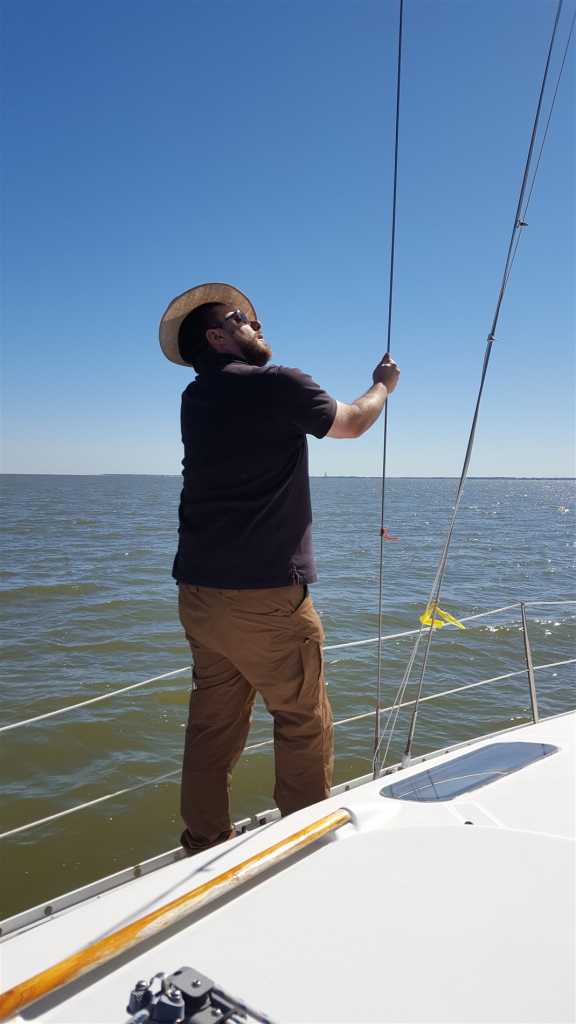
Captain taking a minute to enjoy the sea breeze as we sail upwind on his cutter-rigged Tayana 37
As far as provisioning was concerned, there was a lot less coordination on this trip than in my previous experience. Here, all 3 students were instructed to simply go get enough provisions for 3 lunches and one dinner, independently. And since none of the other students seemed to be interested in coordinating our meal planning and provisioning, I went ahead and bought enough for myself. It turned out that group provisioning would have been a better idea, as there was not enough space in the cold storage to fit everbody’s provisions. So that is a good lesson for future multi-day cruises.
By the time we all made it to Galveston and boarded the boat with our provisions, it was just a little before 12 noon. Before heading out, we discussed weather conditions and decided it was best to try and get the big bulk of heavy sailing and practical instruction done the first day, as the weather threatened to deteriorate the following day. This meant sailing in the Gulf of Mexico until sunset, then starting our way back to the marina after the sun went down.
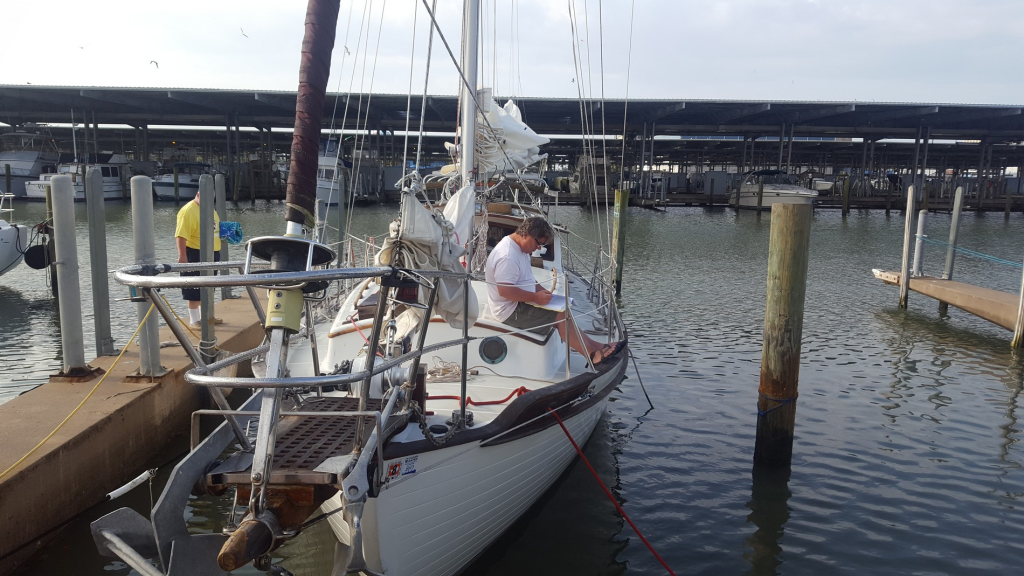
So after having a quick lunch, we threw off the dock lines and headed out under power.
Hoisting the sails single-handed
There is a 1-2 hour course to get to the end of the channel and into the Gulf of Mexico from the Galveston Yacht Basin, assuming a Cruising speed while motoring of 5-6 knots. Before getting into the channel, the instructor had us hoist the mainsail, so that we could motorsail alongside the channel. We later learned that this was also because hoisting sails in the rougher open seas is a lot more challenging than int he calmer, protected waters of the bay.
So in a protected anchorage area just outside of the marina, we prepared to hoist the sails. The instructor showed us a technique we can use to hoist the sails up if single-handed– cut the helm hard over to one side, lock the helm in place, and allow the boat to move in a tight circle under a slow motor. With the boat moving slowly in a circle, you can then move forward to hoist the sails up calmly. Since the mainsail needs to be hoisted when pointing into the wind, you time the moments to haul on the mainsail halyard, so that you hoist up the sail at the times that the boat is pointing into the wind. Of course since we were a crew of 4, there was no need to do this, but it was good instruction nonetheless
Inside or outside the channel?
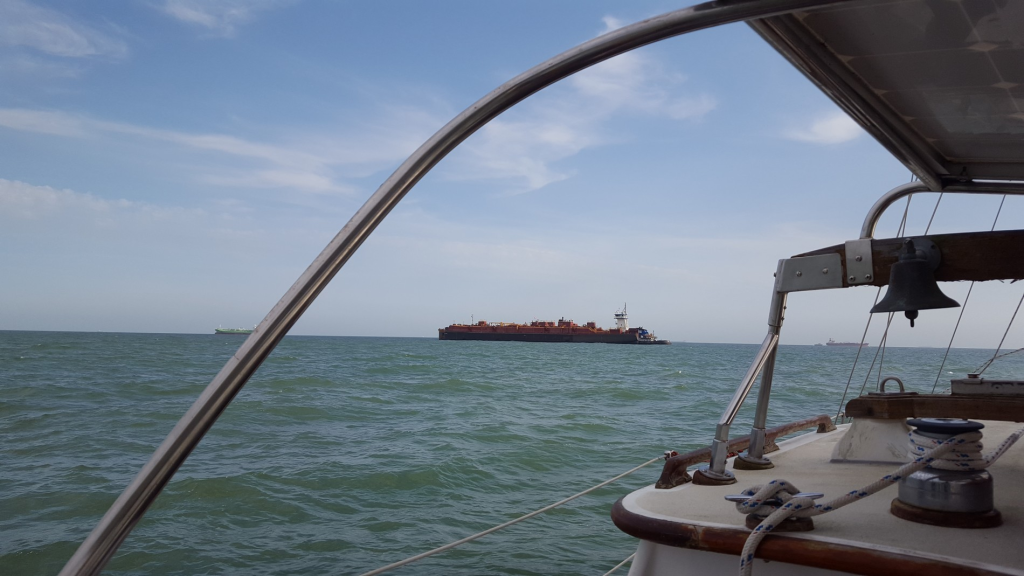
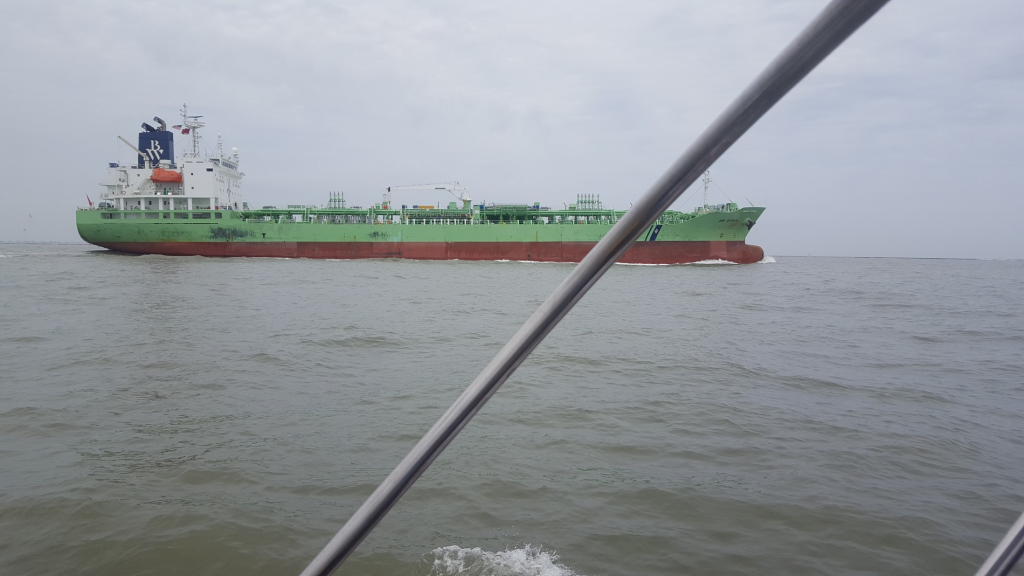
Passed up by a cargo freighter in the Houston Ship Channel
The Houston Ship Channel is one of the busiest ports in the United States. And this was evident when looking at the nonstop traffic both entering and leaving Houston via the channel. Since the large commercial vessels transiting the channel move at about 5 times the speed of your average cruising sailboat under auxiliary power, a prudent sailor would prefer to stay out the Houston Ship Channel as long as it is safe to do so. So when planning a trip exiting or entering a port, it is good practice to examine the nautical charts closely to determine if the boat can safely cruise outside of the channel, by seeing if the depth on either side is sufficiently deep to allow for the boat’s total draft. If there is sufficient space outside of the channel, cruising just outside of the channel markers can be a good risk mitigation strategy.
So we set our course moving from channel marker to channel marker, always leaving the marker so as to remain on the outside of the channel.
Motoring out to the Gulf of Mexico is a somewhat uneventful affair, the main distraction being rubbernecking as all of the various commercial freighters and vessels pass us on their inbound or outbound routes in the Houston Ship Channel.
Being passed by a commercial vessel in the Houston Ship Channel
The Cutter Rig’s Sail Plan
Once we made it out to the Gulf, we then quickly left the channel and hoisted the remaining sails.
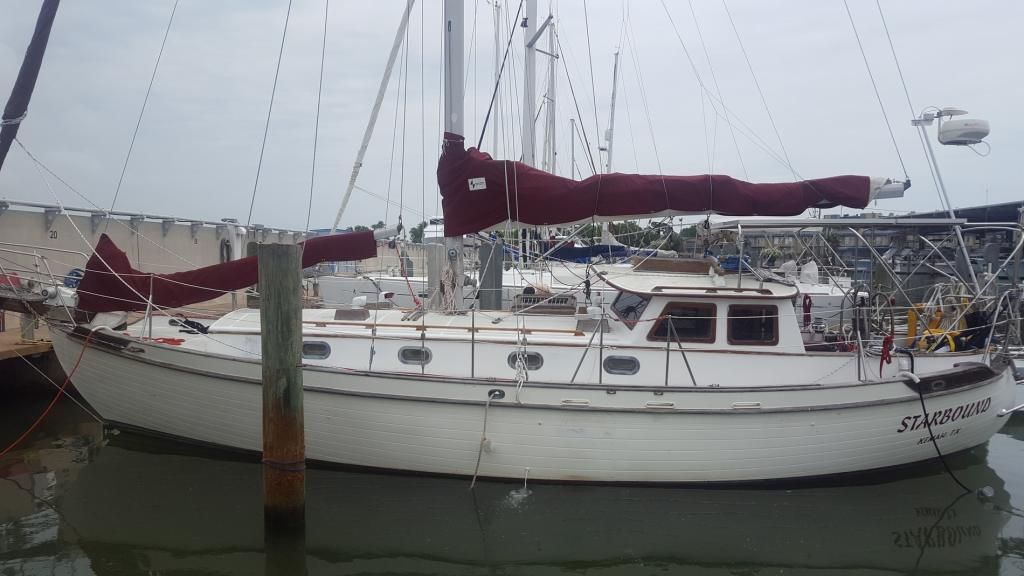
Starbound is a Tayana 37 sailboat, with its sail plan configuration being a Cutter rig. A Cutter rig is very similar to a Sloop rig (headsail/jib and a mainsail), with the addition of a third sail called a “staysail”, inserted between the mainsail and the jib. So that is 3 sails total under normal sail. The staysail is hanked on to the headstay, and the jib is set on a roller furler, its base being connected to the tip of the boat’s bow spirit.
This was my first experience on a cutter rig, and we learned that you set the sails up in this order: first the mainsail, then the staysail, and last, the jib. You would think that one more sail means one more thing to worry about, but in fact the staysail is self-tending, so most of the time you don’t worry about adjusting the staysail’s position. The biggest problem that we saw with the cutter rig, is that with the extra sail in the middle, the jib has an extremely difficult time moving from one side of the boat to the other during the tacking maneuver. So much so that it often gets tangled and requires a crew member to go forward to untangle ad allow the jib to ove to the other side.
Passing the day sailing away
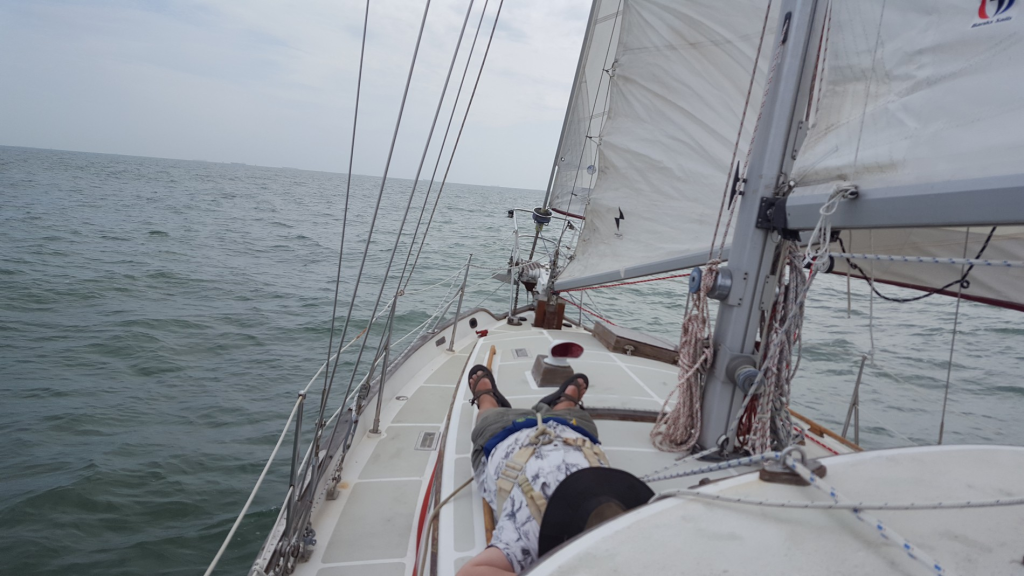
Catching some zzz’s!
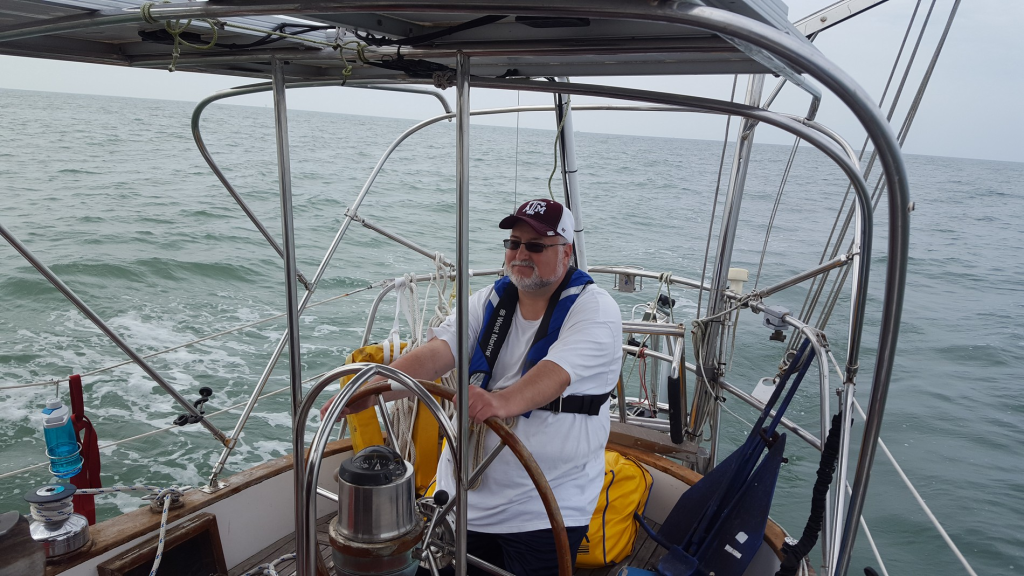
With all three sails hoisted up, we needed to pass the time until nightfall. So each of us students took a turn at the helm. It was more of a ‘set course and steer’ than an exercise with lots of tack and jibe maneuvering. We had amazing weather, which was probably about right given the early May timing of the course. Just enough wind to pick up speed with a comfortable heel angle, without being overpowered and difficult to maintain heading. I was the last to take control of the helm, and so when 1800 on the clock arrived, I was the one to start us back on our journey back to the marina.
Dealing with Engine Trouble
To get back to the marina, the plan was to drop all sails, fire up the engine, and motor on in through sunset into the night. So after all 3 sails were doused, I turned us back to the channel and we began our return journey around sunset. After 5-10 minutes though, after the captain suggested we slow down a bit, the engine died completely on us. Normally on a sailboat this is not a huge disaster, because we can always hoist the sails back up and sail our way in as long as there is some wind. But to attempt to get all the way back to the marina in Galveston under wind power alone, at night, and avoid collisions and slowing down traffic lanes, would be extremely difficult and risky.
So the first order of business was to make sure we were out of the channel, and attempt to get the mainsail hoisted back up. In the meantime, the instructor would do some engine troubleshooting and see if he could get the engine going again.
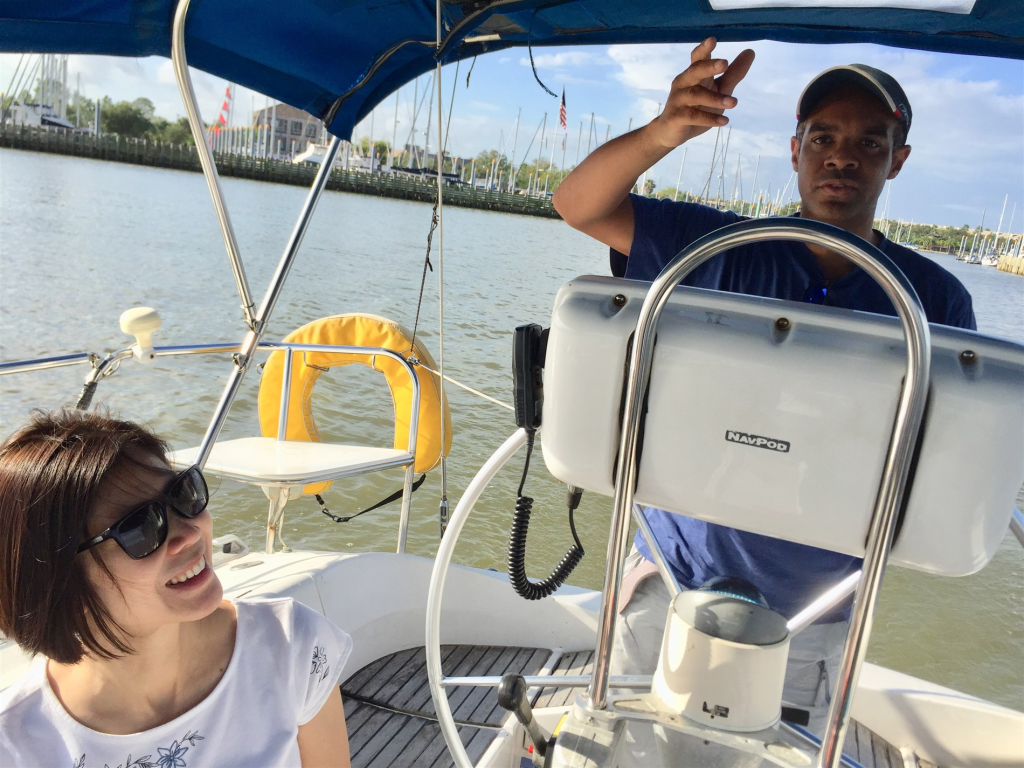
Captain with all smiles behind the helm
Well, us students learned a painful lesson firsthand, on the importance of hoisting the mainsail while pointing directly into the wind. Starbound had “lazyjacks” installed, which are lines rigged for the mainsail so that when you drop the sail it flakes neatly between the lazyjack lines. This is normally a great thing, but in our case, the lazyjacks made it close to impossible to hoist the sails up if you were not pointing exactly directly into the wind. As soon as the boat veered slightly off the wind, the sail ballooned out past the lazyjacks and got stuck, in a position making it impossible to get the sail fully raised.
Since after a few minutes we had stopped, it was now not possible to point the boat into the wind. We struggled for 15-20 minutes or so to find the right time where the waves rocked the boat far to one side, where we had some slack and could try to force the sails up. But none of that worked. So it was a good thing that eventually the instructor managed to get the engine started and running again (In fact the next day we began to wonder if the engine “failure” was actually a part of the instructor’s curriculum). With the engine running again, we decided to hoist the mainsail up so that we could motorsail in at night. The idea was that if the engine were to give out again, we would still have a bit of sailpower available to keep us moving and get us closer to the marina.
Channel By Night
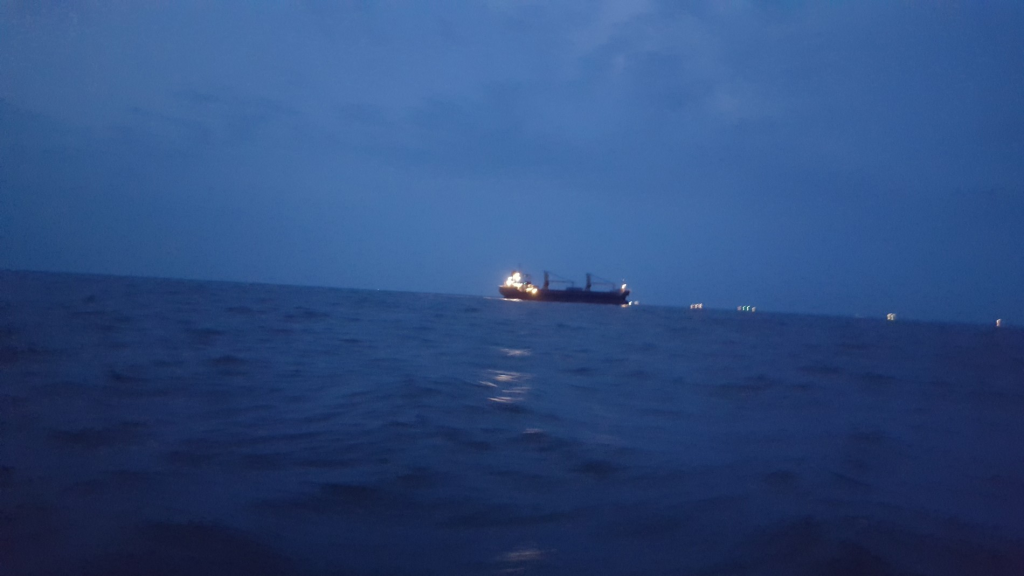
Lights in the distance
After the engine failure drama was sorted out, the sun had dropped significantly enough that true nighttime was imminent. So now we would have a chance to experience bringing in the boat back to the marina when it was dark. In order to do this safely, the trick is to do a bit of nautical chart work before heading out for the day. The same red & green buoys which are easy to spot during the day to establish the borders of the channel, become difficult to decipher from all of the other buoy and commercial vessel lights at night. So for each buoy along the channel, you note down the following:
Light characteristics: The color and flashing characteristic– for example, green, quick flashing, or red, flashing at 4 second interval.
Course to next buoy: Assuming an inbound journey, what is the magnetic course to steer in order to reach the next buoy in the channel.
With the above details noted down ahead of time, you are then equipped to navigate the channel all the way back to the dock.
Knowing what to look for, though, and being able to spot it and maintain a steady compass course in the dark is a lot more challenging than I imagined. For starters, with the mainsail up, a lot of the view from the helm is obscured. So the helmsman is extremely dependent on the crew as spotters to keep track of that next channel marker light, and to make sure the helmsman knows in what direction to point. To make things worse, depth perception is extremely difficult when all you see are lights in the distance. Example: a green buoy which seem to be 1.5 miles out, seemed to jump to 1/4 mile off when a passing large freighter provided a close dark background for it. So it takes multiple eyes and vigilance to make sure the next target remains in sight and is indeed correctly identified.
Breathtaking
And the stakes are high, especially in the beginning of the entrance to the channel– there is a long jetty whose end is marked with a green flashing beacon. And you definitely don’t want to confuse the channel marker for the jetty marker and sail straight towards it. But between the three students, and the captain reading off to us the upcoming channel marker’s flashing characteristics and course, we managed to make it back to the dock without too much trouble. Once we settled in, the captain confessed that he was also keeping track of our position using his smartphone GPS…but that was like belt and suspenders. For us students, it was a good accomplishment to have made it back in at night, without the assistance of digital positioning systems.
After we got all tied up at the dock, a few of us had a small bite to eat, and all of us passed out until morning. That was just under 12 hours at sea.
Exam Day
Sneaking in a little studying
Since the weather was threatening to worsen towards the end of the day, our instructor decided to make it an easy day. We took our time getting breakfast at a local diner, then back on the boat he started to review a few points which would be good to re-hash prior to the written exam.
The exam itself was quite long– I think about 50 questions, no multiple choice but all essay or fill-in-the-blank style. All of us managed to do quite well though, so although it was long and painful, it was not wasted effort.
We then had a “free” evening to go to a restaurant or bar and just unwind for a bit before coming back to the boat to sleep.
Last Day: Anchoring, Reefing, and Wrapping it up
With the exam out of the way, the last day was an opportunity for us to get instruction and practice on whatever skills we wanted help with. One of us wanted more practice anchoring, and I wanted to go through the process of reefing the mainsail, which I had never done myself and involves shorting the amount of sail to help maintain control in heavy winds or heavy weather.
Light Repairs
Before we headed out though, we decided to go around the boat doing small repairs. While we were out the first day, at least one spare halyard line became loose and was quite difficult to recover, and a shackle’s pin came loose while under sail. Well, it turned out that the shackle was the one attaching the mainsail’s tack to the gooseneck, so that was a critical item to address. The other key thing for us to do, was to secure the shackles with wire lashings, to prevent them from coming undone as they had done while under way. So armed with a spool of lashing wire, a pair of wire cutters and pliers, and some spare shackles, we went around making the necessary fixes. This part I enjoyed somewhat, because it was a very clear illustration as to why such maintenance is required. John Rousmanier’s book The Annapolis Book of Seamanship goes over all of these maintenance tasks in great length, but when reading it sounded like a bunch of “required” maintenance that sailors actually never do. So to see the shackle connections lost at sea, and the halyard lines swinging out of control, and all of that due to unsecured shackle connections, that really hammered home the importance of the regular maintenance to the safety of the boat and the crew.
Anchoring and Light Wind Sailing
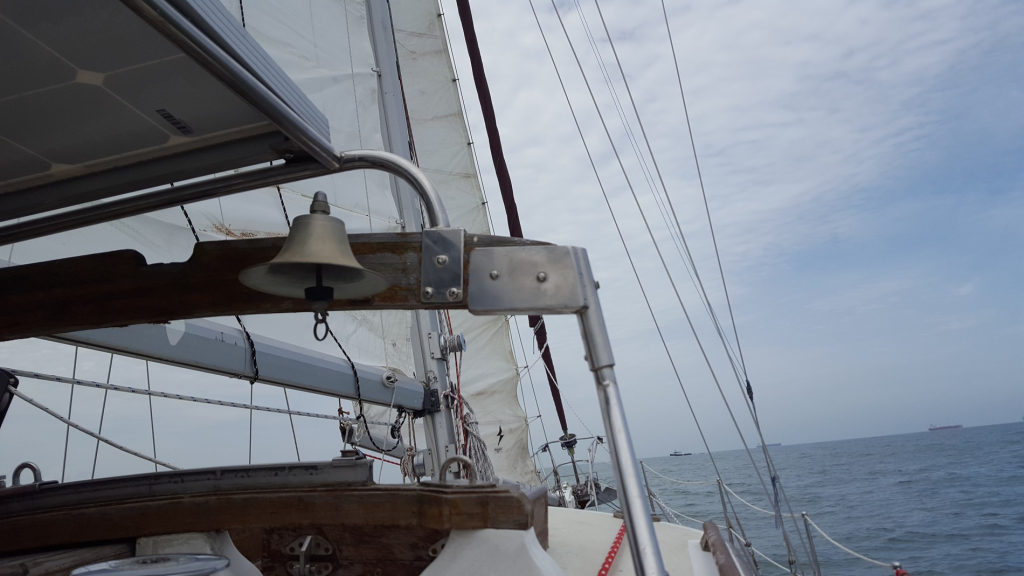
The rig with bells which ring if the boat sways too much suddenly on either side
With the biggest problem areas taken care of, we then headed out for the anchoring practice. I actually wouldn’t have minded getting a shot at managing the anchoring, but the exercise took so much time with the first student that I decided to worry about getting anchoring practice in at a later time. After the anchoring practice was over, the instructor needed time to grade our exams, so in the very light morning wind we hoisted up all 3 sails and did our best to sail around the anchorage site. This was not really a very exciting or fun sail, because first of all the wind was extremely light, and secondly by the time we managed to get up a decent amount of headway it was time to change course via either a tack or a jibe. But we did it anyway for as long as required to to allow for the grading to be complete. He actually gave us a good compliment, that it is not very difficult to sail a boat in good winds, but it is a good show of seamanship skills to keep the boat moving in light wind. After the papers were all graded, we dropped sails and headed back to the the dock for the final practical lesson on reefing.
Docking and the Importance of the Spring Lines
There is one thing that I failed to mention earlier, about coming back to the slip and tying up. In all of my sailing, eduction, and chartering experience at the Bay Area Sailing School, I don’t recall seeing anybody use what is referred to as a spring line during the docking process. You typically have four dock lines rigged up– two on either side of the bow and two on either side of the stern. Spring lines are lines that attach at the middle of the boat, on either side. The instructor explained to me that the spring line was the most important line to tie up to the boat first, as the boat comes into the slip. Once the spring line is attached, the boat is considered to be under control, forward progress halted or slowed, and the remaining docking lines can then be taken care of calmly.
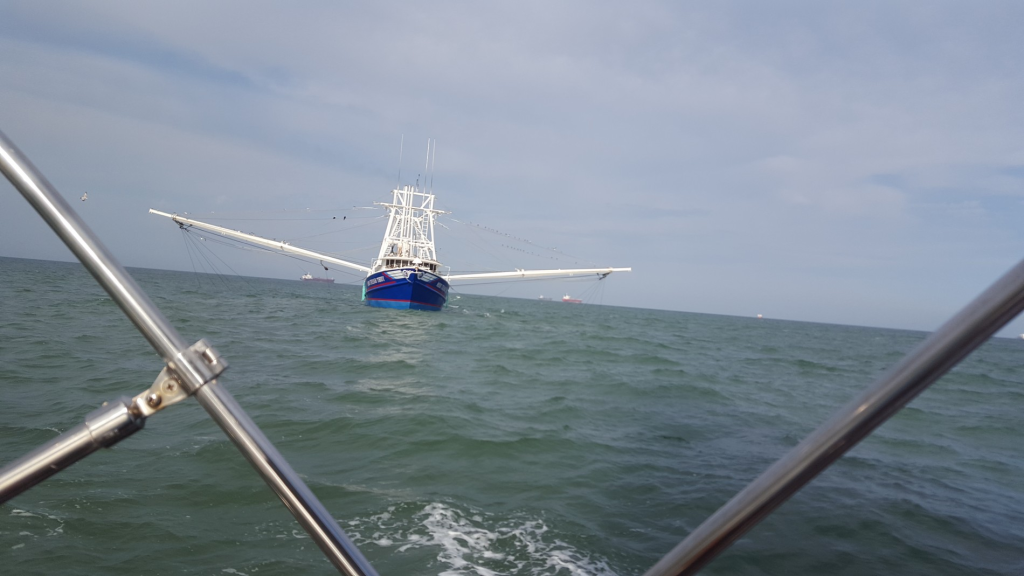
Fishing boat with its nets out
The strategy that the captain used was to establish docking positions for the crew early, explain to each crew member where they should be when leaving or entering the slip, and what they are expected to do when leaving and arriving. My position was to man the spring lines. Since we were leaving the dock lines at the dock, my instructions were to man the boat hook, and as we come in to the slip, grab onto a dock line as quickly as possible, and cleat off the line at the cleat at the middle of the boat. I wasn’t so quick about it the first time, but by the last day I had the spring line hooked and attached in no time. And indeed, we were very much able to calmly attend to the other lines with that spring line firmly secured.
Retrieving submerged lines with a weighed line
Each slip in the uncovered slips of the Galveston Yacht Basin fits two boats, with wooden piling in between for the dock lines. This means that when leaving the slip, one side of the boat was next to a dock/pier, which left plenty of room to drop the dock lines. But the other side of the boat had lines secured to pilings in the water, with only a solitary nail on each piling to hang the dock lines on, for those with excellent lasso skills. All of this to say that a lot of the times when the lasso missed the nail, the line just drops unceremoniously into the water and sinks. This makes it tricky, after the boat is back in the slip, to retrieve these submerged lines for securing on deck. It turns out that there is a pretty slick way to go about it: use a rope with a heavy weight attached to the end!
Handle that helm like a champ!
I think you probably need to see it for yourself to get it, but in short the technique is to throw the weighted line way past where the line is submerged, wait for a few seconds to allow the weight to sink to the bottom, and them slowly drag the line back to the boat. If all goes well, the weight will end up snagging the submerged line on its way up, and then you can make the final few feet with the help of a boat hook. Pretty neat trick!
A final reef for the road
This being the final day, and with one of us students with a long 3-hour trip back home to look forward to, we decided to practice reefing in the slip, as the last practice of the course. The reason I was so keen to get experience putting in reefs to the mainsail is that it is one of the most important tactics to employ in order to maintain control of the boat in strong winds or otherwise heavy weather conditions.
If I learned only one thing about reefing that day, it was that you had better for damn sure install all reefing lines BEFORE you start underway. On the Starbound, the first reef points were already in place but the second reef points still needed to have the reefing lines put in. This actually made for good practice and instruction, because most students learn to reef with all lines already ready to go.
The process to reef when the reefing lines are pre-installed is quite straightforward. Simply drop the mainsail until you reach the first reef point, where you will find a large cringle (reinforced hole along the leading edge of the sail). Attach the cringle to the gooseneck, tighten up the mainsail halyard line and cleat it off, and then pull the reef line tight to secure the reef.
On the instructor’s boat though, the second reef points did not have any reefing lines rigged. So we had an opportunity to see how to set up reefing lines on a sail. The reefing lines at the first reef point were already rigged, and they were set up so that you could tighten up the reef lines from the cockpit. In other words, to tighten and secure the reef, all you had to do was pull on the reefing line towards the back of the boat. So if you ran the reefing lines far back enough, you could secure the reef from the cockpit.
For the lines that we were to install at the second reef point, they would be a much simpler type– just a length of line knotted on one side, threaded through the reef eye to the other side, then a bowline knot on the other side. With this simple rigging, you could quickly tie the knotted end through the bowline’s loop and yank to tie it down. Traditionally you would just secure the reefing lines with reef knots (square knots), but the instructor told us that he prefers to have one end looped to make it simpler to tie down. Add I must agree– I can see how if your crew is not experienced, trusting them to put in a proper square knot can be dicey — better to have a knot than anybody can figure out how to get secured, especially since the reef may need to be secured on a boat which is being battered by heavy weather conditions.
So that’s it!
All of us students passed the practical and the written exam, and so that meant that all three of us would be getting our ASA106 certification. All that was left was for us to pack up all of our gear, haul off the remainder of the trash, and bid everybody farewell.
Not much left for me now in the realm of more training…time to get out there and sail away!
Not too long after my birthday, we reserved a charter for a nice sunny Sunday.
I didn’t find too many takers for the charter, so it ended up just being Drew (who’s been with me on most charters) and Jenn. With just us three, it was an easy morning, finally getting on the boat and in the water by about 10:45 in the morning.
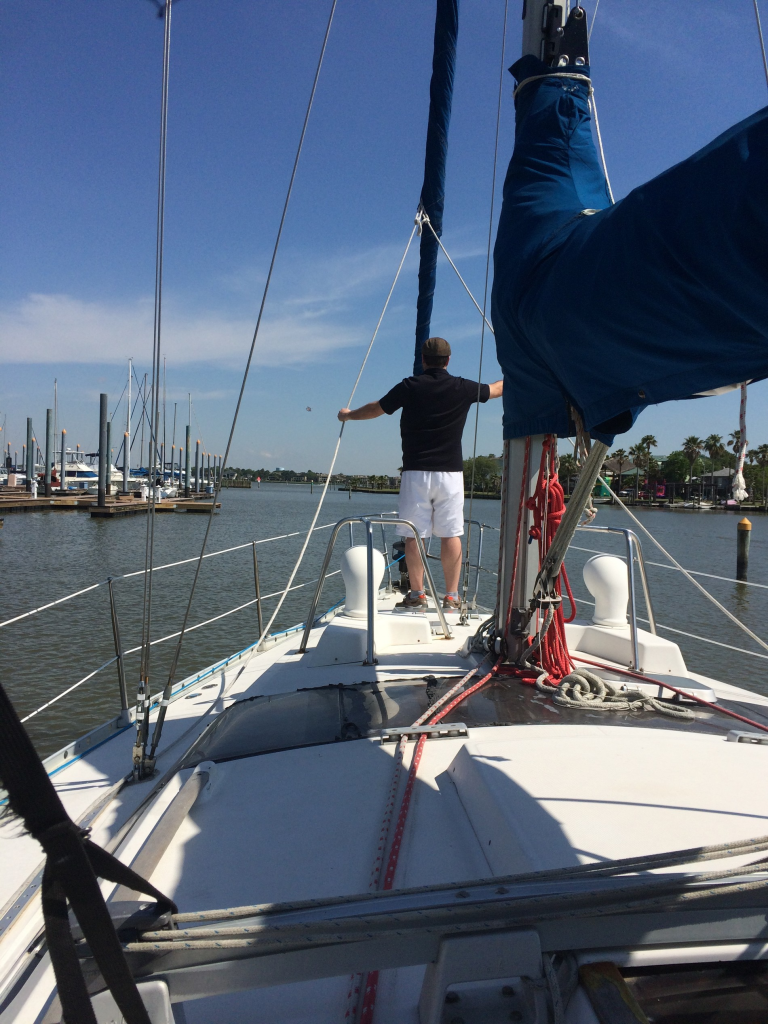
Leaving the marina
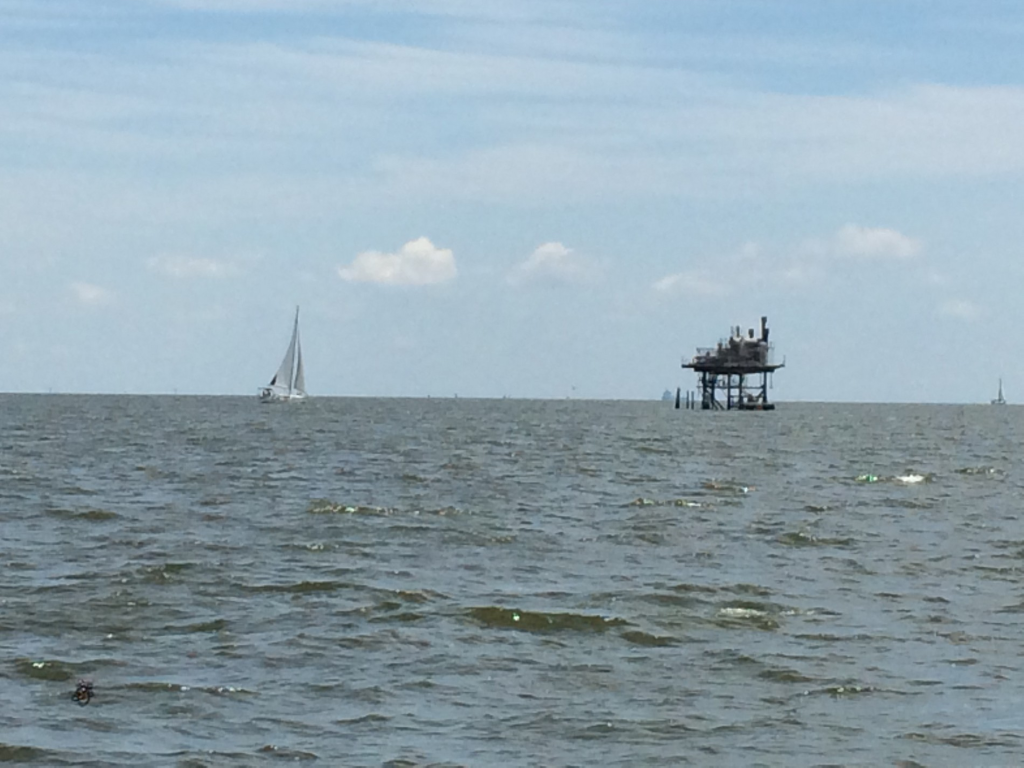
After reaching the end of the channel, we got the sails hoisted up without too much trouble. With the engine shut off, we had a pretty good amount of wind, so we were able to get a good full day’s worth of sailing in. We started by just sailing around back and forth in the bay, but then Jenn suggested that we try to head for the offshore oil platform just before the Houston Ship Channel, to get a closer look. That turned out to be a cool target to reach, because it offered a good lesson on a “lift”.
An oil platform near the Houston Ship Channel in Galveston Bay
Lift
When we headed towards the platform, it was not possible to sail directly towards it, because that would have meant sailing directly into the wind, which is impossible. So we were forced to sail about 30 degrees north of our desired target. But at some point, the wind shifted, such that we were now able to point directly to the platform and still maintain good speed. This shift in wind is called a “lift”, because there was a favorable wind shift of +20 degrees or so, and this wind shift allowed us to sail on a more direct course to the target, without being forced to change tacks and zig-zag to the target. (The opposite of a lift is a “header”, which takes you more off of your desired track.)
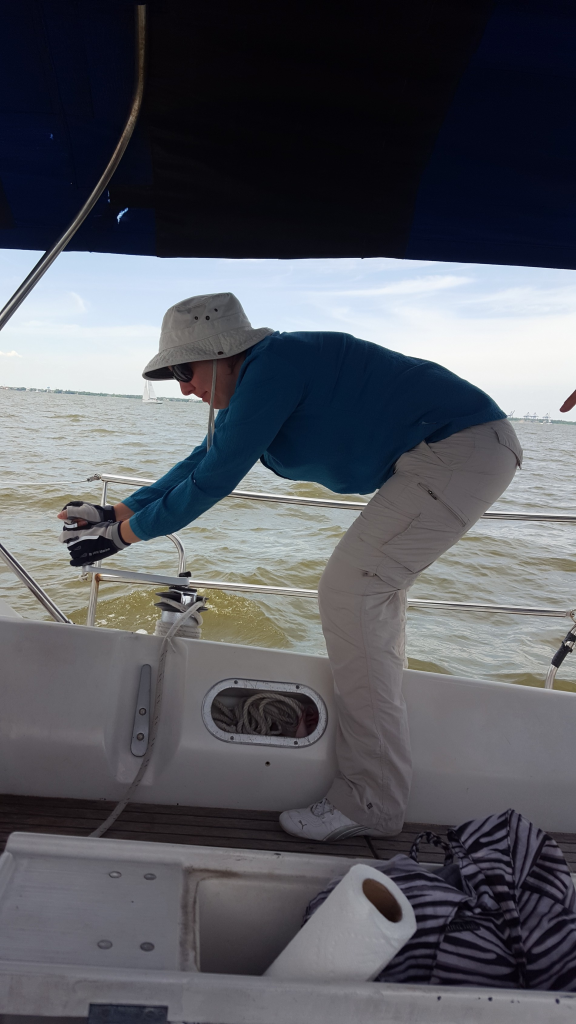
Grind that winch!
I managed to get us fairly close to the platform, but we didn’t get the close-up we were looking for because I changed tack too early, and to try to sail alongside the platform for a closer look would have been too risky. So we contented ourselves with a few photos and went on our way.
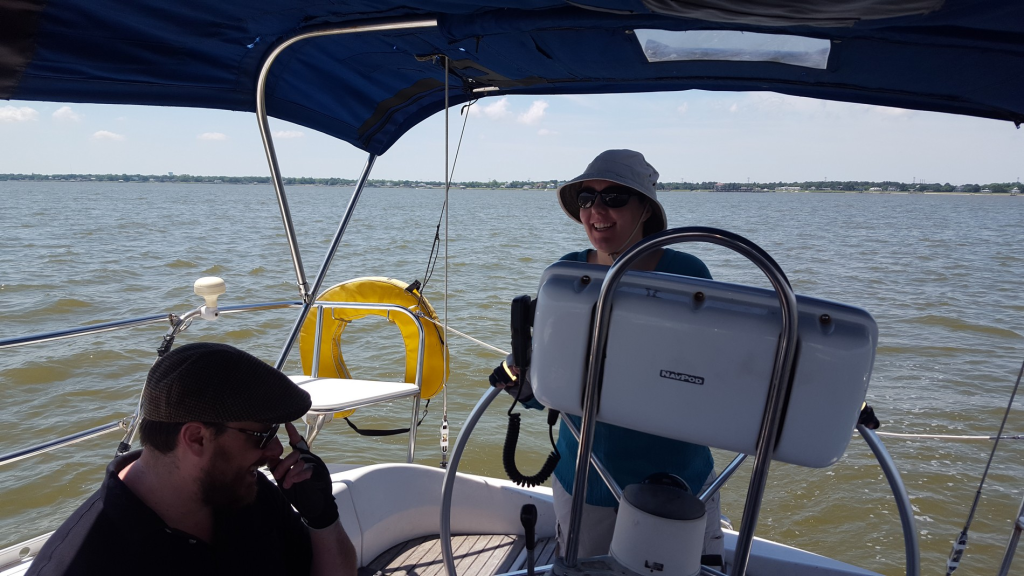
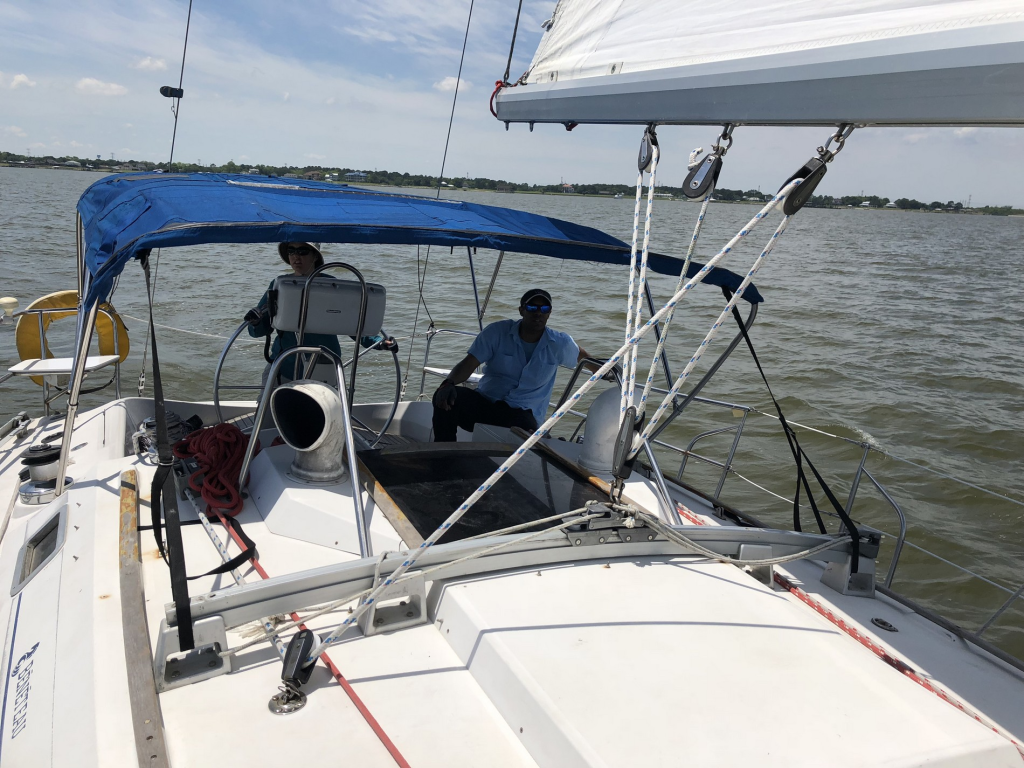
The helmsman and her lookout
Wrapping it up and heading in
The “casse-croûte” was a simple spread of chips & guac, and also a great Boursin cheese spread but with some badly stale crackers. The tortilla chips were good enough, and we tidied up after eating and got back to business sailing again. By the end of the outing, we managed to get our speed up to about 6 knots, which was not bad in the moderate winds we were sailing in.
Checking the wind vane, heeled over close-hauled
When we made it back to the marina, the docking was dicey because of the winds and strong current pushing towards the slip. Maybe also because I suck at docking? Anyway the docking was not slap-stick comedy, but there were at least two trials before we managed to get in safely.
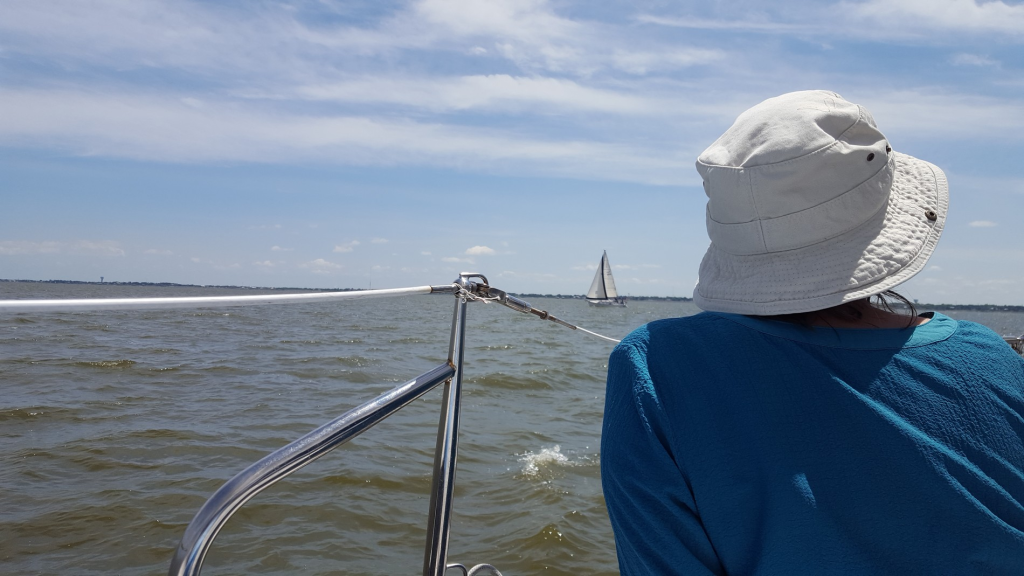
Enjoying the beautiful day at sea
After tidying up the sails and getting the sail covers on, we were done with our charter and we scooted on home. Another charter in the bag!
Even though we’re in Texas, the weather conditions do not leave us tempted to sail out on the water between November and February — so this excursion in the middle of March is my first time out this year. This was well anticipated, because my last-minute plans to head out the week prior were dashed due to lack of boat availability (Spring Break I think). So one week out, I had a full crew of 2 couples plus myself as skipper. But I failed to take into consideration St. Patrick’s Day, which, since it was the day before the scheduled charter, ended up putting 1 of 2 couples out of commission 🙂
Posing at the Marina…
The weather checked out to be very calm with light winds, so we decided to head out anyway, with a total crew of 3, including skipper. But we would be slightly short-handed, as one of the crew was new and would have a hard time managing the lines. We discussed it and decided it was okay– no pressure, if it got too difficult to manage, we could just drop sail and cruise around under motor or just head back in to the marina early.
…and out on the water
The sky was very overcast, so it was not a very happy day for a California boy, but it was not cold so we were in good spirits as we motored out into Galveston Bay. Once out of the channel, raising sail was simple enough…with the mainsail up we were hitting an impressive 0.8 knots 🙂 After a few minutes at that, we managed to get up to about 2-3 knots once the headsail (jib) was rolled out. This was actually not a bad cruising speed, because I don’t think we would have cleanly pulled off multiple tacking maneuvers with just me at the helm and one crew member on the lines.
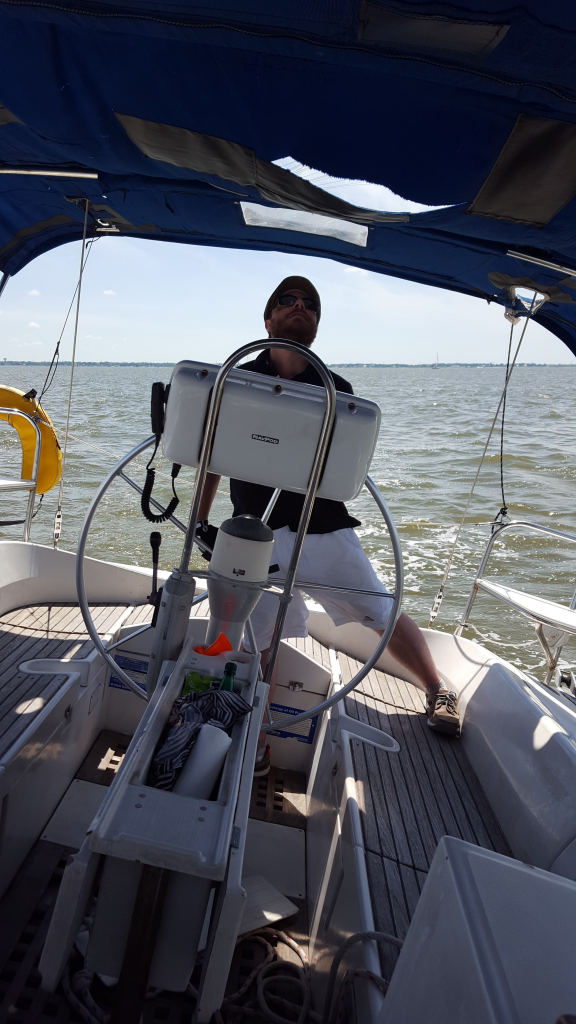
Skipper at the helm
In fact it was good that we were taking it easy, because after not too long my able-bodied 1st mate caught some light seasickness. After an hour on the water, the wind began to pick up slightly, such that we could have probably kicked it up to 6 knots or so upwind if we trimmed the sails in tight. But this was to be a day of easy cruising, to make sure the crew stayed comfy and recovered in calm.
Kicking back, enjoying the breeze
I was surprised to see a lot of sailboats out on the water, since the weather was not the greatest. I would guess they were all a bit like us, anxious to get back out on the water now that the weather cleared up a bit. After an hour or so further, we decided to call it quits and head back in to the Marina. Dropping sail was simple, because on this Beneteau 321 the sail cover is on lazyjacks, and so it does a sort of auto-furling of the sail automatically as it comes down into the cover.
Boats heading out to sea, maybe for a race?
The docking report: fake it till you make it! I steered us back into the slip…but I overshot it, so after a quick reverse and re-try, the boat was aimed perfectly for the next slip over. So I pretended that I thought I was in the right slip, and all thought I did a great job parking. I eventually backed out and went back in to the assigned slip, also with no issue. So it was quite the successful fake-out, if I may say so myself. In any case, the boat did not rub against any part of the slip– so a successful docking in my book.
Tidying up before heading home
All in all it was a very calm sail. The more I go out, the more comfortable it is to handle all of the standard tasks — setting the jib, dropping sail, docking, etc. Okay maybe I can use a bit more practice on the docking…but that is why we’re out here! Skipper Joel out.
The ASA 105 Coastal Navigation certification provides instruction on navigating using paper-based nautical charts.
Many people consider the traditional paper-based navigation techniques to be outdated in the age of GPS and electronic navigation systems. But it still stands that the electronics may break down at some point, leaving you with only paper navigation to fall back on.
As part of Boston-based Community Boating’sCoastal Piloting course, I learned many of these nautical chart navigation techniques back in 2000…but even back then I only partially absorbed the material, and by now I had forgotten 99.9% of what was taught back then.
So for this Coastal Navigation course, I was going to make sure that I not only learned and mastered each technique and skill, but also that I would take the time to document what I learned – this way if I look forward 10-15 years, I would be able to refer back to my notes and remember or re-teach myself the skills without too much trouble.
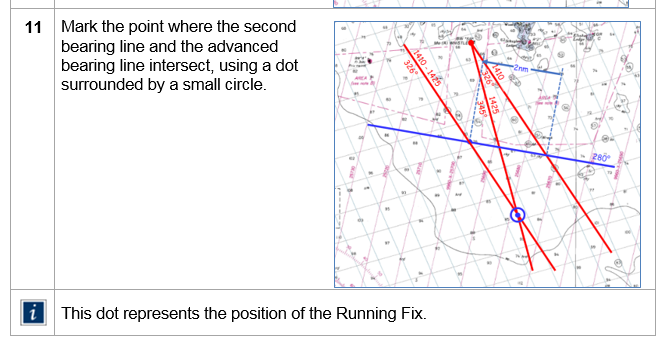
Determine position using a running fix (snippet from my documentation)
The instructor of the course developed a method of teaching which did not rely on textbooks and/or lots of reading material, but rather all skills and techniques directly taught using real examples. Now that the course is over and I have obtained the certification, I admit that I agree that that this teaching method was very effective in learning and understanding all of the skills without much confusion.
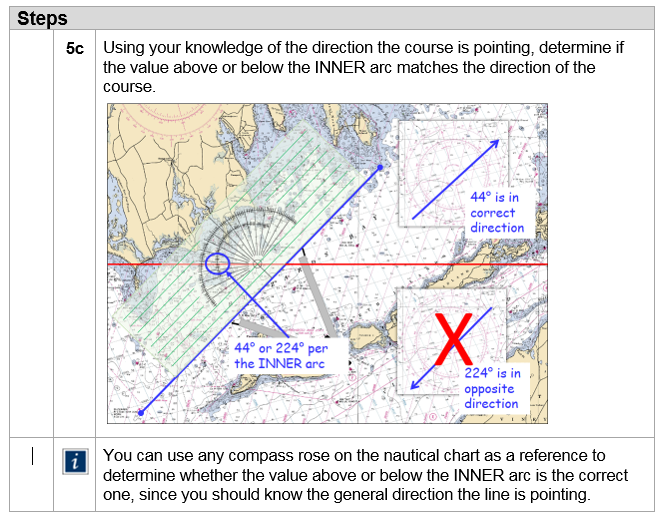
Measuring direction using an overlay plotter (snippet from my documentation)
The only major drawback of this method, is that it requires students to take diligent notes, if they are to leave the classroom and remember all which was taught. And there is not a tremendous amount of time during the course to take sufficiently detailed notes about the techniques; rather you spend most time committing the techniques to memory using exercises.
I will not bore you with a detailed breakdown of how each day went. I will, however, list out here the different techniques that we learned:
Determining Latitude and Longitude of a location
Measuring distances on a nautical chart
Plot and Label a course on a nautical chart
Determine a Fix using Lines of Position
Establish a DR Position
Determine a Running fix
Correcting for Current
Determining Set and Drift of a Current
Correcting for Leeway
Establishing Danger Bearings
Determine True course using Relative Bearings
Read and understand Tide and Current Tables
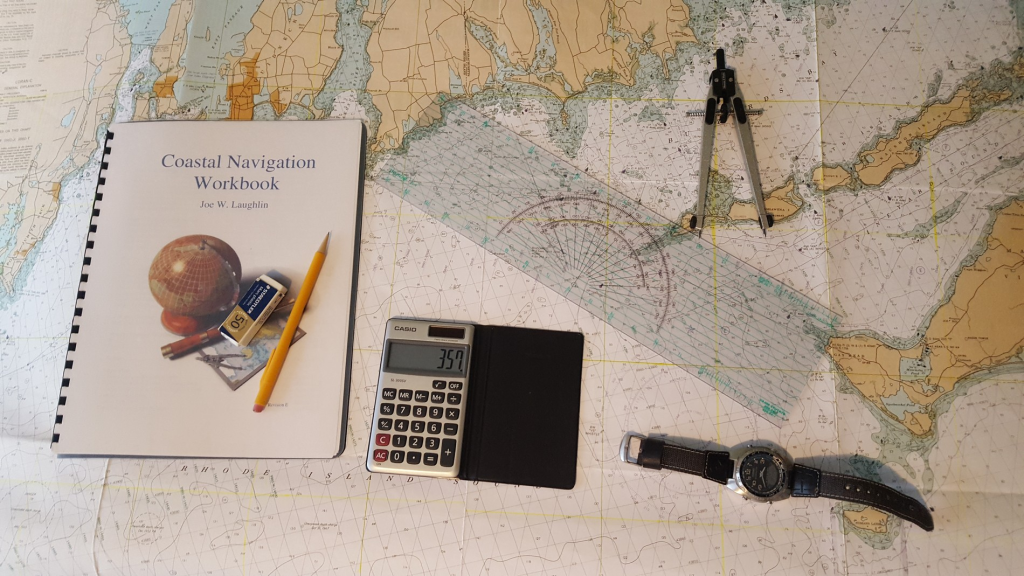
The certification works as follows: first you take the 2-day classroom course. You leave the course with a Workbook with exercises, a pair of of dividers, an overlay plotter, a training nautical chart (1210 TR) and a very simple solar–powered calculator. You then need to schedule a time with the school to take the exam. The main thing you have to practice with, is 2 practice exams they provide.
Tools of the trade
So for me, the 2-day course was only the beginning of my instruction on Coastal Navigation. The meat of the instruction for me, was after the course was over, when I made the decision to fully document each skill and technique in sufficient detail that I would always have a quick reference to fall back on. So for the next 4 weeks or so, I slowly went through each skill or technique, and documented each skill in a step-by-step procedure. All of this was being done on a computer, so that I would have a digital copy of the procedures. The basic method for each procedure was as follows: First, document the procedure using pen and paper. Next, transfer the procedure to an MS-Word document. Next came the challenging part, specifically for the techniques requiring writing on the nautical chart – to create clear visuals documenting each step in the paper plotting procedure.
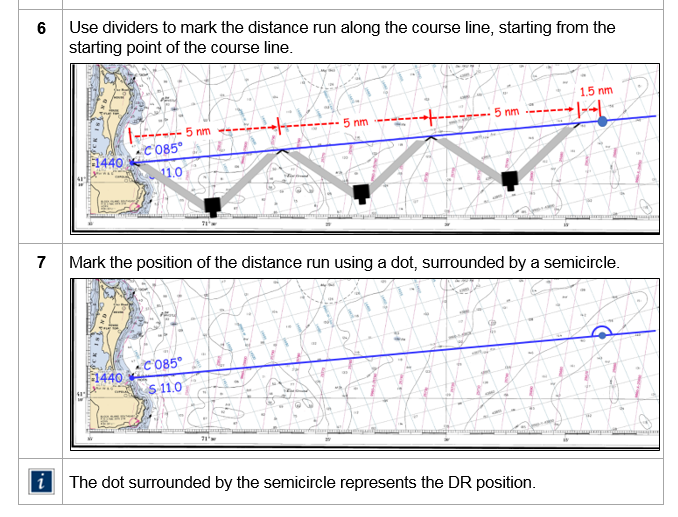
Establishing a DR position (snippet from my documentation)
What I found was that in the course of writing each skill in a step-by-step procedural format, is that I was forced to truly understand the skill thoroughly by the time that the documentation exercise was complete. That took a tremendous amount of time, but in the end it was definitely worth it. And now not only have I obtained the certification, but I also have a printed and bound permanent record of all which I have learned, documented in a way that I should always understand if I ever forget any skill and need to remember how to use it.
At this point the only key certification remaining for me to take under the ASA certification curriculum is the ASA 106 Advanced Coastal Cruising certification. This is where you learn to come into harbor at night, and other advanced skills allowing you to sail under any sea and weather conditions.
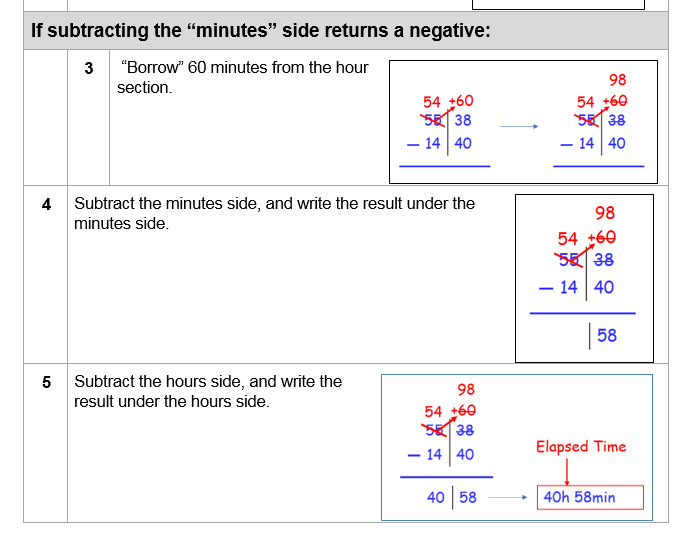
Using military time arithmetic (snippet from my documentation)
But at this point, more important than that course is for me to just get out there and get to sailing. Let’s get it!
Things might get hectic for the next few months, so I wanted to squeeze in another sailing excursion before it got too difficult to get out. My wife was originally supposed to come out on this sail, but she fell ill at the last minute and so I managed to get somebody to fill in for her.
Heading out to sea
Since this was a paying charter, I opted for the “full day” charter. And since I also joined the Bay Area Sailing Association (the sailing school’s sailing club), the “full day” means a full 24-hour charter with no time limit. The lack of time limit is a much more pleasant way to plan for a sail – you can show up later in the morning, and there is no hurry to get the boat back to the marina. The only trick is that if you are not going to head out until after 10AM, you’re gonna want to being food on board because you’ll get damn hungry sailing through the lunch hour.
Hiba helming
We had 2 new crew members, Nick and Hiba. Drew came along also, and so since this was his second time out with me he was automatically promoted to First Mate 🙂
We all met at the house, piled into one car and drove down together to the Marina. Since I was signing up to be a member, the crew was taken aboard the boat while I finished up the membership and chartering paperwork. Once all of the formalities were taken care of, and I was shown around the boat, we took a bit of time to familiarize ourselves with this boat. A Beneteau 32, the nice thing about this boat was that the sail cover is designed to neatly stow the mainsail as it is dropped, so no worries about returning the boat with the mainsail all sloppily wrapped around the boom. (That MIGHT have happened on a previous trip)
Drew striking a pose
After we went over the sail plan and what to expect, we fired up the engine and headed out. The seas were very calm at about 10:30 in the morning, with almost no wind to speak of. But we headed out anyway, beyond the Kemah Boardwalk and out into Galveston Bay. Today the Bay was a lot less crowded — partially I’m sure because it was a lot colder than it normally is in Houston, but also because there were no races planned for that day.
Competent Crew
At the helm, Nick took us out of the channel and into open water. We raised the mainsail and jib, but the wind was so low that I was concerned we would not move anywhere. In fact we did start to move forward, albeit at a very calm pace (2-3 knots maximum).
Nick at the helm
We kept at that for awhile, and we practiced a few calm tacks to get the mechanics down with Nick at the helm and Hiba & Drew handling the jib sheets. After awhile the wind started to pick up ever so slightly, and we began to cruise around 3.5 knots, and eventually making it up to four knots.
Crew hard at work getting through a tack!
After about 1.5 hours, we all got hungry so we broke out the snacks. Cheese, crackers, tomatoes, drinks, and we even cranked up the radio to kick back with some music. We never actually stopped sailing, I think we were at a broad- to close-reached course with me behind the helm for most of the time while we all snacked.
Snack time!
When we finished up with the snacks, we tidied up and then got back to the sailing, because the wind started to pick up a bit more. With Hiba at the helm we got up to 4.5 knots, which was pretty good considering the light wind conditions we were sailing in. But it was a bit too cold out (for Houston), and after awhile Hiba sneaked down into the cabin to warm up as the rest of us continued on sailing.
Moving forward to check the sail trim
By this time we were almost up to 5 knots, but we were just about ready to head back in. It took us about an hour to make it back to the channel entrance – we had sailed out much further than I had realized. It will be good practice in the future for me to start estimating how far out we sail based on our time out and average speed, to see if I can start getting good at navigating us on a planned course, schedule and travel plan.
With the sails dropped and the engine started up, I took us back in to the marina under power. The docking this time was a bit of a mess, with two misfires and u-turns. But we eventually managed to get the boat back into the slip after a few tries and without rubbing the boat against the dock, so all was good.
Bringing her back to the slip in the marina
There was not much tidying up to do, just stowing away all of the items which were loose in thee cockpit. I realized later that I should have brought the winch handles into the cabin, but I’ll just remember that for next time.
Hard at work skippering again 🙂
So even though the wind was very light, we still were able to enjoy a nice calm excursion out in Galveston Bay, with good sailing time. Looking forward to more practice !
Drew, Alex and Varence all decided that they were down to accompany me on my first bareboat charter. None of them considered themselves to be “competent crew”, but Drew had at least been on a sailing cruise before.
The Competent Crew!
We were assigned a Beneteau 390, which is a 39-foot sloop-rigged keelboat with auxiliary power (diesel engine). That size of boat is fitted out with two bedrooms (“staterooms”), toilet, oven & stove, and refrigerator. We would not be needing any of those amenities, though, on our short trip.
After Glen from the Bay Area Sailing Association gave me all of the forms to fill out and explained where everything was on the boat, he left me with my crew and told us to make sure to get back by 1:00 PM. We spent a few minutes more sitting on the boat in the marina, so that I could explain our sail plan and how the sailing excursion would go. The plan was a typical one for such a short trip out of Kemah – take the boat out under power out of the marina to Clear Lake, motor out past the Kemah Boardwalk, and head out into Galveston Bay until we clear the channel (we take 2 channels to get out to Galveston Bay from the marina in Kemah). After that raise the sails, and start sailing until about 12:00 PM, when we would drop sails and bring the boat back to the Marina.
Skipper providing his expert tutelage 🙂
Since it was a calm day with no wind at the dock, casting off was simple and we were under way in no time. The ride out to Galveston Bay was cool, as it gave us a chance to talk about some basics of sailing, and how to navigate in a channel. Once we made it out to the final channel marker, we turned out and raised mainsail first, then the headsail, and we were off!
Joel & Alex posing for a photo op
Well, we were not really off to a speedy start because the wind was pretty weak. But after 10 minutes or so, we were able to head up to an upwind course, and since around that same time the wind started to pick up, we managed to get a little speed and wind in the sails, and we were sailing on our close-hauled course! Alex was at the helm to start us off, and he had a steady hand which was great. We picked up speed slowly but steadily, the boat was keeled well over, and we made it to about 6 knots by the time we needed to change course via a tack maneuver. Not bad for light winds.
Drew posing for the camera
After a short explanation of the mechanics of tacking and the verbal commands and responses, and with Drew and I handling the jib sheets, we handled the tacking with not too much pain. After the tack, Drew took over as helmsman, and he took us first on a beam-reached course, then a more broad reached downwind course. After a jibe, we turned back upwind so Drew could have a hand at helming the upwind course. Since the wind picked up, Drew was able to get us up to almost 7 knots. With the boat nicely keeled over again, this was a good clip to sail on and we all enjoyed feeling the wind on our faces.
Moving upwind at a good clip
After 10 more minutes of that, it was time to start heading back. Varence took over at the helm to get us closer to the shore. The crew pointed out the direction of the first channel marker and we approached the channel entrance, dropped sails, fired up the motor, then I took over helm duties to maneuver into the channel. By this time the wind had picked up and the sea was much more choppy, and so we rocked and rolled a bit as we motored our way back to the marina. Just before we got into the final stretch, a procession of about 25 speedboats began to intersect our path, and it was a bit hairy to find out way though that. But we managed okay, and before long we were heading back into our boat slip in the marina. I was a bit anxious as I don’t have the best track record for docking, but it went very smoothly and all in all we looked like pros as the boat slid gently into its slip and we tied the boat in.
Varence at the helm
I think this first trip out was a success – I had a good time, no major mishaps, and I’m getting more experience maneuvering the boat in the tight quarters of the marina. I discovered that skippering is a fun experience also, because you have the opportunity to really enjoy the sailing, while giving the crew members lots of time to learn how to helm and manage the lines. I think I can begin to enjoy these types of outings.
Skipper hard at work skippering! 🙂
The biggest thing I need to work on for the next times out, is managing the dropping of the mainsail when it’s not a in-mast roller-furling type of mainsail. It was a very sloppy and ridiculous looking affair this time out, and it also looked sloppy with the sail cover on back in the boat slip. So I definitely would like some more practice getting that mainsail sorted out properly, because I strive to leave the sailboat in the best condition as possible when the charter is over.
After taking the Bay Area Sailing School‘s ASA 101 Basic Keelboat Sailing course, each student gets 1 free “mentoring” session with a captain, and 1 free charter. I decided to wait until I was certified to take boats out bareboat, before taking advantage of my mentoring session. And it worked out good because I did not get a lot of practice taking boats out of a slip and docking while under motor.
Captain Vernon is the old-timer who accompanied us on the mentoring session. The session lasts about 4 hours, from 8:30 AM to 12:30 PM, and its main purpose is for the sailing school to give the students sufficient training and practice for them to take boats out safely without supervision. This means mainly getting sailors comfortable and proficient in docking while under motor, and also taking us out to the bay to show us the safest way to get in and out, and where to sail and where not to sail.
There were four of us out: me and a lady who was also certified in ASA 103/104, and a couple who had just finished their ASA 101 course.
The docking drill was for each of us to take the helm, back the boat out of the slip, turn out to the main traffic lane, make a u-turn, then put the boat back into the slip under motor. This is the most daunting part of sailing for me – once we’re out on the water I am fairly confident in my skills, but it is the docking and maneuvering in tight quarters with the motor that makes me the most nervous. Especially since you can damage the charter boat or even worse, another boat owned by somebody else!
The drill was a great start to building my confidence. Two times of docking with the instructor guiding me, and then once with no guidance. I managed to get the boat into the slip without any mishaps all 3 times, so I am starting to get more comfortable with the whole motoring thing.
After all four of us finished the docking exercise, one of us took us out of the marina, out past the Kemah Boardwalk, and into Galveston Bay. I was surprised to find out that the area just in front of Kemah Boardwalk is known as Galveston Bay, because for me Galveston Bay is nearer to the actual city of Galveston. Once in the bay and clear of the channel, we all got practice in doing man overboard (MOB) drills while under motor. The technique is fairly simple – if the MOB falls on the port side of the boat, first note the compass heading, then turn quickly to port for a few seconds, and make a circle turning to starboard. You straighten up when the boat is heading at the previous heading minus 180 degrees. Simple!
Captain Vernon decided that it was best for us to sail with a Jib only. This was not really due to the wind or sea conditions, but more because of the amount of time required to raise and stow the sail on the Beneteau 32 that we were sailing on (The course was only 4 hours, and by this time we only have about 1.5 hours left).
Sailing with a Jib and no mainsail
I had never sailed with only a Jib, so this would be a new experience for me. In the end it was not a huge deal – you sail just as you would as if the mainsail was hoisted. The boat even heels mildly when on an upwind course. So it was new to me, but not much more to learn, really. And when the wind picked up, I was surprised to see just how fast the boat would go with only the headsail up. Captain Vernon did say that if the mainsail were in play we would go 50% faster, but I was still impressed at that one sail’s power.
Passing under the Bayport Blvd. bridge (146) on the way back to the marina
After we all had 10 minutes or so each at the helm under sail, we turned back towards the marina as the mentoring session was almost over. After another student took us in, I was to get us back into the slip. First time in? FAIL 🙁 I started to turn in too late, and I would have rammed the bow into a piling if I hadn’t quickly slammed the engine into reverse gear at full throttle at the last minute. Captain took over the helm to recover, backed us up back to a safe point, and let me have another go at it. This time I made it in the slip just fine, and after the crew secured all of the docklines and we plugged back in to shorepower, the session was over and we parted ways.
In the end the mentoring session was just what I needed. A lot of the time I was just hanging out on the boat, as much of the instruction I already had as part of the ASA 103/104 Combo course. But I definitely learned a great deal about how to safely guide a large sailboat into a slip, and the practice has made me much more confident about taking the boat out on my own.
I have now reached the point where the instruction needs to stop for awhile, and I need to just start getting out on the water on my own and get that sailing experience in! Now just to find a worthy crew….