ASA 103-104 Combo Course, Day 3

Day 3: 10-September-2017

We planned to be out on the water by 8:00 AM, so all of us were up by 6:30 AM to make that deadline. We all ate our bagels and gulped down a short draft of coffee, and quickly motored out of our slip to head back to the ship channel.

Back alongside the Ship Channel

The plan was to sail upwind parallel to the ship channel, which would take us most of the way in. If the wind was blowing in the ideal direction, we could maintain the same point of sail for the entire time without much need of tacking to maintain course. The wind was a strong 15 knots, so it was a very exciting upwind course. On the water, we learned that when sailing upwind, it can actually be smoother and faster to sail with the sails up, than to drop sails and try to motor upwind. We spotted a sailboat with sails dropped, pointed in the same direction as us, about 300 yards ahead. But they not only seemed to be making a very slow go at it, they were also bobbing back and forth quite wildly with the waves. By contrast, our boat was heeled over to one side, but the ride was clearly much smoother than our non-sailing comrades. And in short order, we not only ended up passing them, but by the time we left the ship channel we could not even see them behind us anymore! We really left them in the dust, so to speak.
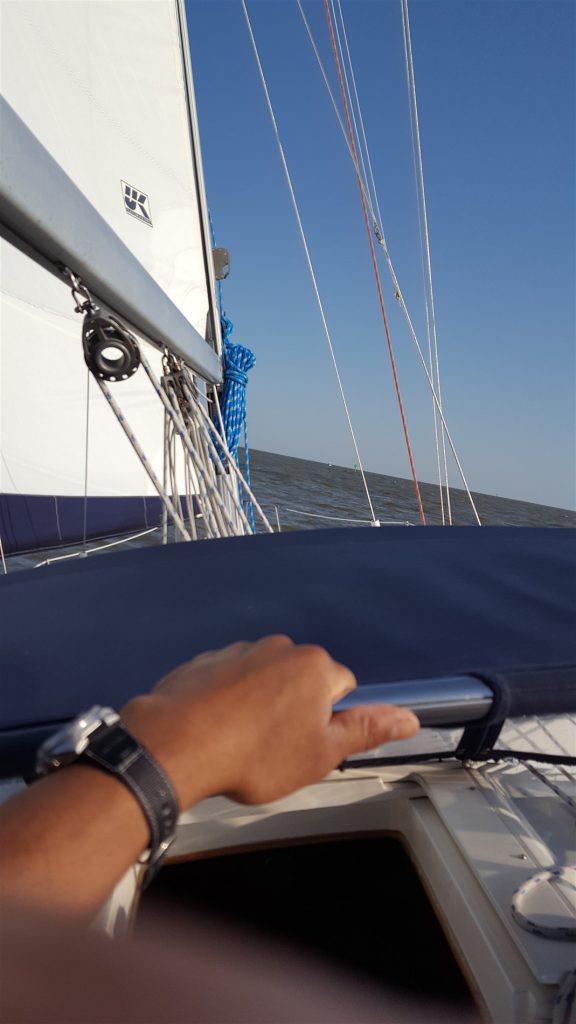
Image of boat's sails
Trying to get a good picture with the boat heeled way over

Bringing it Home & Wrapping it up

The final hour of sailing is when we turned away from the Houston Ship Channel, and we made a direct course towards Kemah. The big challenge on this final leg, is to maintain a beam-to-broad reached point of sail, with a steady compass heading. The others were fairly good at this, but I was pretty terrible at it. I don’t really enjoy sailing downwind, so I always have a tendency to steer more upwind, which brought us way off course. At one point I realized that I was as much as 50 degrees off course! By the time Captain Jon had come back on deck, he was disappointed to see how much off course we had become after 40 minutes or so. No worries though, we were not in a huge hurry so the slight delay was not a big problem.
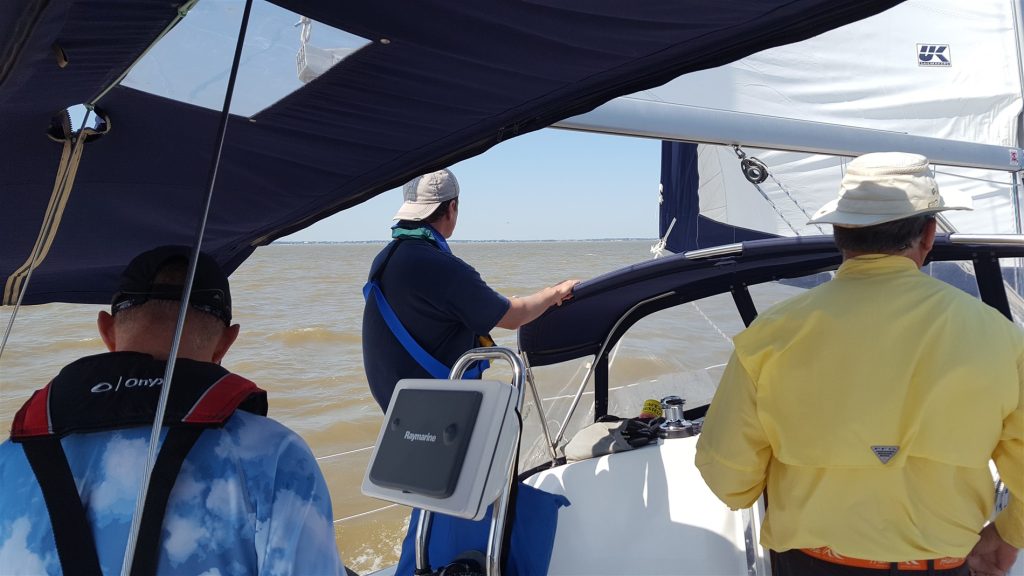
Image of the crew riding on the sailboat on the water
Eddie, Steve, and Capatin Jon on the way back to the Kemah Marina

Our final approach to the marina via Clear Lake was under motor, so we dropped sail and headed in towards our designated slip. I was supposed to take us into the slip, but after an initial mishap, Captain Job took over as the reverse ‘parking’ maneuver was quite delicate in the moderate wind & current conditions. Once secured to the dock, we had our lunch, prepared for a 1/2 hour and then took both written exams back to back. Each exam was 100 questions long!!! I was a bit worried because although I had read both books multiple times, I did not have much time to review the material before taking the tests. But I ended up doing quite well, and in fact I got 100% on the chart navigation questions! (There were only 5)
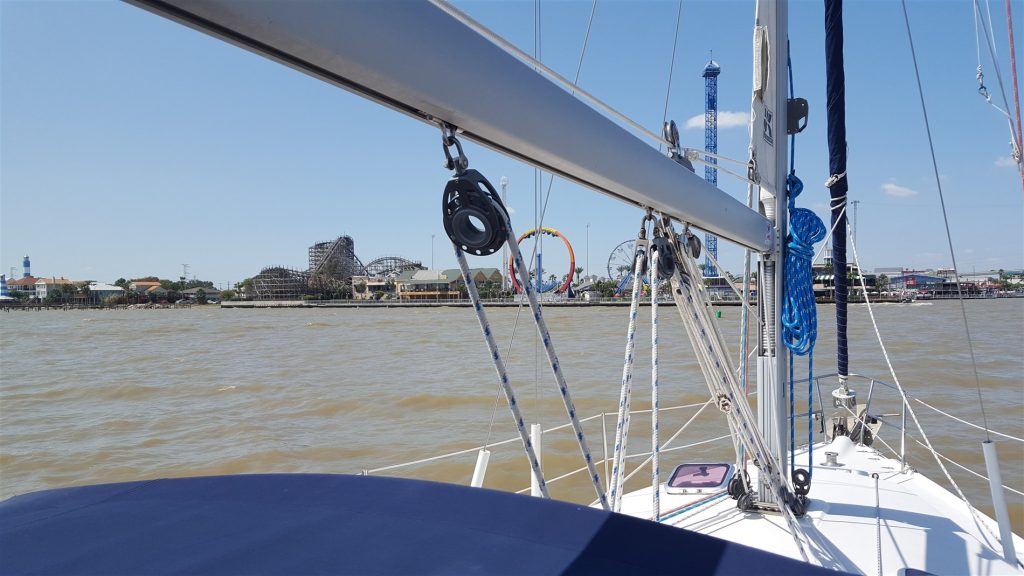
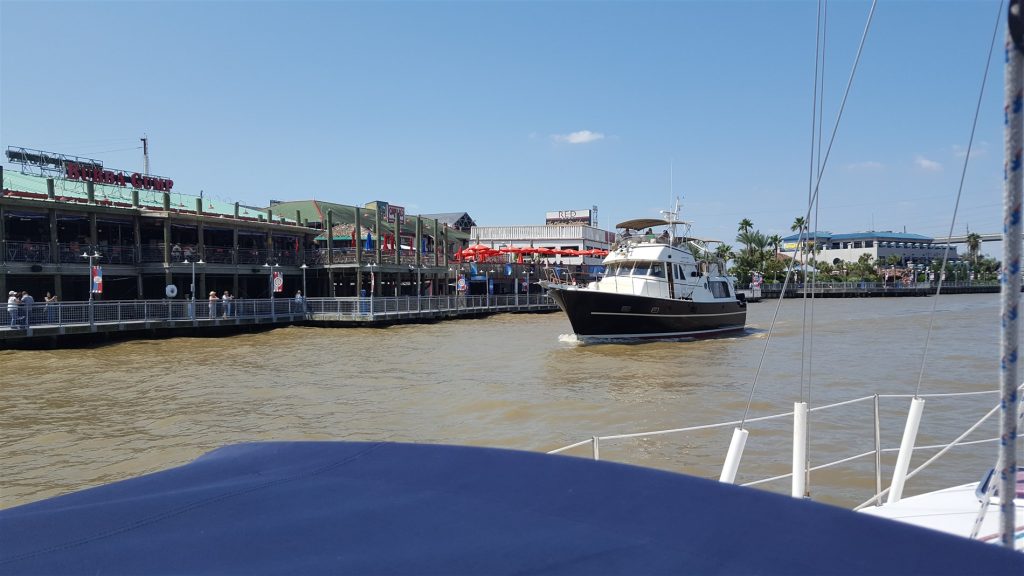
Image of Kemah Boardwalk in the distance, taken from the front of a sailboat on the water
Approaching the Kemah Boardwalk under motor
Image of the Kemah boardwalk taken from the water, while passing a motor yacht
Passing a recreational yacht while passing by the Kemah Boardwalk

All three of us students passed the 103 and 104 certifications, so after a final knot review we gathered our belongings, exchanged phone numbers, and parted ways.

Was it worth it?

When I decided to take this ASA 103/104 combo certification course, my motivations were three-fold. First, I had never been on a 36-foot sailboat with toilet, galley, in-board motor and staterooms. So the course would help me gauge whether that class of boat is my preferred class. Second, I had never been on a multi-day sailing excursion. So the course would also provide insight as to whether multi-day excursions are something I will enjoy, or if day-sailing is more my cup of tea. And finally third, I definitely want the freedom of knowing that I can charter out a boat unsupervised. And the ASA 104 certification provides just that.

So all in all, the course was well worth the money. As for the boat class, I have mixed feelings. There are a great number of things to maintain, but in such a small vessel, the maintenance tasks do not seem to be too overwhelming. On a 36-foot boat, the other drawback is that it is not trivial to sail the vessel single-handed. So solo excursions may prove to be challenging and slightly risky. But I suppose that finding people interested on going out for a sail as crew should not be too difficult 🙂

In the way we structured it, the multi-day excursion was just fne, and a nice stay-cation.There is no need for a hotel as you can sleep on the boat, and if you want to sneak off to a full-service restaurant or bar while docked, that is also an option. Another bonus, we never were forced to use the head on board– the Galveston Yacht Marina had toilets & shower facilities, so that was also painless. The beds on the boat were surprisingly roomy and comfortable. In fact my only issue was the snoring between Eddie and I kept me up on the final night. So I enjoyed the multi-day adventure. I think that the longer you are at sea without docking, the less glamorous the adventure becomes, though.

So I learned a great deal on this 3-day course, and I am now ready to start getting my practice hours in so that I can sail independently with confidence!
ASA 103-104 Combo Course, Day 2

Day 2: 9-September-2017

When we all had woken up, Captain Jon had already brewed the first batch of coffee. He was out on the deck having a smoke and listening to the weather report on the VHF radio. We didn’t need to use the toilet or shower on the boat, because the Marina where we were docked had bathrooms equipped with showers. So after we freshened up & emptied our bowels, we cracked open the bagels & cream cheese, and ate our breakfast over coffee.

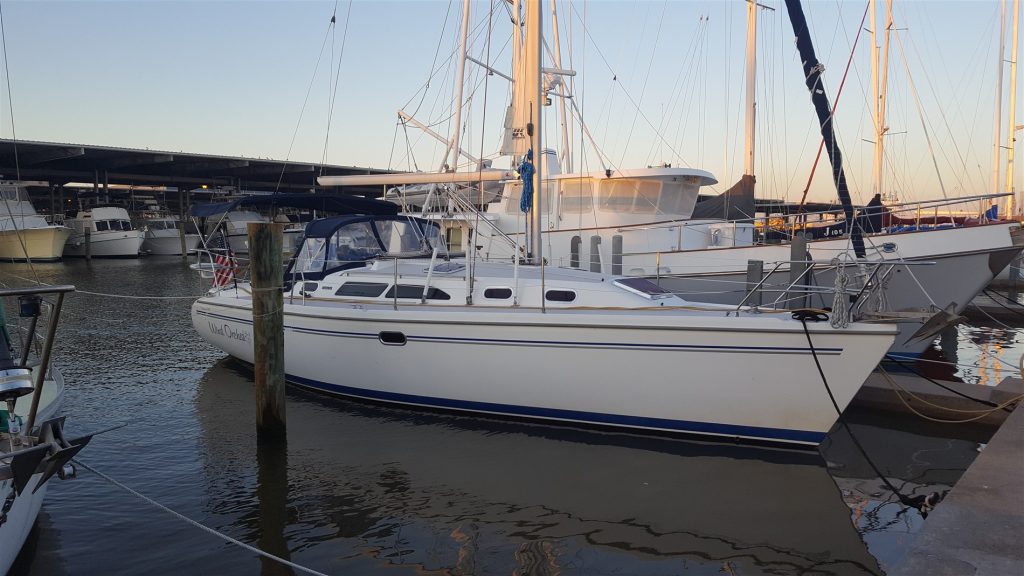
Image of the Wind Orchid sailboat docked at the marina
The Wind Orchid docked in Galveston Marina

The plan for the day was in two parts. In the morning, we could use the area just outside of the Marina to complete our anchoring lesson and exercises. Then we would sail off towards the Gulf, where we would get in more sail time and do our man overboard (MOB) drills. We’d dock back at the same marina in Galveston the second evening.

Image of may sailboats docked in a marina at daybreak
The Galveston Yacht Marina at daybreak

Morning at the Anchorage

I manned the helm and took us out to the anchorage site. We circled around for awhile as Captain Jon gave us the instruction, and then we prepared for anchoring. We decided on using the all-chain anchor rode, and Eddie would helm as all others would manage dropping the anchor. Here you realize the importance of hand signals, to communicate to the helmsman to back up, stop, point in the direction of the anchor, etc. Everything went smoothly, except for the windlass accidentally letting the anchor drop just after it had been 100% hauled in. It was not really a windlass failure, but a mishandling of the rode as we were tidying up. But nobody was hurt, and we were able to quickly recover and get on our way. Before we had raised anchor though, we made sandwiches, opened the bag of chips and ate lunch.

Out to the Gulf

As soon as Captain Jon had finished eating, he broke out the tether, harness, and jacklines, and explained that we would need them as the seas were quite choppy in the Gulf that day.

So with all of our equipment prepared, we began motoring out of the bay and along the outside of the Ship Channel in the direction of the open sea. Once we cleared and rounded the end of the jetty with a wide berth for safety, we raised sails and headed out into the Gulf of Mexico under sail. We had good wind, but it became decidedly more tame and easier to manage after a 1/2 hour or so. But no worries, because there was still plenty of wind to sail in and man, was it beautiful weather! It was just before the end of the summer, and it was the first weekend where the sun had relented a bit and gave us a glimpse of the more moderate temperatures of Houston winter & fall. What a great experience!

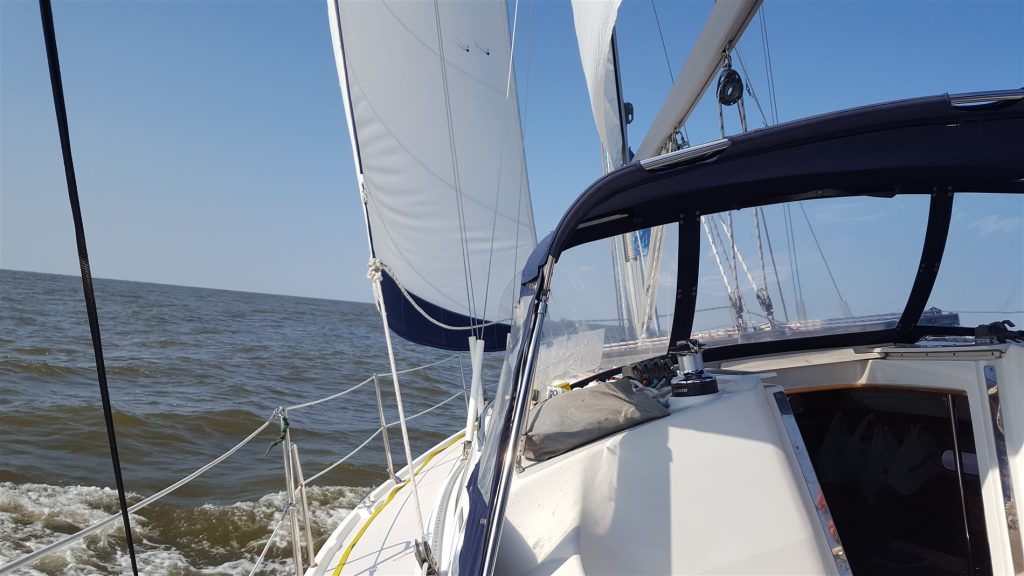
Image from the cockpit of a sailboat which is heeled over to the left
Heeled over on a close-hauled point of sail
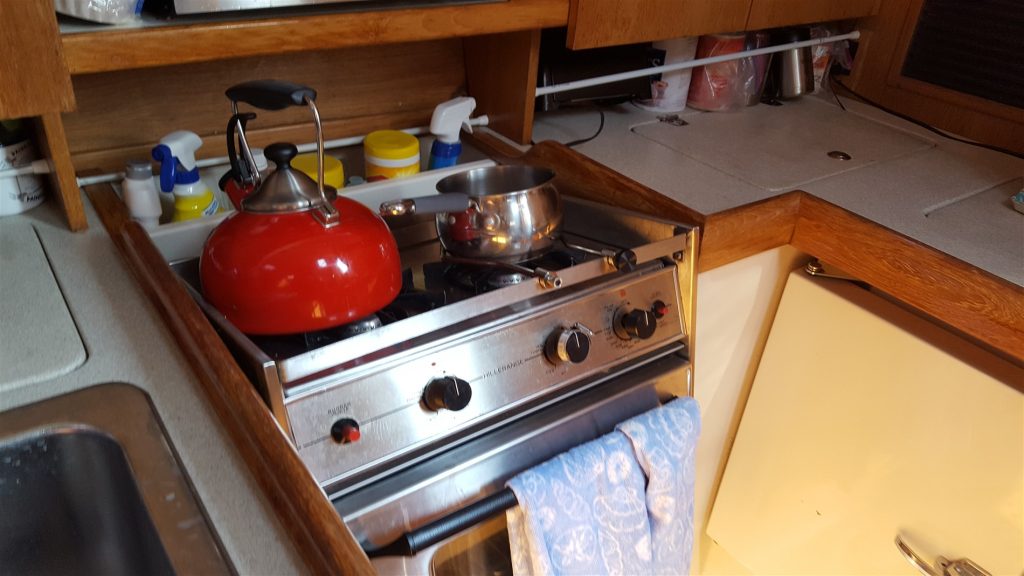
Image of range + oven tilted backwards on the kimbal
The Stove-top remains upright even when the boat is heeled over, because it swivels on the kimbal

Man Overboard Drills

After a few rotations at the helm, we each were to try our hand at the Man Overboard drill. Captain Jon taught us a new method, which involves sailing past the MOB and heaving-to to stop the boat upwind of the MOB. This is a much more pleasant and controlled method, when compared to the method of letting go of the sails and hoping the flogging lines don’t injure the crew or the MOB. I was able to pick up the MOB on my first pass, and the other students also managed just fine. After the MOB drills, we turned to head back to Galveston — we had sailed out to sea for a long time, and we wanted to ensure we got back to the marina before nightfall.

Technique: MOB Drill
In the MOB heave-to technique, you approach the MOB on a close reach. as soon as the bow reaches the MOB, you can tack the boat, leaving the jib back-winded, and complete the heave-to maneuver.

Back to the Marina

The long way back to the marina gave each of us lots of sailing time at the helm. For me, this was a great help because it takes awhile to strike the right balance and to not be forced to over-steer and correct, over steer and correct, on infinite loop. All it took was Captain Jon to take the wheel from me, steer for 60 seconds or so, then show me how well the boat and rudder were balanced by letting go of the wheel and watching the wheel stay in its close to neutral position. If I had let go of the wheel, the boat would have definitely veered wildly off course. So that gave me a good goal to work towards, and I’ll always remember that lesson as I helm in the future.

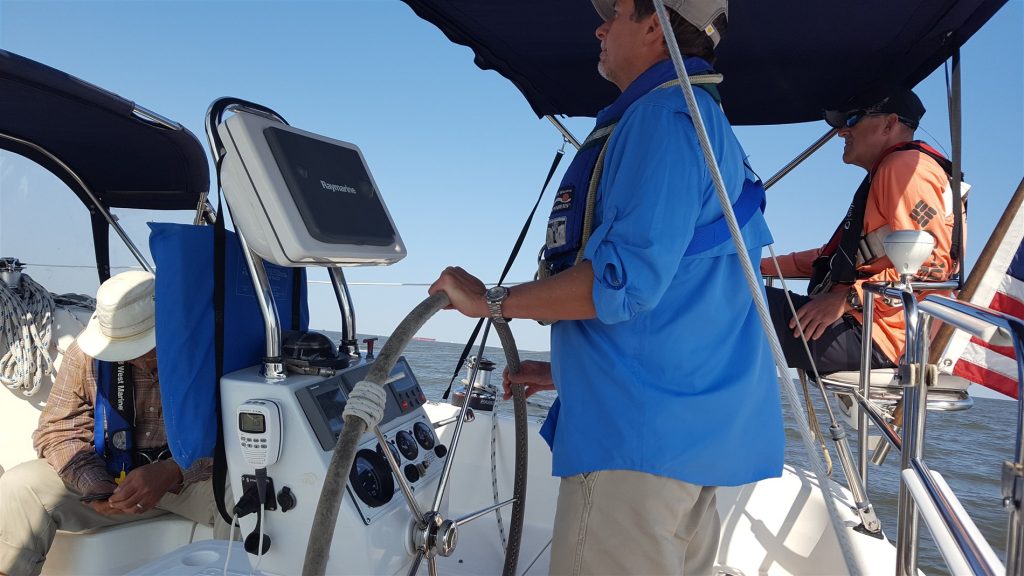
Image of helmsman and crew in the boat
Eddie at the helm of the Wind Orchid
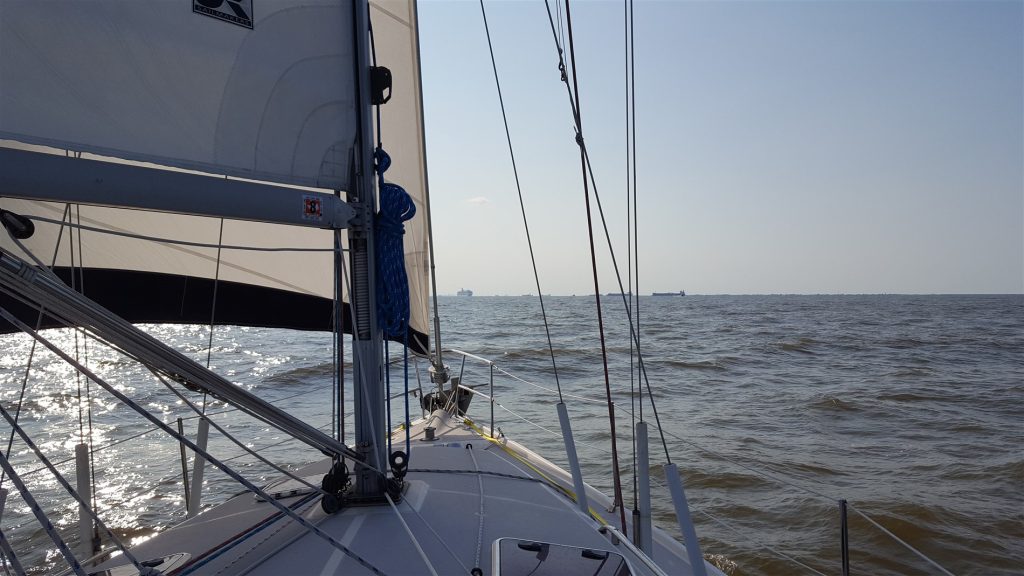
View from the front of a sailboat at a beam reach
Sailing on a beam reach back to the Marina

After a bit of struggle to find the end-of-jetty marker, we rounded the jetty and headed back to the marina on a downwind course. Steve took us in to the slip this time. Once we were all settled in and freshened up, we laid back, cracked a few beers, and got cracking on preparing our dinner. We had planned to make chicken fajitas, chips, and salsa, so while Steve cooked up the fare, the rest of us drank and swapped stories out in the cockpit of the boat. With the food eaten, dishes were washed up and then we went for bed.

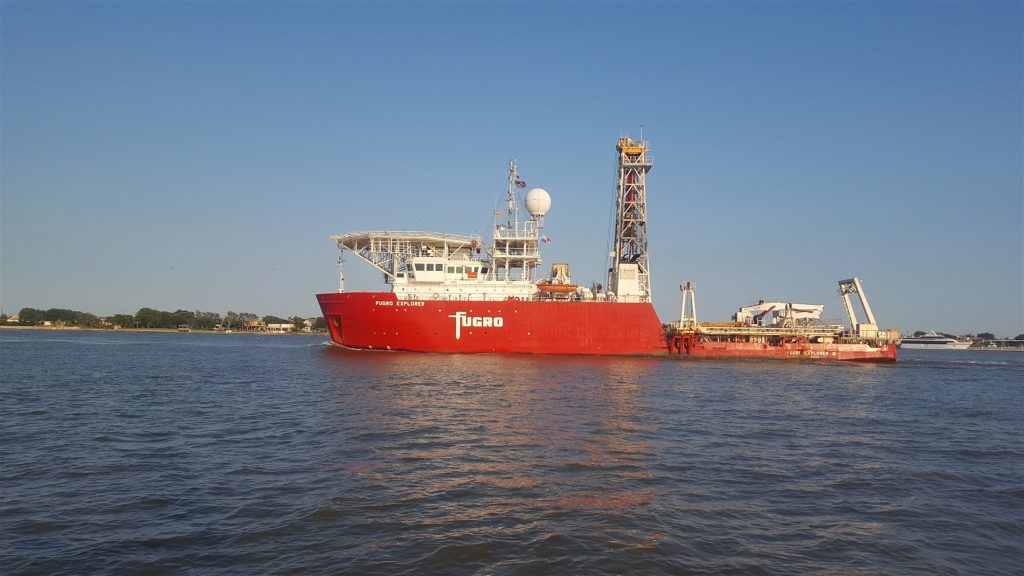
Image of a large commercial vessel in the HoustonShip Channel
Passing up a large vessel inside the Houston Ship Channel

ASA 103-104 Combo Course, Day 1

Day 1: Friday 8-September-2017

Following a 2-week period of natural disasters and family emergencies, I flew back to Houston from LAX on Thursday night, just in time to make it to the ASA 103/104 Combo Course. This would bee a great break from the stress anxiety of the past 2 weeks, so I’m glad I could make it.

I arrived to the Bay Area Sailing School on time at 8:00 AM, but since one student was late, I drove to the nearby marine supply store to pick up a digital watch because I could not find my fitbit. Once all of us were present, around 9:00 AM, we sat down to spend about a 1/2 hour to get to know each other, and to give our stories about why we’re taking the course.

There were three of us students. Me, I was there to get proficient at keelboat sailing, because dinghy sailing has many limitations. The two other gents were close to retirement age, and both had plans to pick up a new sailing hobby for their retirement. Our instructor Jon seemed pretty laid back. He learned to sail during a U.S.-Canada exchange program and picked up the practice again years later. We learned that we ere to spend the next 3 days aboard Jon’s personal boat – a Catalina 350, which is a 36-foot sloop-rigged keelboat with a steering wheel, head with toilet shower and sink, a galley (kitchen) with sink, faucet and propane stove, two staterooms (bedrooms), air conditioning, and a main cabin with a common table and chart table.

Planning the Itinerary & Provisioning

The basic ASA 103/104 Combo Course at the Bay Area Sailing School is generally as follows:

  • Day 1, AM: Learn the boat, get provisions
  • Day 1, PM: Sail to Galveston Bay, Sleep in Galveston.
  • Day 2: Sail to Gulf of Mexico, and return to Galveston.
  • Day 3: Sail back to Kemah, take written exams while docked.

So we got about an hour of introduction to the boat, and then Captain Jon left us students alone so that we could decide on a final itinerary. This was important, because the itinerary would also include how many breakfasts, lunches, and dinners to provision for.

So here is the itinerary we settled on:

FRIDAY 8-SEP

  • Lunch in Kemah, on shore
  • PM: Sail to Galveston Bay
  • PM: Dock in Galveston
  • Dinner: Onshore, at a nearby Pub
  • Sleep on the ship

SATURDAY 9-SEP

  • Breakfast on boat
    • Coffee, Bagels, & Cream Cheese
  • AM: Anchoring practice in Galveston Bay
  • Lunch on boat
    • Deli-meat sandwiches, chips
  • PM: Sail to the open sea in the Gulf of Mexico
  • PM: Practice sailing in the Gulf of Mexico
  • PM: Sail back to the slip in Galveston Bay marina, and dock.
  • Dinner on boat
    • Chicken quesadillas, chips & salsa
  • Sleep on ship

SUNDAY 10-SEP

  • Breakfast on boat
    • Coffee, Bagels, & Cream Cheese
  • AM: Sail back to Kemah, Bay Area Sailing School
  • Lunch on boat
    • Deli-meat sandwiches, chips
  • Finish written exams
  • Part ways.

So based on the itinerary, we decided that we needed the following provisions:

  • Two Breakfasts:
    • 8 Bagels
    • 1 Pot of Cream Cheese
  • Two Lunches:
    • 1 Sandwich per person per lunch:
      • 16 Slices Whole wheat bread
      • 16 Slices turkey deli meat
      • 16 Slices provolone cheese
    • 1 Bag tortilla chips
  • One Dinner:
    • 2 Chicken Quesadillas per person:
      • 16 flour tortillas
      • 2 bags shredded cheese
      • 1 lb. pre-cooked fajita chicken
      • 3 tomatoes
      • 3 jalapenos
    • 1 Bag Tortilla chips
    • 2 Jars salsa
  • Other Provisions
    • 20 lbs. ice
    • 6 gallons bottled water
    • Granola bars
    • 2 cases lite beer
    • 3 bottles Gatorade

So armed with our list, we got the provisions from a nearby Randall’s grocery store, made a quick stop at the marine supply store so I could pick up a re-usable water bottle, then we had lunch at a Chick-Fil-A. With bellies full and a trunk load of provisions, we headed back to the BASS.

Before getting under way

We loaded the provisions and our suitcases/duffel bags onto the boat, then Captain Jon stepped us through the rest of the preparations required once the itinerary is set. We checked the tide tables and weather to get a good feel for how soon we should plan to be sailing in each leg, and adjusted our planned timings accordingly. Best to hang out in Galveston Bay on Saturday morning, and go to the Gulf in the afternoon. Then an early start on Sunday to avoid an ebb current which would fight us all the way back to Kemah.

So after commending us on not over-provisioning, Captain Jon trained us on using the stove, toilet and engine, and we headed out for Galveston on our boat, the Wind Orchid.

Sailing out to the Ship Channel

Steve (one of us students) took us out under motor, out to Clear Lake, then past the Kemah boardwalk. Once clear of the boardwalk, we were able to raise sails, and so we cu the motor and began sailing to the Houston Ship Channel.

But first, a lightweight chart navigation challenge: if we need to target day marker “61” of the Ship Channel, what compass bearing should the helmsman steer to in order to hit the mark? This was not too difficult, and Ed & I rolled out the chart to determine the right heading: 100 degrees. And sure enough, we eventually made it to the right marker, by steering to that course. I had to learn a lesson though, that you cannot stare at the compass while at the helm to keep a steady course — the best you can do is to glance at the compass from time to time.

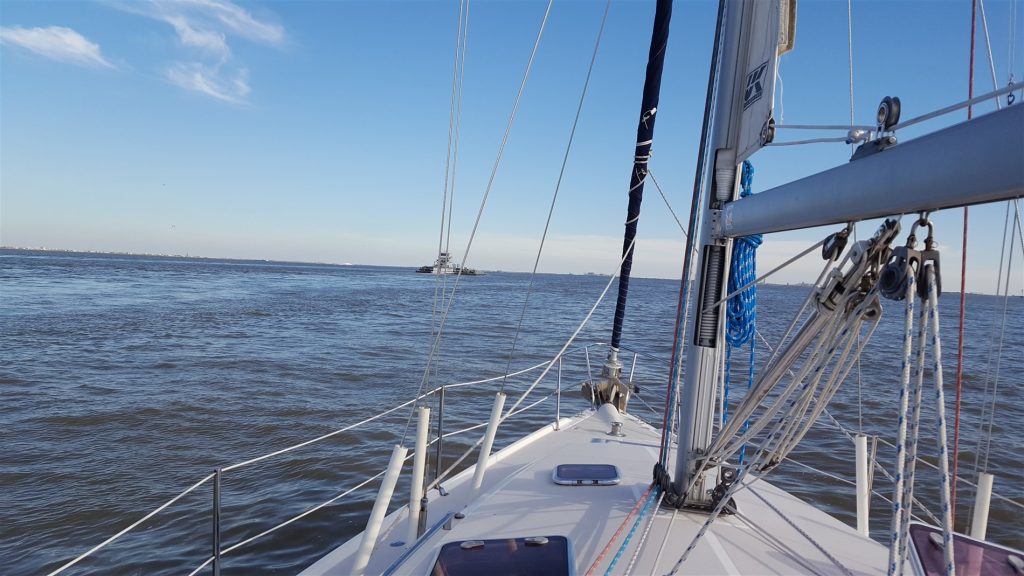
View from the bow of the sailboat
Motoring to the Houston Ship Channel

The plan was to sail outside the Ship Channel, and maintain a course parallel to the Ship Channel. But when the wind suddenly died, we needed to tackle the next chart navigation challenge: how long will ir take us to reach the Galveston marina if we maintain a speed of 4.5 knots? It turns out that the answer was 2 1/2 hours. And since it was already 16:30, we decided to drop sails and use the motor to get us to Galveston before nightfall. (because we were going slightly downwind)

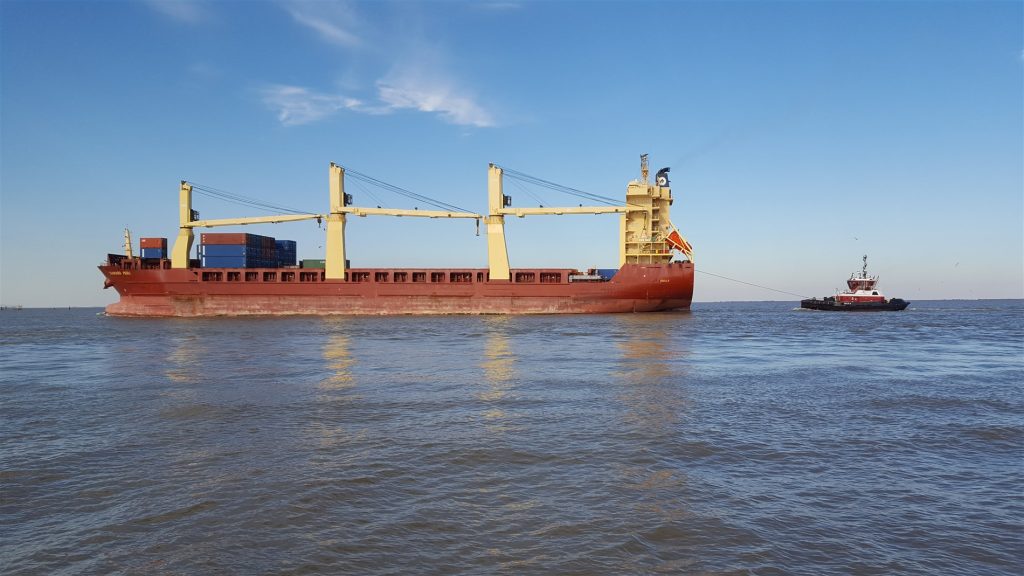
Image of a commercial freighter in the water
Passing a large ship in the Houston Ship Channel

Settling in for the night

Eddie was at the helm to take us to the slip, and after docking and connecting the boat to shore power, we rushed out to the gastro-pub around the corner to get some dinner & beer before they closed.

Back in the boat, we hung out, drank beer & talked shit for another hour or so before tucking it in for the night. On the Catalina 350, there is one  bed per person: one bed in the V-berth, one bed in the quarter berth, and two convertible beds in the main cabin. So each man on his own bed, we slept on the boat.

ASA 101 Basic Keelboat Sailing, Day 2

Day 2 of the ASA 101 course is supposed to be 80% on the water, and the other 20% is the written exam. But at the start of the day, the wind was so low that we had to postpone sailing for the afternoon.

So the written exam was first. I had a chance to study a bit in the morning, so I did fairly well on the exam. After the exam we headed for lunch, and by 12:30 PM we were on the boat leaving the marina for the bay.

After a bit of cruising around and practicing tacking, we quickly moved to the man overboard drills. Each person had their hand at it, and at the end of my turn lightning began to strike so we started to head back as quickly as we could.

The wind picked up a lot, so we turned into the wind so that we could reef the main sheet to reduce the sail’s power. This is where the importance of knowing the knots by heart really sunk in for me. With a storm coming strong and lightning nearby, securing that mainsail quickly with a series of square knots is critical.

After I guided us to the channel leading to the marina, the instructor fired up the motor and we headed in. Again I was reminded of the knot knowledge, because as I sat down at the bow to lower the jib and secure it to the deck, I must have taken 3 minutes to tie that damn square knot 🙂 And by that time the rain was coming down in buckets. I’m so glad I remembered to bring my fancypants rain coat and then left it in the trunk of my car! Note to self, learn those damn knots!

Anyway in a few minutes we were at the dock, we quickly tied the boat to the dock (again the knots) and ran for shelter, thoroughly soaked through and through.

I passed this certification, but there are two more to go before I can charter a boat on my own – “bareboat” chartering, they call it. (Bareboat means the charter company does not provide any skipper or crew to accompany you) I’m on my way !

ASA 101 Basic Keelboat Sailing, Day 1

After two years in Houston, I decided to try and rent out a sailboat and get out on the water. With my RYA Level 3 certification for dinghy sailing, it turns out that there are no places in Houston that rent out dinghys like the Laser. But I did find a school (Bay Area Sailing School) which gives keelboat certification, where the upper levels allow you to charter a keelboat anywhere in the world. The certification is the ASA, or the American Sailing Assoiation.

This school offers basic certification classes every weekend on a 2-day class, so I figured I would try and show up unannounced and see if they had an open space for me. They did! So by 8:30 AM I was sitting in the classroom ready to get started.

I expected a lot to be re-hashing of concepts I already know, which was true. But I was immediately struck by the amount of classroom time– this must be an American thing, because in one day I almost spent more classroom hours than in 2 separate 2-day RYA certifications. (or maybe I’m just shutting the RYA classroom hours out of my mind?) But it was good, as there were many things I learned about local rules. Example? Dumping rules. Apparently the faster your boat is travelling, the larger waste you are allowed to dump overboard. Weird !

Anyway the afternoon was spent in the keelboat. It was a Catalina 22 Capri (vessel named “Breathe Easy”) which has an outboard motor, a tiller-rudder attached to the transom, and a non-furling jib. One thing which was good, was that the instructor did not rush the rigging up part. This made it clear that learning to tie up the bowline (for the jibsheets) and clove hitch (for the fenders) were critical to being able to rig up and sail. None of us on the boat (4 without the instructor) were good at the knots, so we all had some homework to do.

The instructor took us out of the harbor and into the bay using the motor, then once the sails were hoisted up, he put me at the helm first (handed me the tiller). The mechanics of sailing the keelboat is not very different, except that you must rely on the crew to trim the sails. On a dinghy I’m accustomed to getting a feel for the wind by shifting my weight, adjusting the main sheet, and playing with the tiller. On the keelboat though, this a bit slower going since it’s your crew who are controlling the main and jib. So it is much more of a ‘set course, trim sails, and keep steady’ type of sailing, as opposed to the more active constant adjusting and shifting you do in a dinghy.

The first day’s goal seemed to be to get everybody comfortable with sailing a straight course toward a target, and to practice a few tacks. The instructor didn’t focus on sail trim yet, so it felt weird sailing on a close reach with the sails a bit too far out…but the trimming instruction would come later.

Not much to learn, The main thing was working with a jib using a winch, which was new to me. After everybody had their turn at the helm we headed back and that was the end of the day.

The biggest learning for me on the day, was the mechanics and logistics of entering/exiting the harbor, docking and undocking, and rigging up and rigging down the keelboat. At the end of this first day I am looking forward to more drilling in day 2 – man-overboard drills are required to pass the course so that should get me much more comfortable with sailing this bigger boat.

Stepping it up

Today was my first day going out on a boat meant for 2 people, but I sailed it single-handed. I am considering getting a sailboat but wanted to see if it was not too difficult to sail a boat with both a mainsail and a jib single-handed.

It turns out that it is not too hard. At first I had assumed that I could just leave the jib rolled up and pilot the boat with only the mainsail, but the staff told me that without the jib I would have a real hard time sailing upwind. So I said OK and went for it.

The boat I sailed was an RS Feva. I asked the staff if it was similar to the Laser Vago (another 2-person boat), but he said they were quite different. I could see from the rigging of the kicker that it was not meant for serious racing, but I am not overly concerned about being a speed demon so that didn’t bother me very much.

At first I was having a hard time setting the jib right without losing a grip on the main sheet or the tiller, but I got the hang of it after a few minutes and then I was off.

The key was, whenever attempting a tack, to get the mainsail and tiller sorted out first, then move on to set the jib to the opposite side after the boar stabilizes. That was you avoid being too stressed out and trying to too many things at once.

So sailing upwind and getting to close-hauled felt pretty comfortable. But with the trapeze toe-strap I did feel that if I stayed hiked out too far for too long, that I would be unable to get back into the boat easily. So I didn’t do much hard-core close-hauled hiked out stuff.

Downwind was a different story. Unless the wind direction changed whenever I attempted to go to a reach or downwind, I felt it difficult to manage the boat, unsure how the jib should be set and worried that the mainsail would jibe at any moment. I will need to work on that, in fact I might need to pony up for a lesson with an instructor to get better sailing with the wind with a main and jib.

After almost getting decapitated by a landing seaplane, I sailed back to the shore downwind and made a calm landing without too much trouble.

So the verdict? I’m not sure if I enjoy the added work of controlling the jib single-handed, but there does not seem to be too much choice if I want to sail a boat that can take more than one person. I think a private lesson or two might get me more comfortable to the point of being ready to invest in a slightly larger sailboat as my first boat.

I guess time will tell!

1st time sailing in Jebel Ali

Since they changed the rules at DOSC, I now need to find a cheaper way to get sailing experience.

I heard about the Jebel Ali Golf Resort having a sailboat rental facility, so I figured I’d try it out.

The company’s name is “Water Cooled”. They don’t have the Laser boats there, but the RS line. So I showed up and they let me pay $145/hr for a 2 hour session on an RS Quba. Sailing was fine on the Quba, in fact it feels very similar to a Laser Pico. Out on the water it was not overly exciting– I was more interested in just seeing what sailing in the resort’s private cove was like. Pretty weak. Looking out towards the sea from the shore, you see a long sand bar, which is about 1 km away from the shoreline. And from the launch point, if you head towards Abu Dhabi along the shore, you reach the end of the cove in about 15 minutes moving at a slow clip. Then if you turn around to head back the way you came, you end up looking at the Jebel Ali port’s terminus. So not a very scenic cruise. And they do not allow you to go into the open sea– probably a prudent move as I imagine there may be huge incoming vessels at any time coming in to port.

As for the sailing, I did a bit of experimenting in trying to catch the wind in seriously low wind conditions. Found out that when i let out the sail a bit, and tilt the boat away from me, that tilt sometimes allows you to fill in the sails a bit and get moving. So the day was not a total waste.

So all in all it’s a bit of a crappy venue, but if I really am aching to get in some sailing time, it is definitely an option.

RYA Sailing Level 3, Day 2

Man…after the second and final day of the RYA Sailing Level 3 course, my muscles are sore, my fingers chock full of cuts. But I had fun and plus learned a whole lot– here’s how it went down.

The course

Whereas day 1 of the RYA Sailing Level 3 course was all about learning to work as a team on a 2-3 person sailing dinghy, the second day of the course focused more on honing and improving our skills on a single-handed dinghy. For this course the boat of choice was the Laser.

Rigging the Boat

Disclaimer– this section might bore you. Apologies, because this may be a bit more for my knowledge so I don’t forget how to rig up the lasers. Feel free to skip this part 🙂

As a general statement, the lines required were already in place, but none of them were secured or threaded through the proper pulleys. So we were not starting from nothing, but there was sill a bit of work to do before the Lasers were ready to sail.

The task looked impossible at first, but in the end most of the rigging was fairly straightforward. Unfurl the mainsail, insert the battens into the mainsail, drop the mast into the hole. With the mast in place, untangle the kicker (a.k.a “vang”) and inhaul lines to get ready to set them in place. Put the boom in place on the mast, then on the other side of the boom put the hook through the hole at  bottom corner of the mainsail (this hole in the sail is called the “clew”). Now that the mainsail is in place, go back to the mast and insert the key from the kicker into the slot on the boom. You may need to push down on the boom to get the key to slide in.

Now for the inhaul and outhaul lines. First the outhaul– The outhaul line runs all across the boom to the mast then down through two pulleys and through a stopping block (don’t know what that is called). Once the outhaul is through the block and the line is taut but no tight, form a handle at the end of the outhaul line by using a series of false knots to make a firm handle, then form a loop by tying the end of the outhaul line to where the series of false knots started. The inhaul line is simple, thread it up through the hole in the bottom part of the sail at the bottom of the mast, then pass it though the pulley at the bottom and then throug the stopping block. Create a similar handle of false knots.

The kicker line was already all set up, so all I needed to do was untangle it and it was ready to go.

Last step for the rigging was to attach the rudder, get a daggerboard ready, and thread the main sheet. once that was done, the boats were ready to launch.

A little instruction: setting the mainsail for different conditions

Before we headed out on to the water, we got a little instruction on how the sail should be rigged for high vs. low wind conditions.

Out on the water

With the onshore instruction out of the way, we launched out to the sailing course, which was your classic racing triangle course. For those unaware of what this means, you set three bouys in a triangle shape, such that from bouy 1 to bouy 2 you are sailing against the wind (up wind), then from bouy 2 to bouy 3 you are sailing across the wind, and then from bouy 3 back to 1 you are sailing across the wind in the opposite direction. Here we got comfortable with the laser racing techniques, to ensure we moved around the course in the quickest time possible.

Here is the first time I actually started to adjust the kicker line, since upwind it gets slack and you need to tighten it up, and then down wind you need to release the kicker line a bit to allow the boom more freedom to move. It was not as hard as we thought to get the hang of this, and in fact it started to become second nature after 3 or 4 times around the course. In the morning we didn’t stay out too long before heading back to shore for lunch.

Back on the water- The Race

After lunch, the wind picked up a bit more so it was ideal wind speed for beginner’s racing. During the racing I picked up a few good skills:

Stopping in position

I already knew how to stop the boat, by sailing upwind and then letting out the sail until it luffs freely. But for racing it’s important to know how to come to an almost immediate stop (i.e. to sit at the starting line). To accomplish this, you point the boat into the wind, then use force to push the boom out as far as you can push it. It’s important to use the rudder to point the boat into the wind while you push out on the boom, or the stop won’t be as immediate or complete. Then when it’s time to get moving (i.e. 20 seconds to go before starting sound), simply pull in the sail and point away from the wind. Easy!

Sailing towards a mark (close-hauled)

One thing I struggled with, was when I am sailing close-hauled (upwind) towards the first mark, how do I know when the ideal time to tack is, to ensure that when I finish the tack I will be on a direct course towards the first mark? Without this skill, I inevitably waste time with multiple and sloppy last-minute tacking. The fix for this is quite simple. If you are sailing port-side close-hauled, and then you tack to starboard-side close hauled, the difference between these two points of sail is 90 degrees. So if you are close hauled, then it is time  to tack when the mark is directly behind you. This can be easily detected by constantly checking over your right and left shoulders. if the mark is still a bit in front of you, you need to sail a bit further before tacking. If the mark moves to be behind the boat, you know you have gone too far. Using this method almost always  got me to the mark right on a course made good. Excellent!

Final thoughts

After the sailing was over, I had won two of the races. This typically happens when you start out in the best starting position and don’t screw it up. Of course, I had also seriously mucked up at least two of the runs. But all in all, the course was definitely worthwhile, and I picked up some valuable sailing skills along the way. Can’t wait to get out on the water again and flex my renewed sailing confidence!

RYA Sailing Level 3, Day 1

Day one of the RYA Sailing Level 3 course at DOSC.

The basic plan for the Level 3 course is to spend one day working as a team and racing on a Laser Bahia, and then the second day doing some single-handed racing and improving skills on a Laser.

In the morning of day 1, the wind was crazy low. So low, in fact, that we had to get towed back to the marina harbour. But the morning was not a complete loss, we at least got a couple go-rounds of the “triangle-sausage” classic racing course. Not for racing, but just to get comfortable with working as a team on the Bahia. In the afternoon, we at least got enough wind to be able to do some real racing. The instructor broke down the basics of racing to us, and here’s what I captured:

After the course is set, the starter boat is placed on a straight line from the starting pin, such that the line from the boat to the pin is exactly perpendicular to the wind. This forms the starting line. So they way it works is, there are 5 different signals that serve as a countdown until the race begins. The first signal indicates that there is 5 minutes to go. Then there is a different flag that goes up , to signal 4 minutes left, and another flag goes up to signal 2 minutes left. The final flag goes up to indicate 60 seconds remaining, then the starter sound and the race begins. During this time, the basic idea is to either (a) get the sailboat going at a good clip, such that you are crossing the line at a full clip when the race starts, or (b) in crowded conditions to get your boat in the best spot, such that you cna take off once the race starts. As for starting position, the trick is to sail back and forth across the starting line, in an attempt to identify if there is a bias towards one end of the starting line or the other– if one point is higher upwind than the other, then that is the place you want to start racing from since the total distance upwind will be shorter.

I actually had a great time racing, we were two guys and one lady in our boat against two bigger guys in the other boat. It started off pretty lame with our boat devastating the competition at first. But at my second time as helmsman, the boat race started to get close, we even had a close-call collision and were neck-and-neck rounding the last starting pin. But we won 6 races in a row, then headed back to the harbour, full of the adrenaline from some close racing.

(Later we found out that our boat had a slightly larger jib– but I’m sure we won purely on our seamanship skills alone 😉 )

I’m not sure if I will enjoy single-handed racing on a Laser quite as much, but I guess we’ll see…I’ll check back in next week when day 2 of the Level 3  course takes place.