Day 6 (Thursday)
This is the 2nd to last day on the boat. The plan for the day is to head back towards Poros, and raft up for the flotilla’s last night out at sea. We started out and crafted a plan for a race, and in the end it was us against another sailing catamaran from the flotilla. I was at the helm by then, and so captain and I did our best to keep a tight course and keep the sails full. We also needed to keep fairly close to one another and maintain a steady heading, so that the videographer would have a chance at some cool shots and clips. I was able to sail on an upwind course for a good long while, providing the crew with beautiful views of Hydra on our starboard side. As we started to slow down finally, captain fired up the motor so we could head over to our anchorage destination just past Poros.
The main learning point here was that with a cruising catamaran not set up for performance sailing, the sailing experience is nowhere near as exhilarating as on a monohull. In the monohull you can sail on a course much closer to the opposite direction of the wind (sailing directly into the wind is impossible), so the racing sensation is that much more hieghtened in a monohull. Plus the monohull’s heeling angle also adds to the excitement, as the crew piles on the windward beam of the boat to balance it out. Since you cannot sail as close to the wind in a catamaran, the speed sensation is less intense. Because you have a wider angle to the wind on a catamaran, that makes it even harder to perform a full tacking maneuver under sail power only– much more ground to cover to get the bow through the wind and enough angle on the other side to prevent the cat from getting “into irons”– that is when you try to tack, but are unable to swing the bow all the way across, and the boat slows and sails luff because the boat gets stuck facing directly into the wind. If you don’t mind using the motor a bit though, on a cat gettbng out of irons is quite simple– a quick jolt from the port or starboard propeller swivels you around enough to fill the sails up. This is obviously not an option fo racing, but while sailing leisurely it is a nice compromise to keep the sailing fun.
IALA-A vs. IALA-B: Guess they weren’t lying!
As we motored through the channel on Poros harbour, I got the visual reminder of the IALA-A system and how in Europe the color-coding of channel markers is opposite to the IALA-B system used in U.S. waters. In the U.S., you lean the mnemonic “Red, Right, Returning”, which means that as you are entering a port, you must ensure that you are keeping the red-colored channel marker buoys to your right, if you wish to remain safely in the channel. Well, clearly in Greece this does not hold, and you see that red buoys need to be kept to your left to remain in the channel. Cool!
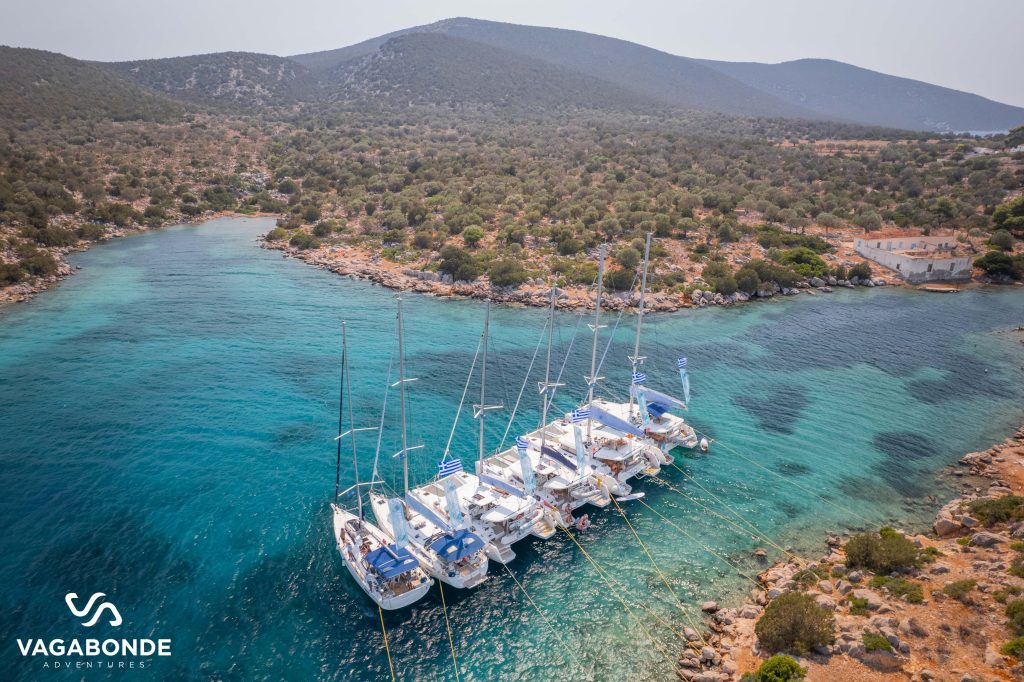
Just 20 minutes oir so more of motoring brought us to the raft-up, and so after tying up we all let ourseves go for a biut and had a great night!
Day 7 (Friday)
Aww, so sad to know that this is the last day of the Greece flotilla week. The night before, I had a chance to catch up with one of the captains who was also an experienced instructor, and I lamented to him how even though I made it all the way to ASA 106 certification, I never had any practical experience reefing. He told me that since Friday was an upwind cruise it should be easy for our captain to put hoist the mainsail and put me through some reefing drills. Great! I made sure to mention my request to our captain in the morning, and he said “sure!”
The plan for the day was simple: late start, stop around 2PM for a swim, then pick up anchor and head back to our starting marina. We had a nice and easy motoring up to our anchoring point, and with our Mediterranean moor in place we swam. Wifey asked me if I would go with her to untie the mooring line when it was time to go, and I sad “sure!”. it all went smoothly, until I got a bit too over-zealous with my aggressive swimming back to the boat with the mooring line– I did not keep a safe distance from the boat, and with too much line swinging around I got a glimpse underwater of the RUNNING port-side propeller! At that point I started to realize that I was in some danger, but the captain fortunately noticed and got the motor off. So I was safe, but it was clear that I managed to get the mooring line caught in the propeller. Captain handed me a mask and snorkel and said (nicely) get to cleaning that line! It wasn’t too hard at first, except for my extremely limited lung capacity– with 10 wraps around the propeller it took me 1-2 tries per wrap to get it all untangled. Well at least I was able to clean up my own mess. With the line cleared, we were quick to get out of there and finish the last leg of the flotilla week. With 1 1/2 hours left in our trip, I reminded the captain about our reefing drills. He said yeah thanks for reminding me! Let’s get to it.
REEFING
So reefing, in concept, is pretty straight forward. There are three points in the sail, both at the front and back of the sail, at different heights. These points all have re-inforced rings in them, where lines can be threaded through, If you have prepared reefing lines before getting under way, then the reefing line is tied to the back of the boom, run up thed back side of the sail to the first reefing point, run back down to the boom, through a block (pulley), and run along the boom to the tack if the boom / mainsail. The reefing line then goes up the front of the sail to the first reefing point, then back down to the clutch where it is secured. Two other lines are then run similarly for the 2 other reefing points.
With the reefing lines all set up, now when it is time to reef, the procedure is as follows. First, if you have not yet started sailing, point the bow into the wind; if uyou are already sailing with the job out, then let out the mainsheet to allow the mainsail to luff. Next step, put the halyard on the winch, and east eh halyard to drop the mainsail until the first reefing point of the sail is almost at the boom. As the mainsail is lowered, the reefing line will go slack– so as the mainsail is dropping, it is ideal to pull in the slack of the reefing line at the same time. Once the reefing point at the front of the sail is almost at the boom, there will most likely still be slack in the back of the boom– so here pulling out the slack of the reefing line by hand is the most efficient way to get the slack out of the reefing line. With the reefing line now tight, east the halyard a bit more until the reefing point is squarely at the boon, and now do a final tighening of the reefing line to get the line taut — being mindful of the tightness of the reefing line both at the front and also at the back of the sail. With the reefing line now secured, the final step is to put the halyard back on the winch and slowly raise the halyard to remove any slack and/or luffing at the front of the mainsail. Now you can fix your heading and trim the mainsail as needed. That’s it, you’re now sailing with one reef in the mainsail. It would also make sense to reef in the foresail / jib — this is simple in most cases, just haul in the jib furling line a bit so the job exposed is smaller. Now you can adjust sail trim and get to sailing. Now mind you, you have only put in a single reef at this point– if you need to reef more yiou repeat the process for the second and third reefing points. Is it possible to skip the work of the first two refs and start reefing directly with thr 3rd (topmost) reefing point? The short answer is yes. The only problem with that is that once you’ve put in that 3rd reef, since you never hauled in the slack of the other two reefing lines, you’ll see that you now have one or two looping reefing lines hanging down, both at the front and back of the boom. Not only is this poor seamanship, but depending on ho the slack lines are swinging they may also be a hazard. So use the quick reefing method at your own risk.
TAKING THE REEFS OUT
Okay! So you are sailing with a reefed mainsail and foresail, but now the wind conditions have changed and the wind has died down, and now you need to remove the reefs. At a high level, again the concept is simple– raise the mainsail back to its full height while letting out the reefing line, until the full sail is out. The first step to removing the mainsail reef is to let out the mainsheet until the mainsail is luffing freely. Now let out (ease) the reefing line– if you don’t do this, the main halyard will never be able to raise the sail up. With the reefing line eased out, now put the halyard on the winch and haul in the halyard to ease the mainsail. As you are raising the halyard, you need to continue easing the reefing line so that it does not block progress. Once the sail is raised up to its full height, now haul back in the reefing line to remove any slack left. With the reefing lines tidied up and the mainsail up, you can now get back to your desired heading and get to sailing again. As a final step, if you also reefed the jib and didn’t let it all the way back out, let out the furling line to get the jib all the way out. Now trim the sails and get to sailing!
THE TRAINING SESSION
It was only me and the captain participating in the reefing drill– so it was like a private lesson. I can explain it well now, but when he asked me to guide him through putting in the second reef, I froze up and struggled through whether to start with the halyard or reefing line. Now that it is clearer in my mind, I should be able to execute the reefing without too much trouble. Thanks for the lesson, captain!
BACK TO THE MARINA
After the drill, the rest of the way home was upwind, so we dropped the sails and motored all the way back to our starting marina. A smooth docking by our captain, and our sailing adventure was brought to an end!
FINAL THOUGHTS
This was my first tine participating in a flotilla, and also my first time sailing in Greece, and also my first time serving as crew in a catamaran.
How did I like the flotilla?
The social aspect of it is great– you get to meet and interact with lots of new people at various stages in their lives, and you get some great conversations and connections that way. In general, the flotilla’s main priority is to provide a fun week for the paying participants. So if there is a desire to get a lot of swimming/snorkeling in and also some pressure to see a few key sights like Hydra and Spetses, then sailing can become a sort of ‘nice to have’ feature– great if we can get in a great sail or two, but sailing can take a backseat to getting to the next destination at a reasonable hour. Granted, in a self-guided bare-boat cruise, you will certainly be confronted with similar dilemmas– I’d love to sail to the next spot, but we won’t get there before dark, or before the good moorings are all taken up. Wifey and I agreed that the flotilla was a great experience, but next time we’d opt for a more sailing-centric excursion like a performance sailing week, or otherwise some sort of regatta.
What did I think about sailing in Greece?
Well it was my first tropical island-type of sailing excursion, so it was very different from what I grew accustomed to sailing in Galveston Bay and the Gulf of Mexico. First off, all of the dockings, whether in a marina berth or anchorage, were all stern-to– in other words you back the boat into its parked position. Next, anchoring was always done with a Mediterranean moor. Both at marina berths and also at anchorages. At marinas, the moor makes sense because there were not individual berths– so an anchor out at the bow is the only way to prevent swing when he boat is perpendicular to the dock. At cove-like anchorages, the mooring lines secured to the shore are more for comfort and safety– it’s simpler to swim when you know that the boat will not be swinging around. Also the boat will be much more stable when you’re trying to sleep. The last thing about sailing in Greece is the swimming! Ain’t nobody getting in the water to swim in Galveston Bay or even the Gulf of Mexico, for that matter. But the water is so clear, warm, and inviting that you cannot resist jumping off the boat for a dip in the sea.
How did I feel about cruising in a catamaran?
Well without a doubt, in the comfort area the cat wins, no debating that. Huge salon area, kitchen bigger than any apartment I’ve ever lived in, and each of the four main cabins with a double bed private toilet and separate private shower. All monohulls I’ve seen have a shared head and shower, and if you’re lucky one en-suite head for the captain’s quarters. Also there is so much outside area to lounge in– up front on the nets, on the foredeck lounge sofa area, behind the cockpit in the upper deck, and of course at the stern in the dining area where there are multiple cushioned benches to lounge in. Wow! Compare that to a monohull, where if you are not belowdecks your only options are crowding in the cockpit at the stern, or else sitting near the beam with your legs hanging off the side if the boat. No comparison! For me though, it is quite a huge vessel, even at 46 feet in length. To cruise around with that level of comfort, I would seek out a smaller boat that has the same private head & shower cabins.
As far as sailing goes, the monohull for me wins in all areas, except for maneuvering under power. I did not helm any docking or anchoring on this flotilla, but it did seem to be a lot more convenient to be able to spin the boat at will via the port and starboard propellers. Other than that, sailing in the catamaran is a lot less rewarding for my taste– at least in a catamaran built for cruising and not for performance. Maybe if I join a racing crew with a catamaran, I might feel differently about sailing the multi-hull. So to wrap it up, as a day sail, I wold opt for a monohull– I get the exhilarating upwind heeling, and can sail more on the upwind courses. But if the wife is coming along for a multi-day cruising adventure, it is hard to argue against the comfort of the catamaran.
So there you have it! Many thanks to Vagabonde Adventures for organizing the flotilla!
— FIN —
Previous Post in series: << 2023 Greece Flotilla Part 1
( Part 1 of 2 in series: Vagabonde 2023 Greece Flotilla )