READER BEWARE: The content of this post is quite technical– its main purpose is for me to try to remember the things I learned about docking a catamaran…so feel free to skip to the next post in this series (2026 Greece: Aegina to Ermioni to Dokos (Day 3)).
After a quick motoring to the Agia Marina in Aegina, I was ready for the docking coaching. The dock at Agia Marina is a cement dock, but with rubber bumpers all around the sides of the dock walls– so this made for a good site for docking practice.
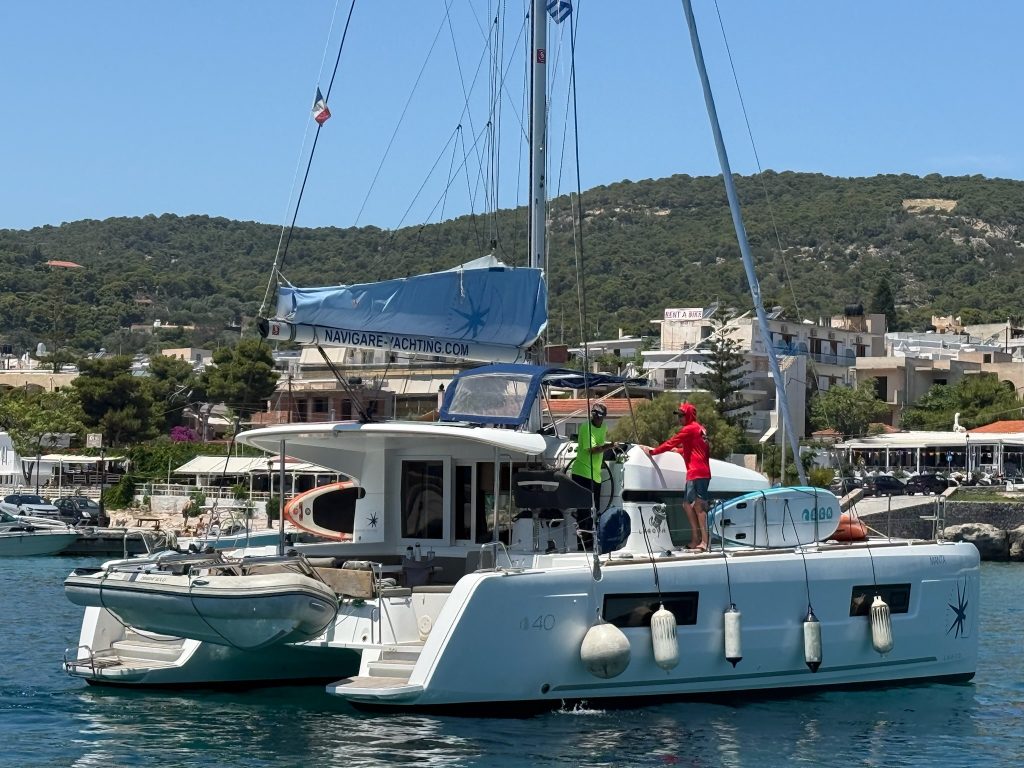
Side Docking Practice
First up for practice: side docking. At first approach, the wind was blowing off of the dock, where the winds acts as a nice extra safety to prevent you from hitting the dock. Of course this also means it’s a bit more challenging to leave the dock against this wind. But what a challenge it is as a newbie to maneuver the catamaran! Since the steering was cable driven and not hydraulic, the technique recommended by our skipper was to leave always one hand on the wheel, and the other hand on both throttle levers. The goal is to use your hand on the wheel to keep it centered, and you do all turning and maneuvering using the starboard and port engine throttles.
At first it was very difficult to get the hang of it, but slowly the feel of steering started to come. A few close calls with the dock, but disaster was averted. With the wind blowing off the dock, we did a bow-first approach, approaching the dock at about a 45-degree angle. Once close enough, the dock line at the bow is looped over the dock bollard from the boat, then tied off to the bow cleat. With one line tied off, the engines can go into neutral and the boat will naturally come to lie alongside the dock, with a bit of throttle helping if needed. Done!
With wind blowing off the dock, leaving is simple also — release the leeward line first, then the windward line, then the boat will drift off the dock.
Stern-To Docking Practice
After the side docking practice, the captain demonstrated the procedure for a “stern-to” docking. This is where you drop anchor, then back the boat in to the dock, so the boat sits perpendicular to the dock.
Once we were docked and my brother-in-law’s family went ashore, the captain, my wife and I started the drills. For a first drill, the goal is to just back into the dock, reversing in a straight line and maintaining a perpendicular angle to the dock. This was great maneuvering practice, where I Iearned the technique to make small adjustments via the two throttles to prevent the boat from veering off its heading. It works like this: to start backward progress, move both throttles into reverse gear, one throttle at a time, but without increasing any RPM’s. This should be enough to get the boat moving in reverse in light winds. If winds are heavy and pushing the boat forward, you may need to give some RPM’s in reverse to overcome the wind. As soon as you have the reverse momentum, click back both throttles to being in gear in reverse with no RPM’s and watch your boat speed. If boat speed is around 1 knot, don’t change anything. If boat speed increases to above 1 knot, kick both throttles into neutral, then alternate moving only one throttle at a time into reverse gear with no RPM’s. Doing this will cause the stern of the boat to veer either left or right, depending on which throttle is in reverse gear. So you can continue this process of moving the starboard throttle to reverse and port throttle to neutral, then moving the starboard throttle back to neutral and the port throttle to reverse gear, and so on, to continue a slower backward progress. And the same approach also applies to moving forward using the forward gear. If you need to swivel the boat around to quickly get its heading back in line, then you can click one throttle into forward gear and the other into reverse gear. If the boat was not moving it will simply swivel around.
After a few back-and-forth drills, I was ready to attempt the anchor drop part of the stern-to docking procedure. For this step, you visualize where you want the boat to end up, i.e. which two bollards or rings you will tie the stern to. With this target in mind, you then position the boat about 3-4 boat lengths away from the dock, ensure the boat is pointing where you want it to go, and then start dropping anchor as you start to slowly move backwards. After counting about 40 meters of anchor chain have dropped (you should be about 10-20 meters from the dock), stop dropping anchor, keep the throttles in reverse gear (no RPMs), and observe your position as the boat slows. If the boat is in reverse gear but comes to a stop and springs back somewhat, that is a test that the anchor is set properly and is holding you preventing any further reverse movement. You can even increase the RPMS and rev both engines in reverse, which will give you further confirmation that eh anchor is holding. Now that you are confident the anchor is set, you can slowly let out more chain as you continue reversing closer to the dock. When you are about 2-5 meters off the dock, stop dropping anchor chain and allow the boat to reverse back and then slowly come to a halt—but at this point don’t let the boat spring forwards—keep the engines in reverse gear so that the boat stays at this close position. At this close position to the dock, slowly increase revs in reverse gear, to show you how far off the dock the anchor is holding you. If you are close enough, you can throw the windward line to somebody on the dock (or you can also try to lasso it from the boat), where they should wrap the line around the bollard or through the ring, and throw the line back to you, where you tie off the line to the stern cleat after removing all the slack. With the windward line tied on, you now have control. If you find that you have skewed and the anchor is no longer pointing straight, you can put some revs in forward gear to slowly move the boat sideways – this will happen thanks to the windward line. Once the boat’s position and anchor chain is straight, you can throw the leeward stern line to shore and tie it off back to the boat. You may need to use the throttles to get the leeward side closer to the dock to achieve this. The leeward line should be tied off at a length matching the windward line, such that the boat sits perfectly perpendicular to the dock. Once the leeward line is tied off, put the engines in neutral and wait for the boat to settle. Once settled, check that the anchor chain is aligned to the centerline of the boat. If it is not, you can use the reverse throttles to slacken the lines to shorten one of the stern lines, or the forward throttles to lengthen one of the stern lines. Continue this procedure until the boat is perpendicular to the dock and the anchor chain is centered aligned to the centerline of the boat. That’s it! Now shut down the engines and frack out the beer!
Next Post in series: 2026 Greece: Aegina to Ermioni to Dokos (Day 3) >>
Previous Post in series: << 2026 Greece: Athens to Aegina (Day 2)
( Part of series: Bareboat Charter in Greece 2026 )